
Contents
Amalou Ighriben is a town in Khénifra province, in the Béni Mellal-Khénifra region. It forms the eastern suburb of Khénifra, in the Middle Atlas.
It is a residential town, closely linked to its larger neighbour. Our ideas for outings are gathered in Things to do in Amalou Ighriben.
Where is Amalou Ighriben?
The town lies at about 32°56′ north and 5°39′ west, just east of the centre of Khénifra, only a few kilometres away.
As the crow flies, Tighassaline is about 18 kilometres to the south and Aguelmous around 30 kilometres to the north-west. Ain Leuh is nearly 50 kilometres to the north-east.
Population
At the 2004 census, Amalou Ighriben had 28,933 inhabitants. It is therefore a medium-sized town, even if it lives to the rhythm of Khénifra.
Many residents work, study or shop in Khénifra, and people travel back and forth between the two towns every day. Rush hour is busy on the road linking them.
A town in Zayane country
Amalou Ighriben belongs to the land of the Zayanes, a confederation of Amazigh tribes of the Middle Atlas. In the early twentieth century, their leader Moha ou Hammou Zayani led the resistance against the French army around Khénifra.
The name of the town is Amazigh. In Tamazight, the word amalou often refers to the shaded side of a mountain.
The Oum Er-Rbia valley
Khénifra and its suburbs spread along the valley of the Oum Er-Rbia, one of the largest rivers in Morocco. Its springs lie further north-east, in the mountains of the Middle Atlas.
The hills around the town are covered with holm oaks, cedars at higher altitude and pastures. Flocks of sheep graze there for much of the year.
A developing town
Amalou Ighriben has grown with the expansion of Khénifra. It has recent residential districts, schools, local shops and bus stops that link it with the centre.
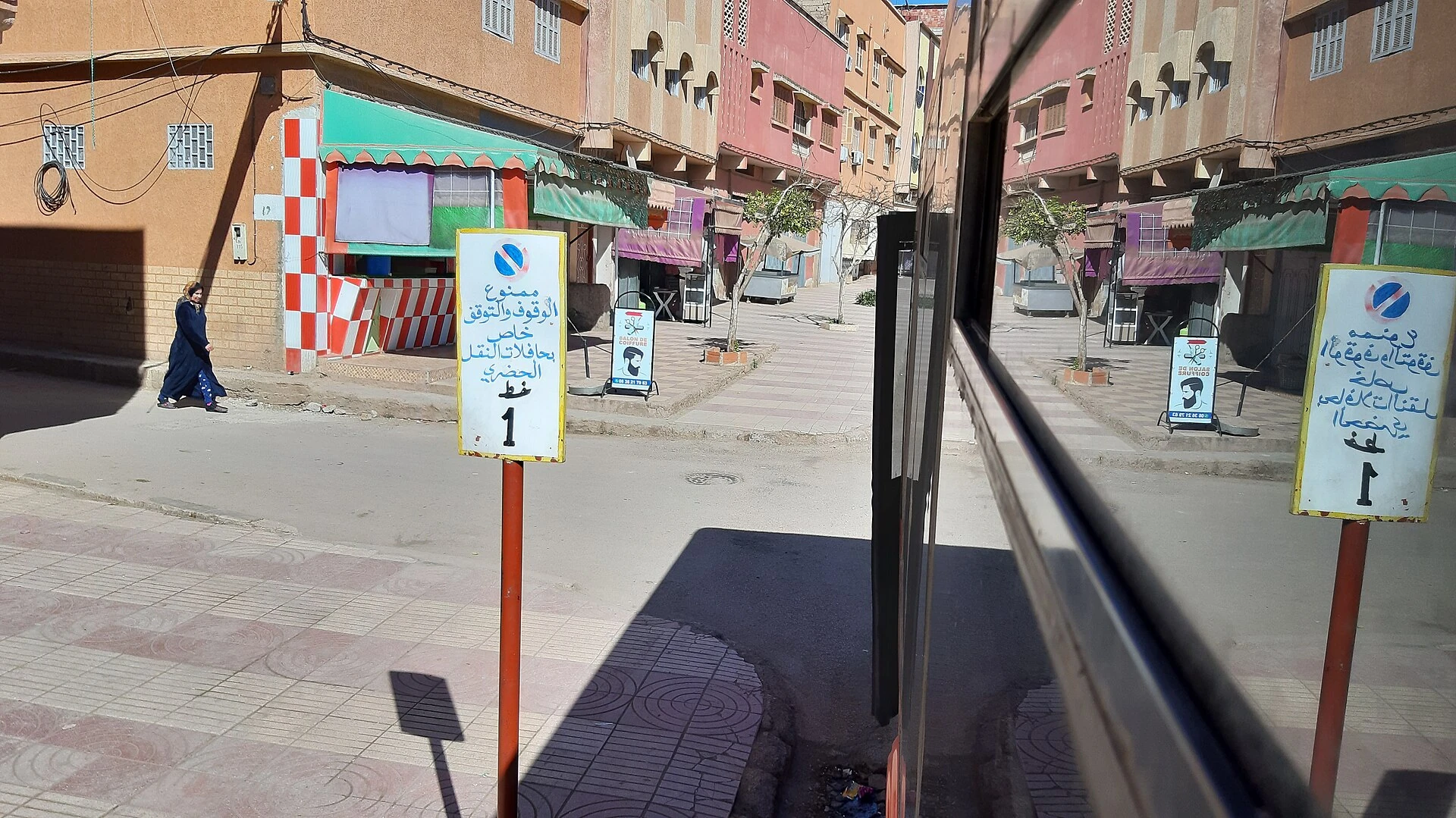
Residents live from trade, public administration, construction and farming in the surrounding area. A recent photograph shows a quiet street of pink and ochre buildings, with bus stop signs.
An Amazigh culture
The Middle Atlas Tamazight language is widely spoken, alongside Moroccan Arabic. Ahidous, a collective song and dance, livens up weddings and festivals. The brightly coloured Zayane rugs are well known.
Climate
The climate is continental. Winters are cold and damp, sometimes with snow on the heights. Summers are hot and dry. Spring and autumn are the most pleasant seasons.
Getting there and where to stay
City buses and petits taxis link Amalou Ighriben with the centre of Khénifra. Khénifra is served by buses to Meknes, Fes, Beni Mellal and Marrakech, and has several hotels.
Tips for your visit
- Stay in Khénifra.
- Bring warm clothes in winter.
- Dress modestly.
- Ask before photographing people.
