
Contents
Locate the town and recognise its names
Souk Sebt Oulad Nemma is a town in Fquih Ben Salah province, within Morocco’s Béni Mellal-Khénifra region. Oulad Nemma and Souk Sebt Ouled Nemma are alternative spellings you may encounter. When researching an address, compare these names with the municipality and map location. The shortened name Souk Sebt may be insufficient to identify the destination. Keep the complete name when asking about a journey, accommodation or directions, particularly when the person answering is based in another part of Morocco.
The town belongs to the wider Tadla landscape, where agricultural land helps explain connections between urban centres and surrounding countryside. This historical and geographical area does not correspond exactly to a single present administrative boundary. Likewise, Fquih Ben Salah province includes places beyond its capital. An address described as being in the province can therefore be in another municipality. Establish the actual location before estimating journeys or choosing an overnight base, rather than treating every provincial listing as somewhere in central Souk Sebt.
Separate administrative change from town origins
The town’s inclusion in Fquih Ben Salah province since 2009 is a useful administrative reference; it previously belonged to Béni Mellal province. This change is not a foundation date. Regional markets provide context for reading the Tadla’s economic relationships, but the consulted sources do not establish a detailed local caravan history or settlement chronology for individual districts. Keep wider historical background separate from documented local events. A convincing narrative should not substitute for evidence about when and how a particular neighbourhood developed.
The expression Souk Sebt refers linguistically to a Saturday market. The name alone does not confirm a present market’s calendar, precise location or scale. Ask for recent local information before organising a stay around that activity. A market primarily serves people who work, buy and supply goods there. Approach it as part of a functioning town rather than expecting a permanent performance or a sequence of monuments. Its interest can lie in everyday exchanges without needing an unsupported list of essential sights.
Understand the agricultural setting
The Tadla plain offers a way to understand links between cultivated land, processing activities, shops and settlements. Crops and their appearance vary with seasons, farming practices and water conditions. A green photograph cannot describe the whole year. For a simple outing, choose a route with known access and observe from public spaces. Fields, farmyards and working tracks do not become freely accessible because they are visible on a map. Confirm permission when a proposed stop involves land that is being cultivated or used for work.
Irrigation canals belong to technical systems serving agriculture; they are not automatically landscaped walking routes. This guide identifies no confirmed canal walk lined with willows or poplars. An aerial image cannot establish pedestrian access, a continuous route or protected banks. Ask about a specific permitted itinerary and a clear return rather than following an unfamiliar water-management structure. If the route remains uncertain, an observation from a suitable public position can explain the landscape without requiring an improvised excursion through operational agricultural infrastructure.
Read the lead image accurately
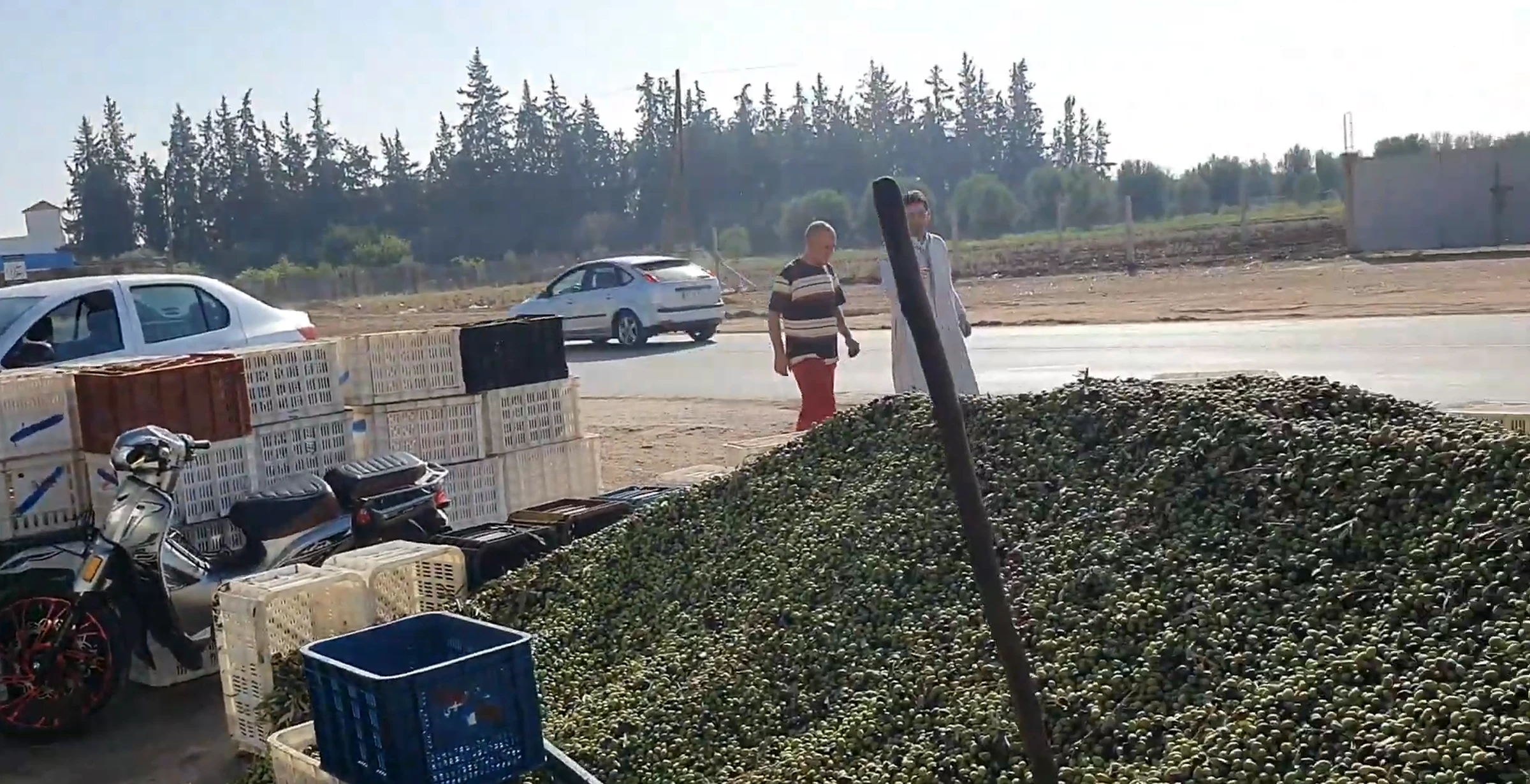
The lead photograph shows olives at a processing location identified as Souk Sebt Oulad Nemma in its Commons record. It is extracted from a video dated November 2023 and described there as freely licensed. It documents an activity at a particular moment, rather than the entire townscape. Its provenance and licence are provided in the caption. Nothing in the image establishes present visitor admission, organised tastings or a workshop tour. The photographed premises are not advertised as a personally tested tourist business.
Olive oil can enrich your understanding of the area without requiring a mill visit. If you want to meet a producer, find a precise address and obtain agreement before travelling. Clarify the welcome arrangements, language and any charge. A working business must be able to organise its own activity, and access may not suit an unannounced arrival. Treat any possible visit as an individual arrangement. A machine photograph does not establish a tourism circuit, and the availability of an item for sale does not include a demonstration.
Explore the centre and choose a meal
An initial visit can connect your arrival point with a few commercial streets and a break selected on the day. Match the distance to conditions and your needs instead of searching for unlocated must-see attractions. Observe activities, traffic and building forms from public streets. Ask before photographing people or close views of private doorways and shopfronts, and keep entrances clear. A modest walk can help you understand the town’s practical role without presuming that every residential district is intended for visitors to explore.
For food, useful information is concrete: an establishment that is open, dishes actually available, ingredients and the current price. Couscous, tagines and grilled meats belong to a wider Moroccan culinary context; possible availability does not make them exclusive Souk Sebt specialities. Product quality and local origin need checking with the seller rather than a general guarantee of impeccable freshness. Explain allergies clearly and confirm that your request has been understood before ordering, particularly when an ingredient might be present in a sauce or accompaniment.
Make purchases using comparable information
When buying olives or oil, ask about the batch origin, quantity, packaging and price before paying. Goods sold in town may come from another production area. A container’s shape or a traditional presentation does not demonstrate certification. Select a sealed package suitable for onward travel and check the carrier’s rules if you will later fly. Compare equivalent quantities rather than judging different-sized containers by their headline prices. Clear information about what is being sold is more useful than an assumption based on where the shop stands.
Carry a payment method suitable for ordinary purchases and ask what a business accepts before placing an order. There is no need to assume that every shop either accepts or refuses cards. Keep a margin for water, a break and the return journey. A meal should fit your actual day rather than a promise of access to family life. A private invitation may occur, but visitors should not treat it as an included service or expect personal hospitality as a consequence of buying food.
Arrange arrival and a possible overnight stay
Check each connection to Souk Sebt Oulad Nemma against your departure point and travel date. Nearness on a map does not guarantee a direct service or regular frequency. Establish the real drop-off point and how to reach your final address, especially when carrying luggage. For a taxi, clarify destination and pricing before departure. This guide supplies no fixed local fare, timetable or operator whose service has been personally tested. Leave enough time to resolve a change without making the entire day depend on a single uncertain departure.
An overnight search should begin with an exact address and direct confirmation of availability. No unnamed collection of charming farms or guesthouses for every budget is guaranteed here. Compare options you can actually identify, their arrival arrangements and the features important to you. A directory entry or old photograph cannot guarantee present opening, cleanliness, quiet, parking or accessibility. Ask specifically about stairs, bathroom arrangements and late arrival where these matter. An attractive rural description is not a substitute for a property that can confirm the services you need.
Match the base to the whole journey
If no local option meets your needs, compare another town as a base with the time and cost of travelling back. Béni Mellal and Fquih Ben Salah have their own destination pages and should remain distinct from Souk Sebt. An alternative base may suit a journey by car but complicate a stop dependent on public transport. Calculate the complete chain from accommodation to your objective and onward or back again. This is more useful than comparing room prices while overlooking several extra transfers.
Adapt plans to the season and daily forecast. An inland stop requires suitable water, breaks and protection according to conditions, rather than assumptions drawn from a coastal itinerary. Autumn or spring alone does not guarantee mild weather and green fields. Check forecasts before a prolonged walk in winter as well as summer. Separate meals, accommodation, transport and purchases in your budget so that competing proposals cover the same needs. Allow a practical margin for changed plans rather than relying on a single optimistic estimate.
Keep neighbouring destinations separate
Béni Mellal, Fquih Ben Salah, Afourar and the Ouzoud waterfalls are separate destinations. They do not become walkable Souk Sebt sights or effortless outings simply because a broader regional itinerary includes them. Choose one additional objective and check its address, access conditions and required travel time. A confirmed return matters as much as the visit itself, especially with connections or rural journeys. Avoid adding distant places to an already full day solely because their photographs appear alongside information about the Tadla.
Readers interested in daily life can continue to the companion article about markets, meals and traditions. It examines cultural themes while distinguishing documented Moroccan practices from an unverified local event calendar. The link helps prepare a respectful approach without promising a festival, workshop or meal in a private home. The main guide organises the stop; the associated article provides complementary cultural context. Neither replaces a conversation with the people or operators who can establish whether a specific activity is currently possible.
Build a visit at your own scale
Start with three confirmed elements: arrival, one straightforward objective in town and a way to leave. Add a meal and, if necessary, an overnight arrangement with verified conditions. A short visit may be enough to understand the place of commerce and agricultural activity in your wider Tadla journey. Expand only when you have time, appropriate transport and clear access. A less crowded plan also leaves space for an unexpected conversation, a closed business or a change in weather without requiring the whole itinerary to be abandoned.
The cited sources locate the town, explain administrative geography and support selected cultural subjects. They do not replace operators for availability and schedules. The photographs illustrate dated activity rather than present access. Keeping these distinctions allows the guide to support a stop appropriate to your interests: everyday urban exchanges, agricultural landscape reading or a break along a longer route. It also helps keep expectations proportionate to what is documented, without turning provincial information and historical images into guarantees of attractions or services.
