
Contents
Sebt Jahjouh is a small village in El Hajeb province, in the Fès-Meknès region. It lies in the countryside southwest of Meknes, on the edge of the Saïs plateau.
It is the main centre of the rural commune of Jahjouh. Our ideas for outings are gathered in Things to do in Sebt Jahjouh.
Where is Sebt Jahjouh?
The village lies at about 33°43′ north and 5°40′ west. As the crow flies, Meknes is about 21 kilometres to the north-northeast, or some 30 kilometres by road.
Aïn Karma is less than 10 kilometres to the north-northeast and Agourai about ten kilometres to the southeast.
Population
At the 2004 census, the centre of Sebt Jahjouh had 3,585 inhabitants. It is a small village, surrounded by hamlets where most of the commune’s population lives. Families there have lived from the land for generations, in low houses surrounded by gardens.
A market name
The word sebt means Saturday in Arabic. The village owes its name to its weekly souk, which brings together farmers from the nearby hamlets. Jahjouh is the name of the commune and of the surrounding area.
Fertile countryside
Around the village stretch fields of cereals, olive groves, orchards and pastures. The soils of the Meknes region are among the most fertile in Morocco, and farming supports most families. Wheat, barley, olives and fruit trees share the land, along with a few vegetable plots near the wells.
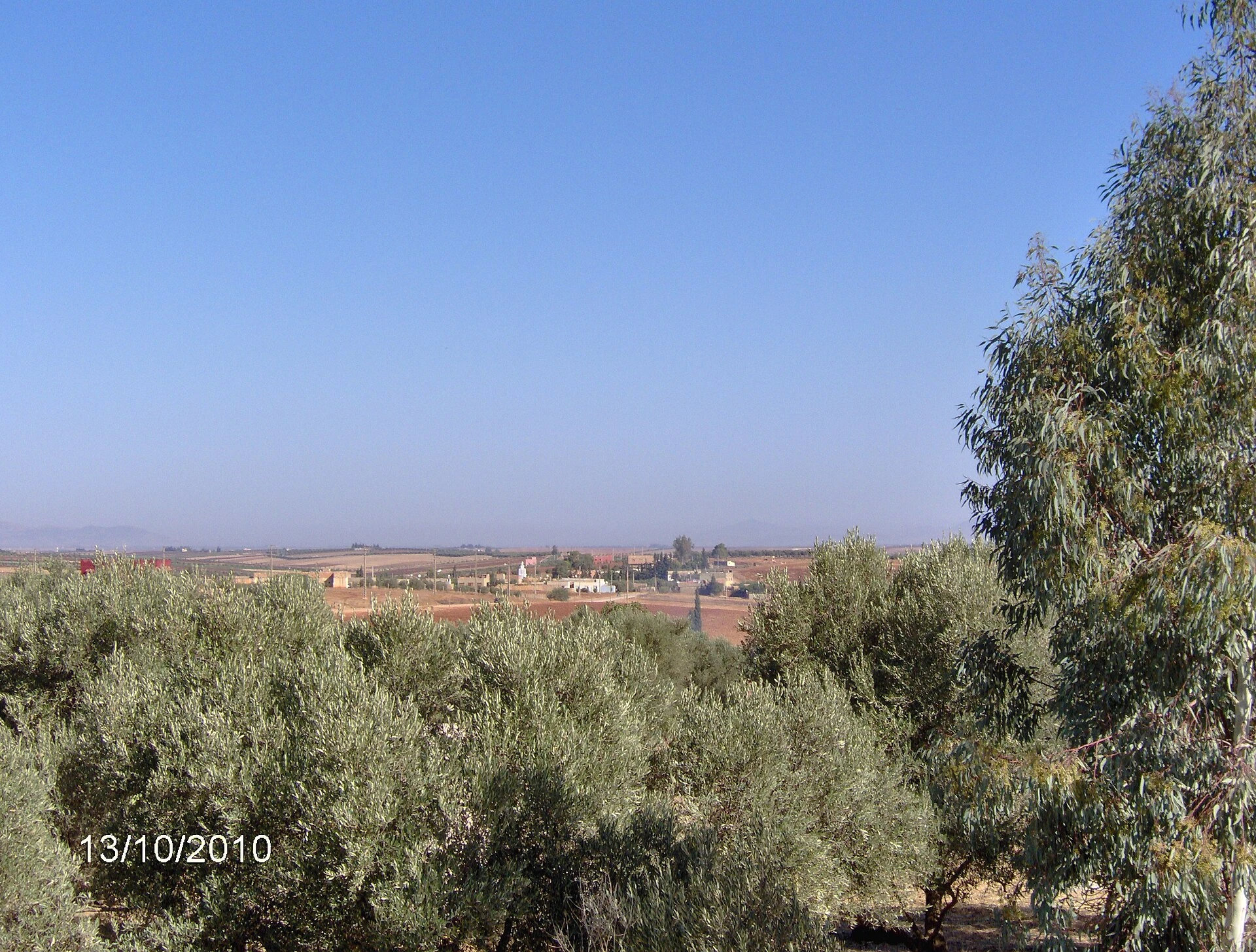
A panoramic photograph from 2010 shows the hamlet of El Qisaria, with olive trees in the foreground and the plain stretching to the horizon.
Village life
The centre of Sebt Jahjouh houses the commune’s administration, a school, shops and cafés. On souk day, the square fills up with animals, carts and traders.
The rest of the week, the village is calm again. Many people go to Meknes for paperwork, studies or major shopping. Shared taxis leave regularly from the centre and fill up quickly on souk day.
Between Meknes and the Middle Atlas
Sebt Jahjouh lies between the imperial city of Meknes to the north and the first slopes of the Middle Atlas to the south. On clear days you can see the wooded hills rising towards Agourai and El Hajeb.
Climate
The climate is Mediterranean with a continental touch. Winters are cool and rainy, sometimes with morning frost, and summers hot and dry. Spring and autumn are the most pleasant seasons for a visit.
Getting there and where to stay
Shared grand taxis link Sebt Jahjouh with Meknes and the nearby villages. There is no hotel in the village, so it is best to stay in Meknes, which offers a wide choice.
Tips for your visit
- Come on a Saturday for the souk.
- Stay in Meknes.
- Come in spring for the green countryside.
- Ask before photographing local people.
