
Contents
- Begin with an identified gate
- Put the fortifications in historical context
- Observe towers without inventing admission
- Read stone, whitewash and inhabited space
- Locate the palace and cultural spaces
- Look towards the sea from an appropriate position
- Understand layers without assigning everything
- Give the walk a readable structure
Begin with an identified gate
Assilah's medina is first an inhabited town within fortifications. Choose a gate you can find again from your accommodation and locate it before entering. Bab al-Homer and Bab al-Bahr are documented names; do not automatically attach either to any opening you see. A gate is a movement landmark as well as a historical subject. Look at its connection with outside streets, passage and houses instead of seeking only an empty composition. Present uses belong in the reading of a place. If the group separates, agree a precise accessible meeting point.
The general word medina is not enough for finding one another. With a pushchair, wheelchair or difficulty walking, ask about surfaces, thresholds and the particular route. A compact old centre does not guarantee level ground or one route suitable for everyone. An easy entrance does not describe what follows. A short walk with a recognisable return can be more useful than a vague promise to see everything inside the walls before a fixed departure time.
Put the fortifications in historical context
The Portuguese capture in 1471 is a major marker in Assilah's history. Early sixteenth-century building work shaped the town's lasting silhouette. This should not reduce Assilah to one period: occupation, transformation and reuse produced the ensemble visible today. A general date cannot date every stone. The town account names Diogo Boitaca in connection with fortification work. For a visitor, understanding the relationship between enclosure, entrances and sea is more useful than turning that reference into certainty about every detail. Defensive forms answered particular purposes and circumstances, while their place in the present town is different.
Keep established history, source descriptions and personal impressions distinct. A repair's appearance does not establish its age. Where a detail matters, seek reliable identification or a competent explanation instead of adding an ancient origin to make the account more dramatic. Looking carefully can reveal questions rather than immediate answers, and those questions can be retained for later reading without making the walk less worthwhile.
Observe towers without inventing admission
Borj al-Kamra is a major tower in the medina's outline, associated with early sixteenth-century Portuguese fortifications. The reference consulted dates it to 1509 and explains its representation of power as well as its place in the fortified system. This helps read volume, height and position. It is not confirmation of present interior admission. Other structures, including Borj al-Bahr, connect defences with maritime approaches. Similar names should not be exchanged in photographic captions. Start with what is genuinely identified from where you stand. An older picture may show an angle now obscured or an entrance subsequently changed.
Do not promise an ascent, terrace or summit view merely because a tower exists. Its exterior may already explain its role in the ensemble. For any particular visit advertised locally, confirm responsibility, extent and current conditions. This article does not turn every tower into an equipped attraction or describe a continuous route along high sections. An accessible exterior observation can be a complete heritage experience without searching for an unconfirmed elevated passage.
Read stone, whitewash and inhabited space
Stone walls and white houses create a characteristic contrast. They are not simply scenery maintained for photographs. Doors, windows and lanes belong to homes, commerce and ordinary movement. Observing passage widths, light and relationships between volumes allows a reading of the town without entering private spaces. An open door is not an invitation. Ask before a close portrait or photographing a domestic interior. Coloured details can be interesting without invented symbolism. A blue façade alone establishes neither building age nor family history. Prefer a precise simple caption: medina lane, identified detail or ramparts from a known position.
Site photographs retain sources, authors and available dates. They record moments rather than guaranteeing identical furniture, shops or wall paintings during a later visit. Recognising this gives the town room to change and live. It also keeps observations credible when shared afterwards: a colour scheme seen on one street should not become an explanation for every house or a claim that the entire medina has remained unchanged through several centuries.
Locate the palace and cultural spaces
The palace associated with Moulay Ahmed Raïssouli belongs to the early twentieth century according to the town reference. Cultural reuse links urban history and contemporary activity. Ksar Raïssouni also appears in moussem descriptions as the cultural palace. Such names do not establish that the whole building is freely accessible at any hour. Distinguish exterior, authorised entrance and temporary exhibition. The Hassan II Centre is another place linked to cultural activity, not an automatic extension of a palace admission or visit. An event may open certain spaces under particular arrangements without describing the rest of the year.
If entering matters, find current information specifying what can be seen. No room, permanent collection or guiding service is described here as personally inspected. The exterior can still help explain how a town reuses buildings and connects memory, exchange and art. Add an interior only when genuinely announced. The arts article develops the relationship while separating the history of a place from availability today, so the itinerary need not depend entirely on an entrance that has not been confirmed.
Look towards the sea from an appropriate position
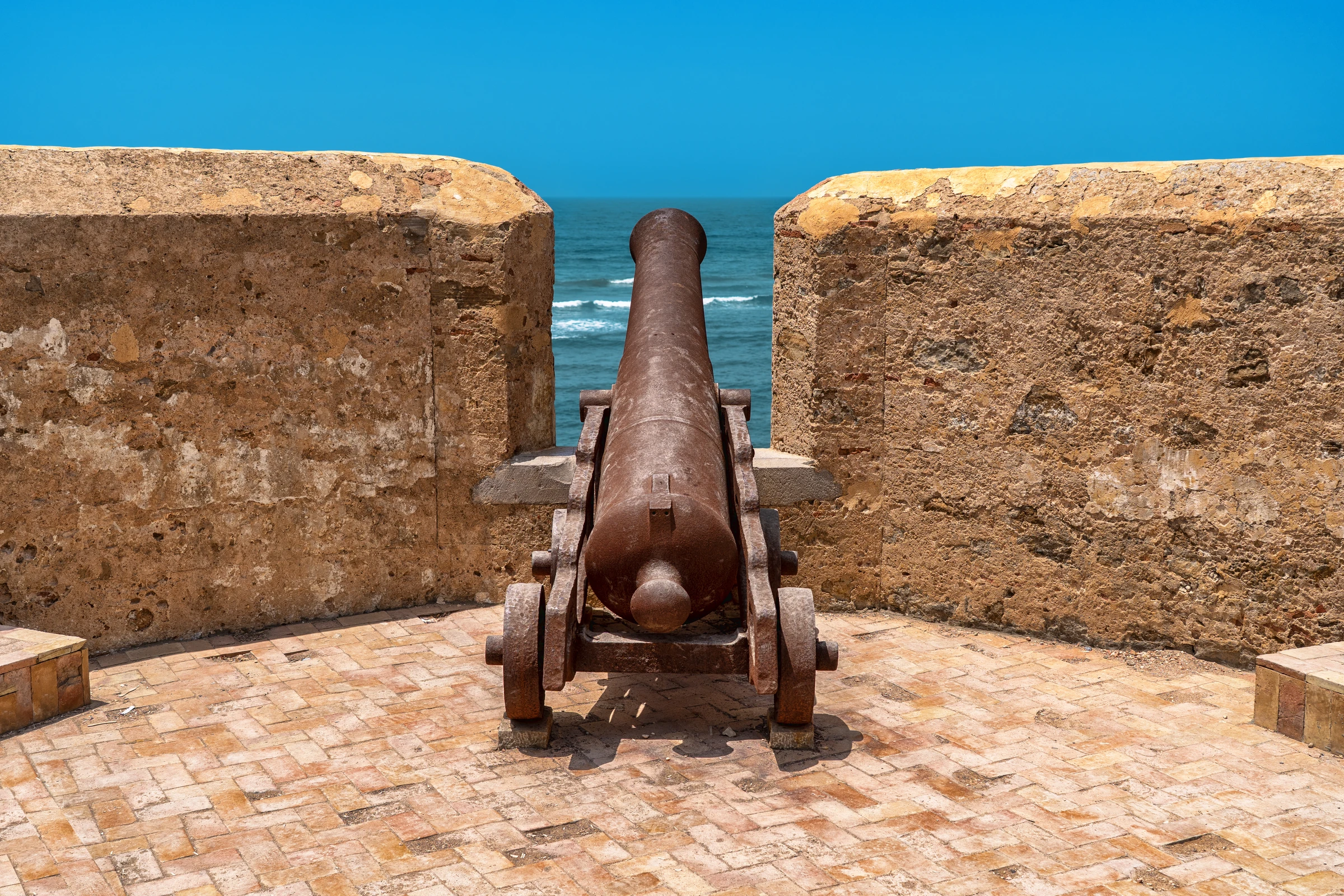
The ramparts gain meaning through their Atlantic relationship. From a permitted approach, observe coastline, built volumes and the meeting of town and water. A projecting work is not necessarily a promenade that can be followed to its end. Surfaces can be wet and conditions change with wind and waves. Stay within indicated limits instead of crossing a barrier to reproduce a photograph. Sunset is a possible light effect, not a daily guarantee or an obligation to remain until dark. Plan a return to a known gate before selecting a distant viewpoint.
A heritage walk remains separate from swimming or a beach outing. Calm-looking water in a picture says little about the place and hour you reach. The coast article helps choose another activity when you want more time by the ocean. Religious or burial spaces nearby must retain their uses; an attractive perspective does not turn every place into a public photographic terrace. It is possible to study defences and sea from a straightforward position without searching for the highest or most exposed frame.
Understand layers without assigning everything
Assilah has names and inheritances linked to several languages and periods. Arzila and Arcila appear in historical accounts and searches. They can help retrieve a reference, but do not necessarily identify additional towns to add to the route. The Spanish protectorate belongs to modern history; that does not make every building outside the walls a construction of that period. Likewise, ancient traditions mentioned in summaries should not place an archaeological site in the medina without an established location. Lixus is near Larache and requires another visit. Keep interpretation proportionate to available evidence.
A historical enclosure can contain later buildings and successive interventions. Searching for a town fixed at one date leads to misunderstanding what is visible. A richer walk accepts change, compares functions and keeps unresolved questions rather than assigning a dynasty or heritage status to every façade. Where two sources use different names, retain their context instead of assuming the discrepancy proves two separate monuments. The town's layered story can remain clear without an exhaustive chronology or unsupported claims about every stone.
Give the walk a readable structure
Organise around a few points: chosen gate, correctly identified tower, accessible lanes and a permitted maritime view. This is a method of looking, not an official itinerary or opening promise. Adapt it to the day and the group's pace. A pause allows notes to be read and relationships to be considered instead of simply accumulating images. Before leaving, distinguish observation, published explanation and what someone told you. This prevents an impression from turning into historical fact in the journey's account. The arts, coast and practical articles extend discovery without requiring everything on one day.
Returning through the same gate can leave another area for later. Assilah's medina and walls offer enough relationships between defence, habitation, trade and creation to sustain an attentive visit without monument interiors or an unconfirmed high access. A successful walk may end with several good questions as well as a few reliable answers. That is more informative than an apparently complete circuit whose names, functions and admission conditions were never really established.
