
Contents
- Experiencing Berrechid Beyond the Tourist Trail: Living Culture of the Chaouia
- 1. Tracing the Historic Kasbah of Berrechid and Oulad Hriz Heritage
- 2. Berrechid’s Weekly Souk: An Unforgettable Sensory Spectacle
- 3. Architectural Walk: From Avenue Mohammed V to the Historic Train Station
- 4. Mosques and Spiritual Landmarks
- 5. Tbourida (Fantasia) and Oulad Hriz Moussems: Living Equestrian Heritage
- 6. Rural Cooperatives and Sunset Walks in the Chaouia Countryside
This article is part of our complete Berrechid travel guide.
Experiencing Berrechid Beyond the Tourist Trail: Living Culture of the Chaouia
When travelers plan a cultural itinerary in Morocco, their thoughts naturally gravitate toward the ancient medinas of Fez, Marrakech, or Meknes. Yet truly understanding the depth of Moroccan society also means exploring its historic provincial towns—the agricultural and tribal heartlands that have sustained the kingdom for centuries.
Berrechid belongs squarely to this category of authentic destinations, where heritage is not confined behind museum turnstiles but lives on through vibrant weekly markets, equestrian traditions, and proud local memory.
As the historic seat of the Oulad Hriz tribe in the center of the Chaouia plain, Berrechid offers curious visitors an unscripted immersion into modern Moroccan history, early twentieth-century town architecture, rural commerce, and ceremonial horsemanship.
This detailed Morocvia.com guide highlights the most rewarding sights, walks, and cultural experiences to include during your time in Berrechid.
1. Tracing the Historic Kasbah of Berrechid and Oulad Hriz Heritage
Every cultural walk in Berrechid begins with the story of its founding kasbah. Built in the nineteenth century by Caïd Berrechid, an influential leader of the Oulad Hriz tribe, this fortified compound of rammed earth and local stone formed the original nucleus around which the modern city grew.
In pre-colonial Morocco, the kasbah fulfilled three vital functions: serving as the seat of local authority, safeguarding vast reserves of wheat and barley harvested across the surrounding plain, and acting as a secure caravan station along the north–south route linking Casablanca and Rabat with Marrakech.
Although twentieth-century urban expansion reshaped much of the town, the historic quarter surrounding the site of the former kasbah remains deeply evocative. It was here in 1908 that fierce clashes took place between Chaouia horsemen defending their homeland and French colonial forces advancing from Casablanca.
Wandering through this older district allows attentive visitors to observe the architectural transition between traditional Chaouia earth-and-stone dwellings and the earliest administrative buildings erected during the first half of the twentieth century.
2. Berrechid’s Weekly Souk: An Unforgettable Sensory Spectacle
If there is one experience you should not miss in Berrechid, it is visiting its sprawling weekly souk. Across the Chaouia plain, market day remains the social and economic high point of the week—a lively gathering where farmers, shepherds, and artisans converge from surrounding rural communes such as Oulad Abbou, Sidi El Mekki, Jaqma, and Lambarkiyine.
From early morning onward, the market lanes buzz with friendly bargaining, calls of spice merchants, and the earthy aromas of freshly harvested produce.
The souk is traditionally organized into specialized sections that offer a fascinating glimpse into rural Moroccan life:
- Produce and Grain Quarter: A vibrant showcase of the Chaouia’s agricultural abundance, featuring pyramids of sun-ripened tomatoes, golden onions, potatoes, fresh mint, cilantro, and burlap sacks brimming with durum wheat, barley, and chickpeas.
- Spice and Olive Alleys: Stalls overflowing with bright turmeric, aromatic beldi cumin, ginger, saffron, ras el hanout blends, and dozens of varieties of green, black, and purple olives cured with preserved lemons and wild herbs.
- Rural Handicrafts and Basketry: Hand-plaited dwarf-palm (doum) baskets, woven reed mats, unglazed clay tagines and bread-baking dishes, and carved olive-wood kitchenware.
- Livestock Market (Rahba): Located on the outer edge of the souk, offering an authentic look at traditional sheep trading, particularly the prized Sardi breed native to the Chaouia.
3. Architectural Walk: From Avenue Mohammed V to the Historic Train Station
Downtown Berrechid lends itself to a pleasant self-guided walking tour illustrating the town’s evolution over the past century. Avenue Mohammed V serves as the city’s main civic artery—broad, shaded by mature palms and ficus trees, and lined with public buildings, banks, bookstores, and welcoming sidewalk cafés where residents gather to socialize over mint tea.
Continuing toward the railway station district reveals a noteworthy ensemble of 1920s and 1930s architecture dating from the era when Berrechid emerged as a key rail hub connecting Casablanca, Marrakech, and the phosphate mines of Khouribga.
The station building itself, along with several vintage grain warehouses and residences nearby, displays the understated neo-Moorish aesthetic characteristic of Chaouia crossroads towns.
Nearby public gardens provide shady afternoon resting spots popular with local families.
4. Mosques and Spiritual Landmarks
As in every Moroccan city, mosques anchor neighborhood life and define Berrechid’s skyline. Minarets in the Moroccan tradition, often decorated with geometric patterns, act as landmarks in the town centre.
While interior prayer halls are reserved for Muslim worshippers, admiring the exterior stonework, carved cedarwood doors, and the serene atmosphere on the square around Friday midday prayer (Jumu’ah) offers deep appreciation for traditional Moroccan craftsmanship.
5. Tbourida (Fantasia) and Oulad Hriz Moussems: Living Equestrian Heritage
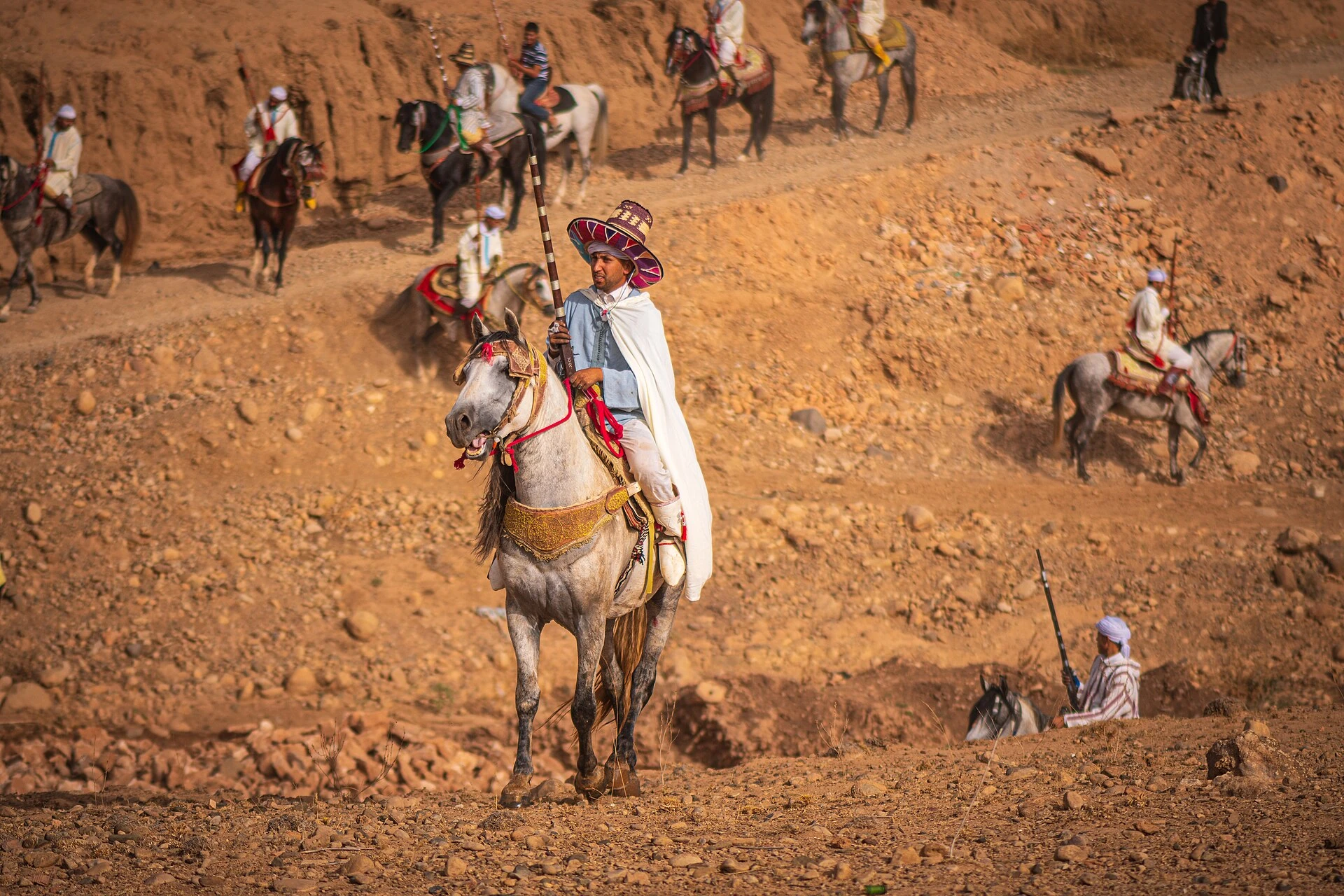
If your visit to Berrechid coincides with a Moroccan national celebration (such as Throne Day, Youth Day, or the Green March anniversary) or one of the province’s annual moussems, you may witness one of North Africa’s most thrilling cultural spectacles: Tbourida, inscribed on UNESCO’s Representative List of the Intangible Cultural Heritage of Humanity.
Across the Chaouia plain, ceremonial horsemanship is a cherished art passed down through generations of the Oulad Hriz. Dressed in immaculate white djellabas, finely wrapped turbans, and embroidered leather satchels, riders charge down a 200-meter dirt track (mahrek) in disciplined formation.
Guided by their troop leader (moqaddem), they spin long black-powder flintlock rifles (moukahlah) overhead before firing a synchronized salvo meant to detonate as a single deafening thunderclap—an unforgettable display of skill, pride, and camaraderie.
6. Rural Cooperatives and Sunset Walks in the Chaouia Countryside
To round out your cultural immersion, consider visiting local women’s agricultural cooperatives on the outskirts of Berrechid, where traditional hand-rolled couscous, herbal infusions, and cold-pressed oils are produced using time-honored methods.
Nature lovers will also enjoy an early morning or sunset stroll along country tracks bordered by olive trees and prickly-pear hedges, watching golden light sweep across endless fields of wheat.
To integrate these activities into your broader trip plan, return to our main overview: Discover Berrechid: Complete Guide, History & Must-See Highlights.
