
Contents
- Identify the complex before arranging a visit
- Place Ma El Aïnin in historical context
- Understand what a zawiya can represent
- Look at materials and successive conditions
- Confirm access without inventing opening hours
- Connect heritage and literature without merging them
- Photograph and share a dated encounter
- Fit a heritage visit into the stay
Identify the complex before arranging a visit
The zawiya associated with Ma El Aïnin is an important reference for understanding Smara's history. Its interest extends beyond a photograph of a doorway or an arch: it connects teaching, religious networks and Saharan movement in the late nineteenth century. The terminology used in descriptions matters. A zawiya may combine several functions and spaces; a mosque, enclosure and ruined area do not automatically form one accessible visitor circuit. Before travelling there, ask which point will be reached and what can actually be observed. Knowing the intended place is more useful than assuming a general name explains the whole visit.
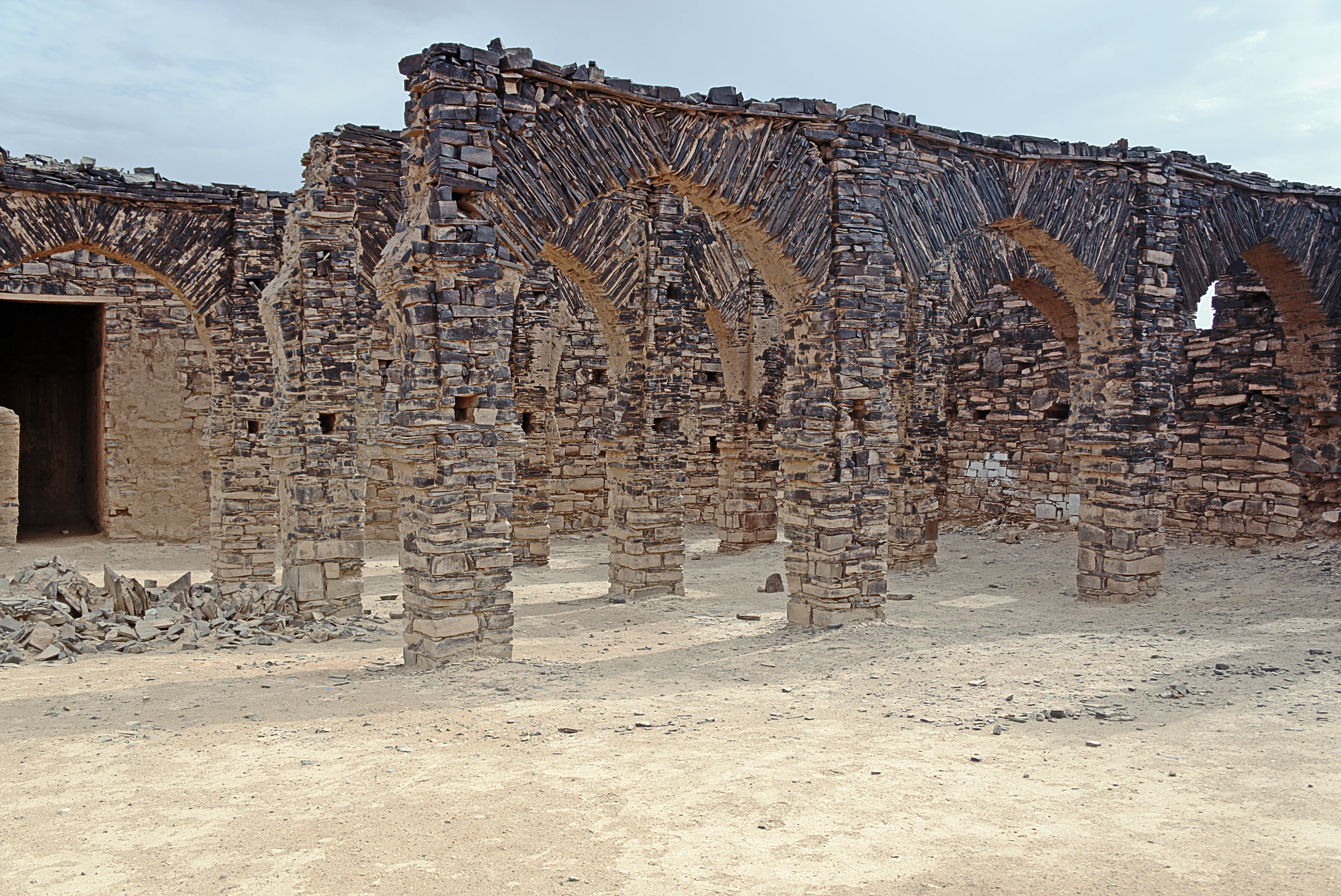
The ruin photograph opening this page is documented outside the complex's walls in December 2016. It identifies a dated condition rather than the present state of every wall. Another photograph in the main guide shows an entrance in March 2019. Neither establishes ticketing, regular hours or current interior access. Choose a precise destination so that even an authorised exterior visit has a clear purpose. Expectations built by combining pictures taken in different spaces and years can otherwise turn an interesting heritage encounter into a search for a complete tour no one actually offers.
Place Ma El Aïnin in historical context
The references present Ma El Aïnin as a religious and intellectual figure born in the area of present-day Mauritania and active across wide Saharan networks. They associate the establishment of Smara with the late nineteenth century, with 1898 used in the town account. Chronologies are not identical across every description, so this period is more reliable than assigning a precise year to each architectural element. His founding role, links with Moroccan sultans and resistance to colonial expansion provide context. They do not by themselves settle contemporary political questions or establish all the functions of every surviving space.
The individual's biography and a building's uses should remain distinct. The biographical reference places his death in Tiznit in 1910, which does not support announcing his tomb in Smara or inventing a local funerary visit through name association. Teaching, authority and movement offer substantial subjects without multiplying supposed landmarks. If an accompanying person develops a historical account, ask which parts derive from a document, a tradition or a personal explanation. This preserves local memory's value while avoiding the appearance that each stone has been independently dated. A careful explanation can acknowledge uncertainty without making the place less interesting.
Understand what a zawiya can represent
A zawiya is not simply a monument crossed for a picture. The term can refer to an institution with religious, social and teaching functions whose forms differ across places and periods. At Smara, this context helps explain the historical importance of the establishment associated with the sheikh. It does not establish that a collection, study room or library is currently open to visitors. Any such offer requires confirmation about the particular place, date and person authorised to receive guests. An institution's past intellectual role and a contemporary visitor service are different propositions and should not be merged.
This distinction supports better questions. What does the accessible part show? How is this space used now? Does a feature belong to an earlier condition, a repair or a later adaptation? You do not need definitive answers to everything to appreciate the site. Observing an entrance, passage and relationship between volumes already gives substance to an authorised visit. A serious account accepts limits rather than assigning an ancient purpose to every opening. The value lies in connecting what can be seen with evidence, not in making the building supply a perfectly complete story for the duration of your stay.
Look at materials and successive conditions
The documented photographs show different aspects of the complex, including walls, arches, passages and ruined sections. They encourage comparison of spatial relationships without proving all features belong to one phase. Colour and weathering alone do not date a surface. A repair may repeat earlier forms, while an opening may have changed use. Understanding a particular phase would require a source establishing it. This guide does not substitute an attractive architectural narrative for that work. Describing the appearance of masonry can be useful while leaving its precise date, construction sequence or original function unresolved.
From an authorised position, take time to notice volumes and how light reveals details. Do not climb masonry or cross a closed section for a better angle. A ruin is not a playground, and stones should not be moved to display their texture. Walking possibilities depend on the surface and current instructions. When access is limited, attentive exterior observation remains worthwhile. It distinguishes being close to a feature from having permission to explore it physically. With children, a simple activity such as comparing shapes and shadows can sustain interest without sending them beyond understood and permitted areas.
Confirm access without inventing opening hours
For an accompanied visit, clarify meeting point, content, language and proposed duration. Ask whether the agreement covers transport only or includes a heritage explanation. A driver knowing a place does not necessarily act as a guide. Price, waiting and final destination should be understandable before commitment. No current admission price or opening time is published here because photographs and historical notices cannot guarantee those details for your dates. If something is essential to the trip, obtain a specific answer rather than allowing a broad phrase such as monument visit to stand for every expectation.
A religious place may require particular dress and behaviour; follow the responsible person's instructions and access restrictions. An open door alone does not constitute permission to enter. Ask before photographing interiors or recording explanations. If an area is unavailable, do not look for a side entrance to evade the decision. Reorient the programme towards an authorised exterior, town walk or reading. The visit remains coherent when it respects current use rather than demanding the access imagined beforehand. A clear limit also prevents other travellers from receiving a recommendation based on a passage that was never properly authorised.
Connect heritage and literature without merging them
Smara features in Michel Vieuchange's notebooks and in works by J. M. G. Le Clézio. Reading may prepare your attention, but each text belongs to its author and context. A fictional scene does not necessarily identify a particular room; a 1930 image is not the site's current condition. The culture article explains how to approach these references without repeating an old route or asking today's residents to embody literary characters. Heritage benefits from being placed in time rather than requiring the present to reproduce a powerful page or a scene that has acquired symbolic meaning.
Useful questions might concern the role of a place of learning in wider movement, the way an outsider describes a building, or the details that remain observable. These are more productive than pursuing an exact picture regardless of access. They also reveal what sources leave unknown. A narrative can be compelling without being archaeological evidence or practical travel guidance. Keeping genres distinct supports appreciation of both the work and the real complex, including its transformations. It allows a reader to recognise an interpretation as an interpretation instead of unknowingly turning it into an architectural or historical claim.
Photograph and share a dated encounter
Choose an authorised viewpoint that does not obstruct people using the space. Seek consent for portraits and check restrictions before an interior photograph. Permission to record an exterior does not automatically extend to whatever lies beyond an opening. Note the part shown and the date: an entrance, room and ruin carry different meanings. Accurate captions make photographs more useful than a broad Smara monument label attached to every detail. If the identification remains uncertain, preserve that uncertainty instead of supplying a name later through visual similarity to another image or a place mentioned in a book.
When reusing another person's image, retain author, source and licence, as on this page. Reuse rights do not independently certify the caption or visiting conditions; those are separate checks. The December 2016 photograph illustrates a located past condition, not confirmation of a restoration or present opening. Resolution supports observation of materials but cannot supply undocumented history. In a travel account, distinguish what you saw, an explanation received and information taken from a text. This method lets a personal impression remain expressive while preventing it from becoming a guarantee of services or access for every later reader.
Fit a heritage visit into the stay
The visit can combine with urban observation while retaining time for movement and a pause. For reduced mobility, ask about the final approach, steps and the possibility of staying in a simpler area. Vehicle proximity does not prove suitable circulation inside. Children can notice shapes and light without climbing walls or leaving permitted areas. A limited but understood programme leaves more attention than a rushed passage between uncertain stops. Clarify how the group will return if someone becomes tired, rather than assuming everyone will complete the same movement once the visit has begun.
The main guide locates Smara, while town, landscape and planning articles help select other parts of the stay. A Sakia el-Hamra outing requires its own preparation and should not be added automatically to the zawiya visit. Maintaining these scales keeps heritage a substantive subject rather than a pretext for accumulating distance. Afterwards, reading or organising your notes may be more useful than another hurried stop. You can leave with dated, attributed observations and questions for further study, without having to invent the rooms or areas that were not accessible during your own encounter with the complex.
