
Contents
- Separate the sources from the urban river
- Understand the river beyond a single viewpoint
- Clarify the final approach before departure
- Observe water and waterfalls without assumptions
- Treat visible services as questions to confirm
- Fit weather and equipment to the place
- Agree transport and the return in advance
- Relate the sources to the rest of your stay
Separate the sources from the urban river
The Oum Er-Rbia flows through Khénifra, but its source area is a different destination in the surrounding Middle Atlas. It lies upstream, outside the town centre, in a commune also named for the river. A photograph of a waterfall or a rocky channel should therefore not be presented as a central street scene. Begin by identifying the exact point proposed for your visit. A river name covers a much greater geography than the place where you will leave the vehicle and start walking.
Decide whether the outing is intended for landscape observation, a particular waterfall viewpoint or another clearly described activity. These are not automatically interchangeable. A transport provider's use of the word sources does not settle the final approach or guarantee access to every photographable corner. Ask what is reached and what remains optional. The distinction is especially useful for a short stay, because it prevents time in town from being confused with a separate excursion. You can appreciate the same river at different scales without pretending that its urban banks and its upstream emergence areas belong to one uninterrupted pedestrian visit.
Understand the river beyond a single viewpoint
The sources form part of a river system that continues through other landscapes and regions before reaching the Atlantic near Azemmour. Khénifra is inland; the river's eventual mouth does not give the town a sea frontage. This wider context helps connect mountain water, urban settlement and downstream uses without reducing the river to one waterfall. The reference discusses multiple emergences, but their appearance and accessibility cannot be assumed identical or permanently available to visitors at every point.
Detailed figures for flow, length or the number of springs are not necessary to enjoy the setting and are not treated here as current measurements. Published accounts can differ in scope and date. Instead, observe the relation between rock, channels and surrounding activity from a safe, permitted position. A photograph shows water at one moment, not a guaranteed discharge for the season. If someone explains a feature locally, distinguish that explanation from what you can see yourself. This makes your understanding more robust than a list of impressive numbers whose measurement and present relevance have not been established for the particular place you are visiting.
Clarify the final approach before departure
The last section between vehicle and viewpoint deserves as much attention as the main road journey. Ask about steps, slopes, uneven surfaces, narrow passages and where a person can turn back. A general description such as easy does not answer those questions. With children, an older traveller or reduced mobility, describe actual needs rather than asking only whether everyone can go. The answer should concern the specific route proposed on your date, not an attractive image of another access or an earlier season.
Identify the return as well as the outward direction. A passage that seems manageable going down may be more demanding on the way back, and an appealing route onward may not form a loop. Keep a modest shared objective so the group can enjoy the place without pressure to reach every viewpoint. If access is unclear or a restriction changes the plan, ask for an authorised alternative rather than following another visitor through uncertain ground. A short observation from suitable space is a complete visit when it matches the people present; there is no need to turn an unverified path into a compulsory challenge.
Observe water and waterfalls without assumptions
Water can be the central interest of the outing without becoming an activity to enter. Clear water is not evidence of potability, while a calm-looking pool does not establish safe swimming. Bring drinking water and keep observation separate from any activity that needs its own current information. Do not infer depth, footing or permission from people visible in an older photograph. Their presence describes one moment and does not provide instructions for another visitor, a different season or a child with different needs.
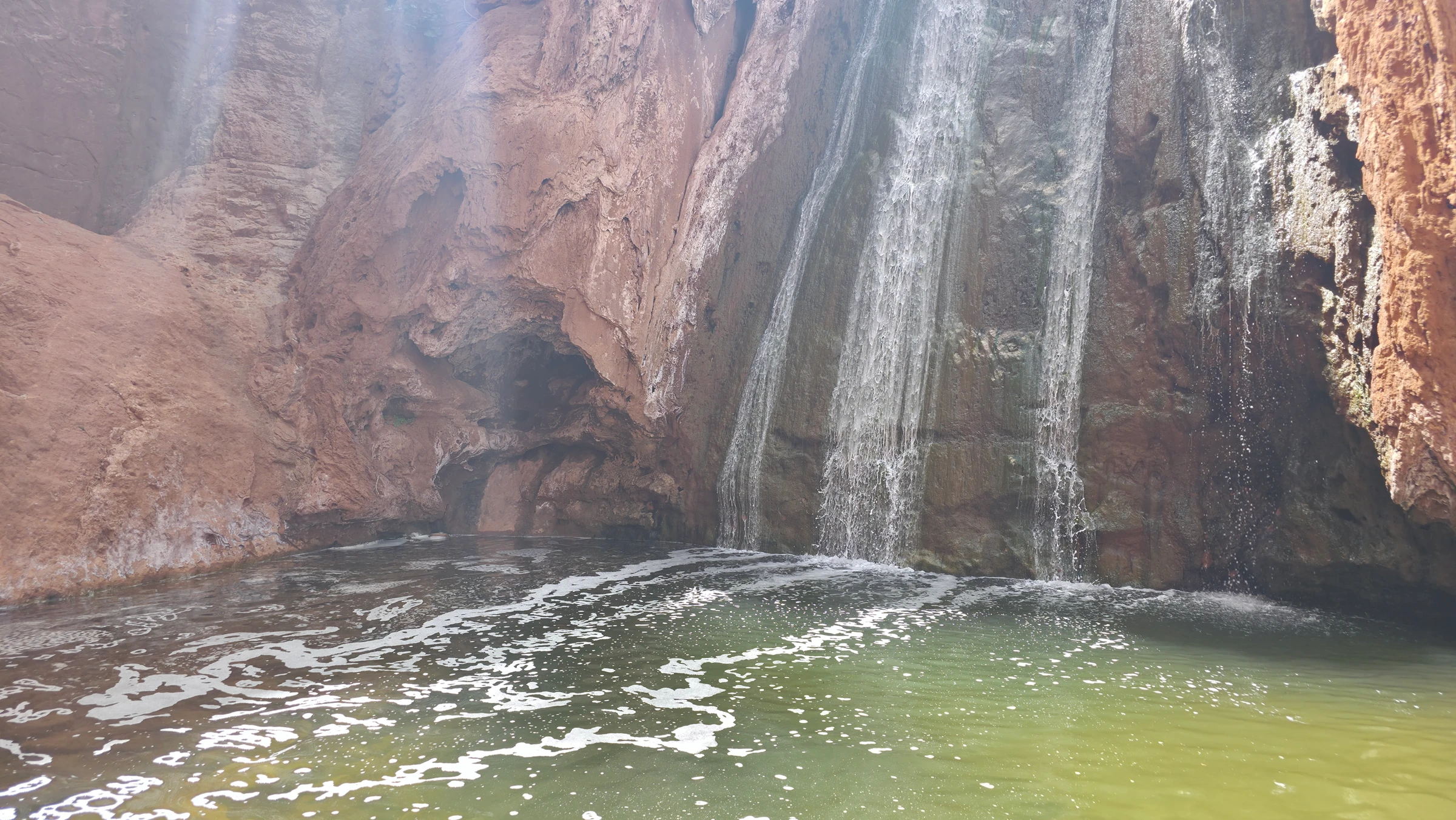
For photographs, choose a stable position and avoid leaning over water or wet ground for a marginally better angle. Water, rock and reflected light already offer useful subjects from an appropriate place. Do not block a narrow passage while taking pictures. If a close view includes other visitors or workers, ask before making them the subject. The waterfall image illustrating this article is a dated, located photograph, not proof that its precise camera position remains suitable today. The purpose of the image is to help recognise the setting while keeping the actual visit dependent on conditions encountered and permissions confirmed on the ground.
Treat visible services as questions to confirm
Some photographs of the source area show tables, structures and visitors. These can indicate human use at the time of the picture without establishing a current menu, opening schedule or inspected service. If you want to eat, ask what is available, what the quoted price includes and where the meal will be served. A seating area and a complete meal are not necessarily the same offer. Confirm any essential dietary requirements before accepting rather than assuming that a familiar dish always has the same ingredients.
Bring a suitable snack if your group needs food at predictable intervals. Keep wrappers and leftovers with you until they can be disposed of properly. A practical visit does not require depending on every facility mentioned in earlier travel writing. If a service is offered, make a separate, clear agreement about its scope and cost. This guide does not claim a personally tested restaurant or guarantee a vendor's presence. That restraint leaves room for choosing something genuinely available on the day without making the basic success of the excursion depend on an advertisement or photograph that cannot establish present conditions.
Fit weather and equipment to the place
Check weather for the source sector rather than relying only on central Khénifra. Relief, exposure and recent rain can affect comfort and surfaces. Choose footwear for the actual approach and clothing that answers the forecast, keeping an alternative if conditions change. No annual average can tell you whether a particular passage will be appropriate tomorrow. Ask locally about the route you intend to follow, especially when your plans depend on a close approach to water or a surface that may become slippery.
Take potable water, a charged phone and useful details saved offline. Share meeting information with the other travellers so the return does not depend on one device. Carry only what your outing needs, but keep room for a pause and a shorter route. If someone becomes tired or uncomfortable, adapt the visit before the return turns into a problem. A well-chosen observation point can provide an engaging view of water and rock without a long walk. The goal is to spend attentive time in a real landscape, not to complete an itinerary drawn up before the ground conditions and the group's capabilities were understood.
Agree transport and the return in advance
Before confirming a vehicle, identify the departure address, exact destination, waiting arrangement and return point. An outward ride does not automatically include pickup later. If a proposal combines several stops, ask how they affect time at the sources and what happens if the programme is shortened. A driver is not automatically a walking guide. Accompaniment, language, meals and any other services need their own description so everyone understands what is being agreed rather than relying on the broad word excursion.
Choose a meeting point recognisable without a constant internet connection and a way to communicate delays. If the group separates, agree how someone can return early and who remains with travellers needing assistance. Include approach, waiting and the complete journey back to the useful address when thinking about the return. Leave a margin before another reservation or a long onward stage. A shorter outing with clear arrangements often offers more satisfaction than a series of destinations added at the last moment, none of which leaves enough time for quiet observation, an unhurried meal or a rest.
Relate the sources to the rest of your stay
The sources can be a main outing from Khénifra or a stop within a journey whose content has been made explicit. They are not automatically included with Aguelmam Azegza or Ajdir. Lake, forest and town answer complementary interests but each needs planning at its own scale. Ask for exact places, time on the ground and final destination before bringing several themes into one offer. A shared regional label should not conceal a day largely spent transferring between points without enough opportunity to appreciate them.
Related articles provide context rather than a booking or a guaranteed connection. If you continue to Ifrane, Midelt or Béni Mellal, plan those towns as independent stages. After visiting, record the access used, conditions observed and services actually chosen, together with their date. Separate your own observations from explanations received and possibilities you did not verify. An image or an account cannot confirm that the same experience will repeat.
This precision keeps the river within its real geography and allows the source area its own interest, without inventing a permanent flow, activity or visitor service to make the stay sound more spectacular than it needs to be.
