
Contents
- A cultural identity beyond mining
- Place the festival’s beginnings in context
- Read a programme practically
- An urban photograph is not festival evidence
- Films and discussion offer different perspectives
- Other expressions need current announcements too
- Coordinate travel, food and accommodation
- Keep the account situated
A cultural identity beyond mining
Khouribga has a cultural history deserving its own subject alongside phosphates. The African film festival, documented from 1977, offers a precise starting point. It does not turn the entire town into a permanent screening venue. For a cinema-focused trip, first establish whether an event matching your dates is actually announced. Festival history explains cultural role without supplying today’s programme, an open venue or access to people named in a previous edition. A known event can remain relevant to understanding the town even when the practical circumstances of attendance still require further confirmation.
Separate town discovery from participation. A walk can interest you without a screening. A dedicated cultural visit needs a date and actual offer, helping choose accommodation and duration without expecting activity to appear automatically. You can prepare by researching works or filmmakers in a published programme. The stay then involves films genuinely announced rather than a vague search for animation because the city hosts a known festival. This distinction supports a programme suited to your interests. It also prevents an unrelated urban photograph from creating expectations of entertainment at a particular square or building every evening.
Place the festival’s beginnings in context
The dedicated source places establishment in 1977 and discusses cine-clubs, the Fédération nationale des clubs de cinéma du Maroc and Noureddine Saïl. These references show a history of circulation and discussion of African cinemas. They require no invented world ranking or permanent audience figure. Early encounters and successive editions belong to different contexts. A founding year does not mean operation, venues and procedures remained identical. Understanding change is more useful than treating an anniversary as proof of uninterrupted arrangements or assuming that a film programme from another period can be reproduced during a present visit.
General accounts sometimes describe an annual event, while the dedicated history records other frequency decisions and postponements. Do not calculate the next occasion from a simple rule. Find a recent announcement for the intended edition. Abbreviations including FCAK and FICAK can appear; establish that the reference concerns Khouribga. An old edition page remains useful historically without justifying reservations for assumed dates. It should not provide supposedly current hours. Before making bookings dependent on attendance, identify a programme sufficiently precise to explain when, where and under which conditions your chosen activity is actually expected to take place.
Read a programme practically
A useful programme specifies date, venue, time and entry for each intended activity. Screening, discussion, competition and workshop are different formats; access to one need not include the others. A broad announcement may omit reservation arrangements or public eligibility. Ask before arranging travel. This guide provides no current ticket, price or schedule and guarantees no visitor workshop. Understand the actual offer rather than inferring it from an enthusiastic previous-edition account. A precise question about one activity is more useful than assuming all festival-associated spaces are freely accessible for a visitor’s entire stay.
Also check language, subtitling and discussion format if these matter. An African festival brings varied works and audiences; its title does not answer those practical questions. With children, identify suitable screenings instead of assuming uniformly family-oriented programming. Where several venues are listed, allow time between them. A venue address is not a whole neighbourhood, and a short interval may not accommodate a meal or extra visit. Check distance and travel conditions before adding commitments. A less crowded programme can provide greater attention and comfort than moving continuously between activities whose timing and access have not been fully understood.
An urban photograph is not festival evidence
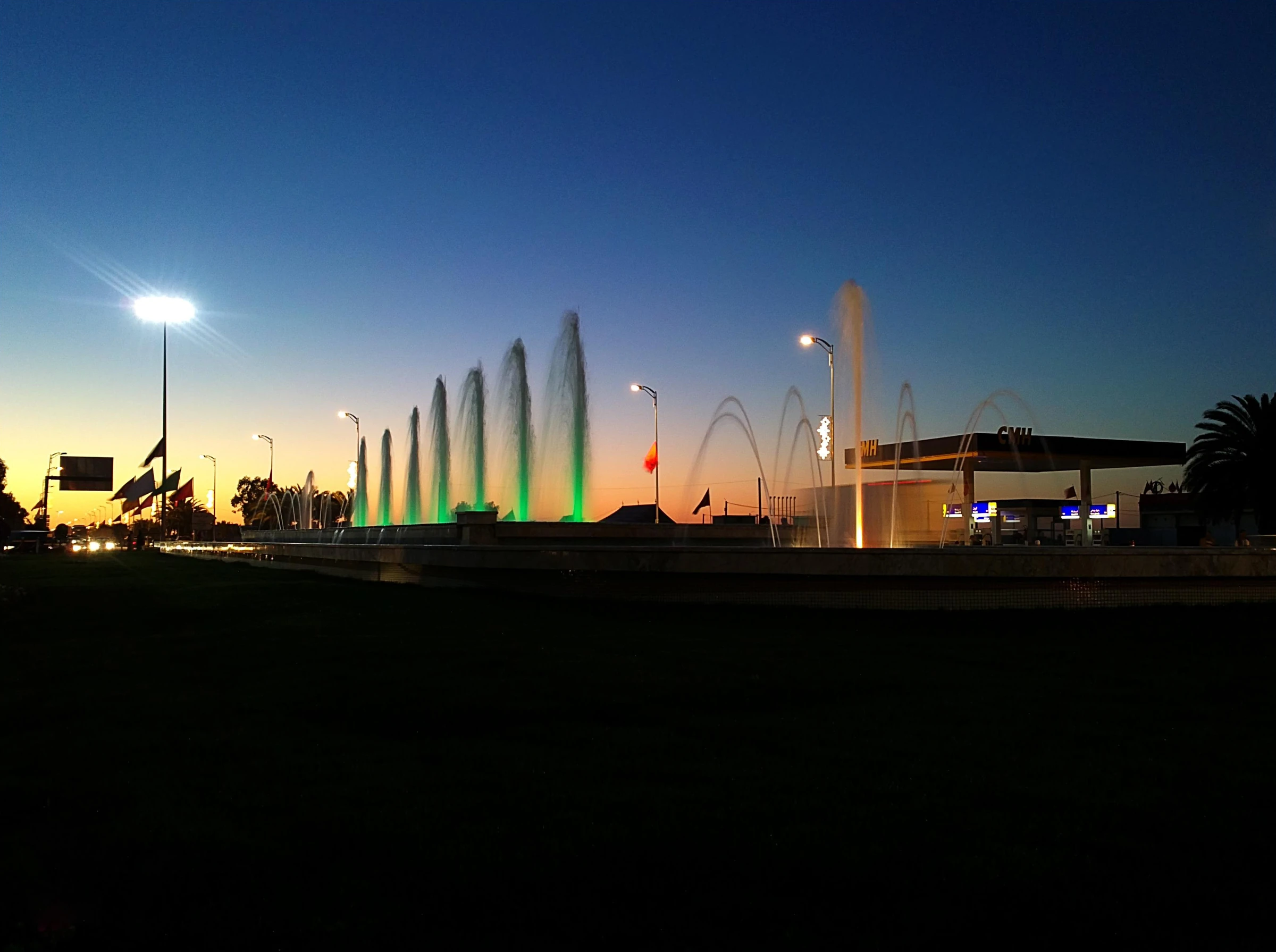
The illustration records a Khouribga fountain at dusk in April 2012. It supplies urban context and keeps the real light of that moment. It depicts neither screening, festival evening nor cinema equipment. No unrelated event photograph has been renamed to fill a gap in the checked selection. A town can be illustrated without implying every illumination or gathering belongs to the cultural subject. The caption deliberately preserves that distinction. Its dated appearance also establishes no current daily fountain operation or promise that the same surroundings and lighting can be encountered during your own stay.
Apply the same care to personal images. An evening gathering proves no permanent programme, and an old poster may concern an expired date. Ask agreement before making someone the main subject and respect event photography rules. Permission to attend does not automatically authorise recording or publishing a work. An accurate account with venue and date can preserve memory without disturbing a screening. You need not produce images to demonstrate attendance. If photographing exteriors instead, identify them as such and avoid attributing an interior use not established by the frame or a reliable source about that particular building.
Films and discussion offer different perspectives
African cinema does not name one uniform style. A programme can gather different histories, languages and forms. Read notices and choose what interests you instead of summarising a continent through one screening. A post-film discussion can illuminate a work without turning one speaker’s statement into an explanation of every film. That attention makes attendance richer than treating it as another box between a walk and meal. It allows a small selection to have depth while leaving other subjects open, rather than claiming comprehensive cultural understanding from a short visit and one publicly announced encounter.
If attending one activity, choose through content and actual availability. A shorter encounter followed attentively may satisfy more than an overloaded schedule requiring early departures. Leave time to reach the venue, understand entry and settle according to instructions. This article promises no personal exchange with a director or team. Announced public meeting, a name on a poster and a private interview are different situations. Their conditions should not be merged. A traveller can appreciate a film and its context without an additional personal encounter, and a successful visit need not depend on receiving access never offered to the general audience.
Other expressions need current announcements too
Sources mention Abidat Rma and cultural activities across the province. This introduces a musical and performative subject, not a confirmed appearance during your stay. Programming may concern Khouribga, Oued Zem or Boujaad, so identify the actual town and venue. Do not move every provincial event into central Khouribga. A tradition described in a notice is neither nightly entertainment nor a workshop reservable without an organiser. Historical significance and visitor availability are different questions. A careful plan can retain curiosity while requiring a current offer before transport or accommodation decisions depend on that activity.
For an additional event, seek a recent announcement, conditions and compatibility with your trip. A photograph or older account supports understanding rather than calendar confirmation. Cultural practices belong to people and contexts, not merely accessories illustrating an industrial city. Interest does not justify asking residents to perform spontaneously for a camera. A respectful encounter and announced activity provide a sounder basis than permanent local-animation promises. Your account can explain a tradition’s relevance while admitting that you did not witness a performance. That is more useful than presenting a general source description as a personally experienced service.
Coordinate travel, food and accommodation
A screening-focused stay requires arrival, room and final journey with enough margin. Check actual transport with the relevant operator and separate town arrival from venue arrival. The station photograph in the main guide establishes a building, not a connection conveniently preceding a screening. If accommodation expects you late, clarify entry and communicate timing. Cultural participation should not leave luggage or room access uncertain. A clear practical base allows greater attention to the activity itself. It avoids a rushed departure from a film because a supposedly simple last transfer or reception arrangement was never actually confirmed.
For meals, choose an option fitting available time and ask what it serves. Intervals shrink once walking, ordering and return are included. No establishment is presented as personally tested. Within a group, agree priorities and meeting points. Rest or mobility needs may justify a simpler programme. Participation is better when people can follow an activity without pressure than when every session is added to demonstrate completeness. Not all venues or entrances may suit the same requirements. Questions about actual steps, paths or assistance are more useful than broad assurances that the event is central or the city is easy to navigate.
Keep the account situated
Afterwards, identify attended activities with date and venue. Separate a film seen, a discussion announced but not followed and history read beforehand. Do not infer an unchanging annual programme from one edition. Precision helps future visitors understand your experience without assuming identical services for themselves. It also allows cultural life to change instead of fixing the city in one remembered evening. A dated account can be enthusiastic while remaining clear about its limits. Describing what you genuinely encountered is more informative than expanding it through activities that appeared in a programme but were not part of your visit.
The main guide and urban, industrial, regional and stay articles can complement attendance without making everything compulsory within one day. Khouribga can interest through work and film circulation without every stay including a mine attraction and festival night. Starting from an actual programme and understood journeys gives cinema the place you want. The rest can remain open and proportionate to confirmed possibilities. There is no need to invent animation to fill intervals. A quiet walk, meal or pause may support the cultural experience better than an extra objective whose current access, location or service has not been established for the date concerned.
