
Contents
This article complements our complete Rissani travel guide.
Rissani is known for its history, but just as much for its market. Since the days of the caravans, the town has lived from trade, and the souk is still the beating heart of the whole palm grove. People from the ksour come to shop, sell their harvest and catch up on news.
This article gathers everything you need to enjoy the market, taste medfouna and choose good dates. For the town’s history, Sijilmassa and the ksour, see our complete Rissani travel guide.
A market shaped by the caravans
The Rissani souk occupies a large complex of covered lanes and courtyards just behind the central square. Its ochre walls, arcades and gates recall the old fortified markets of the south. Several gates lead in, which makes finding your way a little confusing at first.
Each trade long had its own quarter: grocers on one side, cloth merchants on the other, blacksmiths and basket makers further on. This layout can still be sensed today, even though the shops have diversified.
Unlike markets in the big tourist cities, the one in Rissani serves local people first. Everyday goods far outnumber souvenirs. That is exactly what makes it so lively and so interesting to watch.
Market days
The souk is open every day, but three days are especially busy: Sunday, Tuesday and Thursday. On those days, families from nearby villages arrive in the morning by van, by bicycle or on donkeys.
Activity peaks between 9 am and noon. In the afternoon, some traders pack up and the pace slows considerably. To see the market at its liveliest, arrive early.
Market days can change occasionally, for example during religious holidays. Ask your accommodation to confirm the evening before your visit.
What you will find at the souk
Dates take centre stage: they are sold loose, in crates or in boxes, with dozens of different varieties. Next to them, stalls offer spices, almonds, olives, vegetables from the palm grove and henna grown in the region.
The craft lanes display babouche slippers, palm-leaf baskets, pottery, Berber jewellery and carpets woven in southern villages. You will also see fossils from the quarries between Erfoud and Rissani.
The livestock market takes place in a separate enclosure. Sheep, goats and donkeys change hands in cheerful chaos. Visitors often notice the large donkey park, where villagers’ mounts wait for their owners.
Stay discreet in this part of the market. These are serious deals for the herders, and many do not like being photographed. A simple hand gesture to ask permission avoids misunderstandings.
Shopping well at the souk
For food, prices are usually fixed and shown per kilo. For crafts, bargaining is part of the exchange. Keep it friendly: offer a reasonable price, take your time and say thank you even if you do not buy.
Be wary of touts offering to guide you around the market for free. Their tour often ends in a shop where they earn a commission. If you want a guide, ask your accommodation instead.
- Bring small notes and coins for small purchases.
- Taste the dates before buying: sellers are happy to offer a sample.
- For fossils, ask whether the piece is natural or restored.
- Keep your bag closed and in front of you in crowded lanes.
Medfouna, the desert pizza
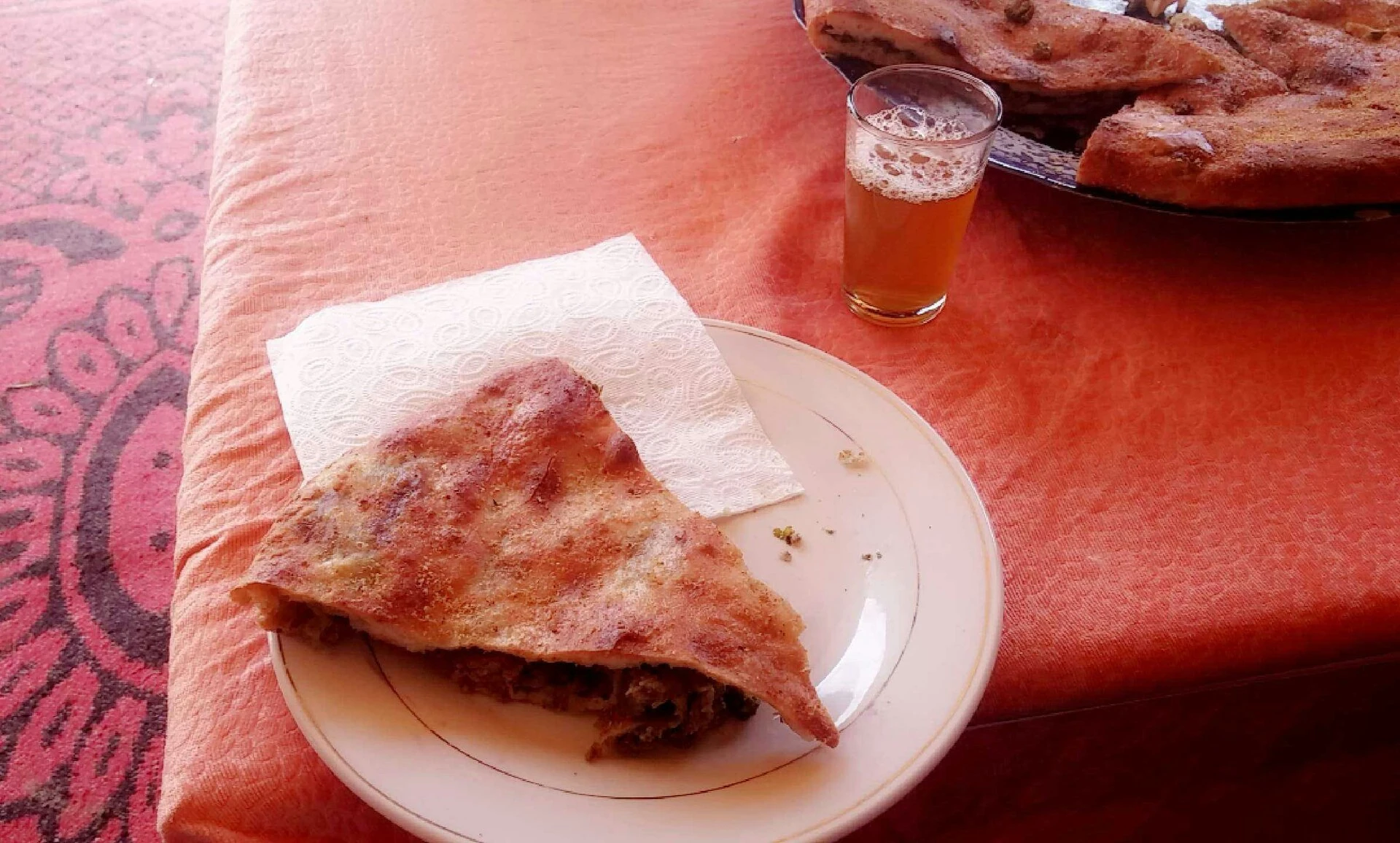
Medfouna is Rissani’s signature dish. Its name means buried in Arabic, because it was once cooked under hot sand or embers. Travellers often call it Berber pizza.
It is a large round bread filled with minced meat, onions, eggs, almonds and spices, then sealed and baked in a wood-fired oven. The crust turns crisp while the filling stays tender. Every family has its own recipe.
Many small restaurants in the centre make it to order. Baking usually takes about an hour, so it is best to order in the morning for lunch. One medfouna easily serves two or three people.
Some bakeries will also bake a filling you bring yourself, as local families do. It is a good chance to see the communal ovens still used in several neighbourhoods.
Other flavours of the Tafilalet
Local cooking relies on simple ingredients. Goat or mutton tagine with vegetables, harira soup and Friday couscous appear on most tables. Dishes are often seasoned with a homemade spice blend.
Khlii, dried meat preserved in fat, keeps for a long time and goes with eggs at breakfast. Bread baked in an earthen oven and local honey complete a typical meal.
At home, people also serve tagoula, a barley or maize porridge enriched with olive oil and butter. It is a winter dish, comforting after a cold night.
Dates, treasure of the palm grove
The Tafilalet palm grove produces some of the best dates in Morocco. The most prestigious variety is mejhoul, large, fleshy and sweet, known worldwide as medjool. It costs more than the others.
The market also sells boufeggous, prized for its melting texture, and jihel, a drier date that keeps for a long time. These everyday varieties are what families eat all year round.
The harvest runs from September to November, the best time to buy fresh dates. Every autumn, Erfoud also holds a date festival, with a market, competitions and entertainment.
To carry your dates home, choose well-sealed boxes. They keep for several weeks somewhere cool and for several months in the fridge.
Tea and hospitality
In the Tafilalet, as elsewhere in Morocco, mint tea goes with every meeting. It is served very sweet, poured from a height to make a light foam. Refusing outright can seem rude; you can simply accept one glass.
If a shopkeeper invites you to have tea in his shop, it is often a sincere gesture, but also a way to start a sale. You remain free not to buy anything.
During Ramadan, most restaurants close during the day. The market stays open in the morning, and the atmosphere becomes very festive after the fast is broken.
Planning your morning at the souk
- Arrive around 9 am on a Sunday, Tuesday or Thursday.
- Start with dates and spices, then move on to the crafts.
- Finish at the livestock market, before the herders leave.
- Order your medfouna for lunch as soon as you arrive.
- In the afternoon, visit the monuments described in our Rissani travel guide, or carry on to Merzouga.
