
Contents
- Early Days: Santa Cruz de Mar Pequeña and the 1860 Treaty
- 1934: The Founding of Spanish Sidi Ifni
- The Ifni War and the Spanish Province
- 1969: Return to Morocco
- Art Deco Landmarks to See in Sidi Ifni
- Self-Guided Walking Tour of Spanish Sidi Ifni
- Photography Tips for Art Deco Hunters
- A Fragile Heritage
- The Spanish Legacy Today
- Mistakes to Avoid on a Heritage Visit
- Sidi Ifni History FAQ
- Conclusion: An Open-Air History Lesson
Few Moroccan towns wear their history as openly as Sidi Ifni. A few minutes' walk through the centre is enough to sense that something is different: geometric facades, rounded balconies, a Spanish-style square, a former church and an old airstrip in the middle of town. For thirty-five years Sidi Ifni was the capital of a Spanish territory, and that period left an architectural footprint unique in Morocco, usually described as Art Deco.
In this article, MOROCVIA traces the history of Sidi Ifni, from Spanish rule to the handover of 1969, and guides you around its main landmarks. For an overview of the destination, read our complete Sidi Ifni travel guide.
Early Days: Santa Cruz de Mar Pequeña and the 1860 Treaty
Spanish interest in this coast goes back a long way. In the fifteenth century, Castilians set up a trading post on the Atlantic shore opposite the Canary Islands called Santa Cruz de Mar Pequeña. It was abandoned a few decades later, and its exact location was debated for centuries.
The 1860 Treaty of Wad-Ras referred to Santa Cruz de Mar Pequeña in connection with a Spanish establishment on the coast. That reference does not prove that the old trading post stood at Sidi Ifni: its historical location is disputed and is often associated with Khenifiss, much farther south. Distinguish the earlier post, the claimed territory and the town developed after effective occupation in 1934.
1934: The Founding of Spanish Sidi Ifni
Colonel Capaz Arrives
Effective Spanish occupation began in 1934 with Colonel Capaz’s expedition. Sidi Ifni became the administrative capital of the territory of Ifni. The planned town developed during this period, but the history of its buildings should not be confused with the older history of Ait Baamrane communities. This distinction helps explain the facades without reducing all local history to European rule.
A Planned Colonial Town
The Spanish laid out a new town on an orderly grid: straight streets, a grand central square, administrative buildings, barracks, a hospital, schools, a church, a cinema, gardens and housing. Most of this was built between the 1930s and the 1950s, when Art Deco and architectural rationalism were in fashion. The result was a small, coherent colonial capital with white facades and geometric decorative details.
The Ifni War and the Spanish Province
In 1957, forces linked to the Moroccan Liberation Army launched an offensive against Spanish positions in the region. The conflict, known as the Ifni War, lasted into 1958. By the end, Spain held only a small perimeter around the town of Sidi Ifni. In 1958 the territory became a Spanish province, as did the neighbouring Spanish Sahara.
Through the 1960s the town lived under Spanish administration with a large garrison. Its main challenge was logistics: without a deep-water port, supplying the town by sea was difficult. An aerial cableway was built to link ships anchored offshore with the coast, and its remains can still be seen near the shore.
1969: Return to Morocco
Under diplomatic pressure and in the wider context of decolonisation, Spain and Morocco signed an agreement in Fez in January 1969 for the return of the territory. The official handover took place on 30 June 1969, a date still commemorated every year in Sidi Ifni.
After the Spanish left, much of the European population departed and the town entered a quieter period. It later became the capital of Sidi Ifni Province, created in 2009 as part of an administrative reorganisation.
Art Deco Landmarks to See in Sidi Ifni
Place Hassan II (Former Plaza de España)
This is the historic heart of the Spanish town. Lined with palm trees, benches and tiled flowerbeds, it is surrounded by several colonial-era official buildings. Take your time walking around the square to admire the facades, colonnades and sculpted details.
The Former Church, Now the Courthouse
On the square stands the town's former Catholic church. After the Spanish departure the building was repurposed and now houses the courthouse. Its silhouette is still recognisable and illustrates how many colonial buildings found new lives.
The Old Spanish Consulate
Also on the square, the former Spanish consulate is an emblematic building of the Spanish presence after 1969 and one of the most photographed facades in the centre.
The Boat-Shaped Building
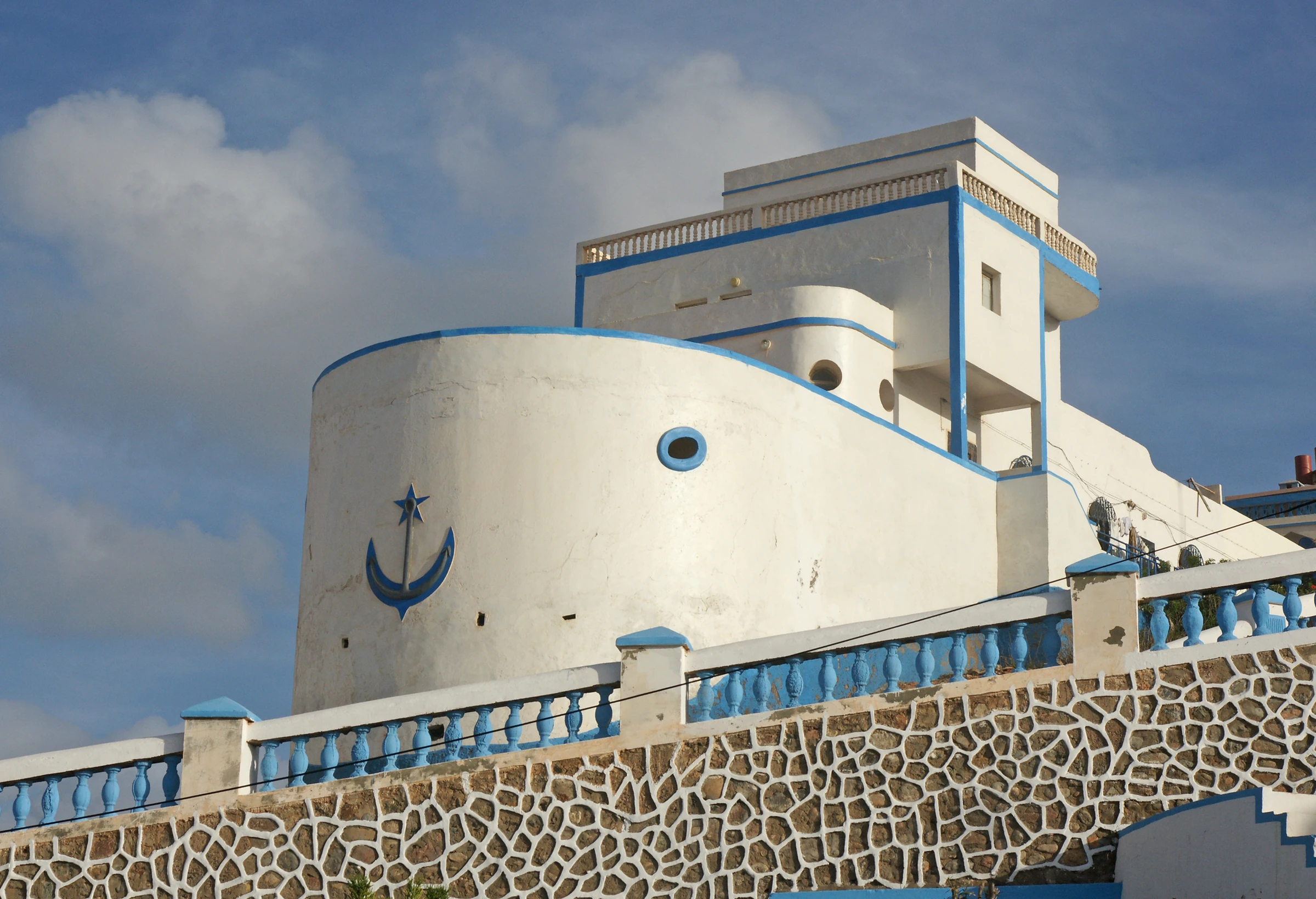
One of Sidi Ifni's best-known architectural curiosities is a building constructed in the shape of a ship, formerly linked to the maritime administration. With its prow and ocean-liner lines, it is a textbook example of the Art Deco fascination with great transatlantic ships.
The Lighthouse and Nautical-Style Buildings
On the heights, the Sidi Ifni lighthouse watches over the ocean. Around town, several buildings echo this maritime inspiration with turrets, porthole windows and rounded forms, which visitors often describe as lighthouse-shaped.
The Old Airfield
The town still has the wide strip of its former airfield, built by the Spanish to link Ifni with Spain and the Canary Islands. This large open space at the heart of town is a rare testimony to the enclave's strategic importance.
Houses and Streets of the Centre
Beyond the landmarks, the whole centre rewards a slow stroll: low houses with blue doors, rounded corners, geometric friezes, old shopfronts and gardens. The white-and-blue palette has become the town's visual signature.
Self-Guided Walking Tour of Spanish Sidi Ifni
- Start at Place Hassan II: walk around the courthouse, the former consulate and the official buildings.
- Wander the central streets to spot Art Deco houses and painted facades.
- Head to the boat-shaped building and the cliff edge for ocean views.
- Continue towards the lighthouse and the promenade.
- Finish near the old airfield, then walk down to the harbour to see the remains of the cableway.
Allow two to three hours at a relaxed pace. Morning and late afternoon offer the best light for photographing the facades.
Photography Tips for Art Deco Hunters
The town's white walls reflect a lot of light, so the harsh midday sun can flatten details. Early morning, when the sea mist is lifting, gives soft and atmospheric images, while the golden hour brings out the blue trims and the curves of the facades. Look for symmetry on the main square, details such as ironwork and tiles, and the contrast between the buildings and the ocean behind them. Always be discreet and ask permission before photographing people, and avoid pointing your camera at police stations, military sites or official guards.
A Fragile Heritage
Much of this heritage suffers from time, salty air and a lack of maintenance. Some buildings have been restored, others are closed or damaged. Local initiatives and enthusiasts campaign for its preservation. As a visitor, you help by staying in locally run accommodation and treating the sites with respect.
The Spanish Legacy Today
The Spanish influence lives on in collective memory. Some older residents still speak Spanish, old place names are still used, and Spaniards born in Ifni sometimes return to retrace their childhood. This blend of Ait Baamrane Amazigh culture, Moroccan traditions and Spanish memories gives the town its distinct identity.
Mistakes to Avoid on a Heritage Visit
Many visitors rush through Sidi Ifni, taking a single photo of the main square before moving on. Instead, take time to get lost in the side streets, where the most interesting details hide: old doors, painted signs, ironwork and small houses with rounded corners. Avoid entering closed or ruined buildings, which are often unsafe and sometimes private, and do not climb walls or rooftops for a better angle. Finally, strike up a conversation with residents when the opportunity arises.
Older locals are often happy to share memories of the Spanish era and of the 1969 handover, and these exchanges can bring the town's history to life far more vividly than any information panel.
Sidi Ifni History FAQ
When did Sidi Ifni become Spanish?
Spain effectively occupied the territory in 1934, based on the 1860 Treaty of Wad-Ras. The town was the capital of Ifni until 1969.
When was Sidi Ifni returned to Morocco?
The official handover took place on 30 June 1969, following an agreement signed in Fez in January that year.
Why is Sidi Ifni known for Art Deco architecture?
Most of the town was built between the 1930s and 1950s, when Art Deco and rationalist styles were popular. The geometric and rounded facades reflect that era.
Can you go inside the historic buildings?
Most are administrative or private buildings and are not open to visitors. They are best admired from outside on a walking tour.
What was the Ifni War?
It was the 1957 to 1958 conflict between the Moroccan Liberation Army and Spanish forces, after which Spain kept only the area around Sidi Ifni.
Conclusion: An Open-Air History Lesson
Sidi Ifni is an open-air history book where every facade tells a chapter of the story between Morocco and Spain. Look up, linger on Place Hassan II and gaze at the ocean from the cliff. To complete your visit, explore the other MOROCVIA guides and plan a culture-rich trip through southern Morocco.
