
Contents
- Recognise the change of province and region
- Distinguish town from shoreline access
- Observe the coast without exchanging place names
- Choose beach time according to actual conditions
- Give the food tradition a practical place
- Approach heritage without inventing access
- Prepare transport, stops and meeting points
- Return with a comparison rather than a forced circuit
Recognise the change of province and region
Bouznika is in Benslimane province, within Casablanca-Settat region. Skhirat belongs to Skhirate-Témara prefecture in Rabat-Salé-Kénitra. An excursion therefore visits a neighbouring destination rather than a remote district of Skhirat. This distinction helps interpret accommodation descriptions and image captions. A Bouznika landscape should not be presented as Skhirat beach merely because both towns lie along the Atlantic corridor between Rabat and Casablanca. Administrative context also provides a useful check when a search result uses a broad regional label that does not identify the precise place you want to reach.
Start by deciding why you wish to go: another coastal setting, time in town or a meal. One main aim makes it easier to select an arrival address and allocate travel time. There is no universally short journey to promise; it depends on starting point, traffic and transport. A regional map explains direction, while the actual programme needs specific locations and a return solution. This is particularly important when a train or reservation fixes the end of the day. Leave enough margin to enjoy the destination instead of treating the neighbouring town as an effortless extra stop.
Distinguish town from shoreline access
As with many seaside destinations, the name Bouznika does not by itself mean arrival on the sand. Urban areas, residential sectors and coastal entrances serve different purposes. For a meal or room, check the address and last transfer. An ocean photograph heading an offer proves neither a public path from the property nor an uninterrupted promenade. Obtain confirmation of the features that matter to your decision. The impression created by an image is not enough to establish how the place can actually be reached or whether it suits everyone in the travelling group.
For a short outing, one section may suffice. Trying to connect every coastal point risks multiplying transfers and searches for access. River mouths, rocks and built areas do not automatically form a consistent pedestrian itinerary. Do not cross a fence or private land simply to follow the coastline. A pause in a clearly accessible place can be more enjoyable than a circuit drawn without knowledge of crossings. Comfort depends on the actual route, not straight-line distance. Plan the walk only after the approach is understood, and retain a straightforward option to stop or return if the ground does not suit the group.
Observe the coast without exchanging place names
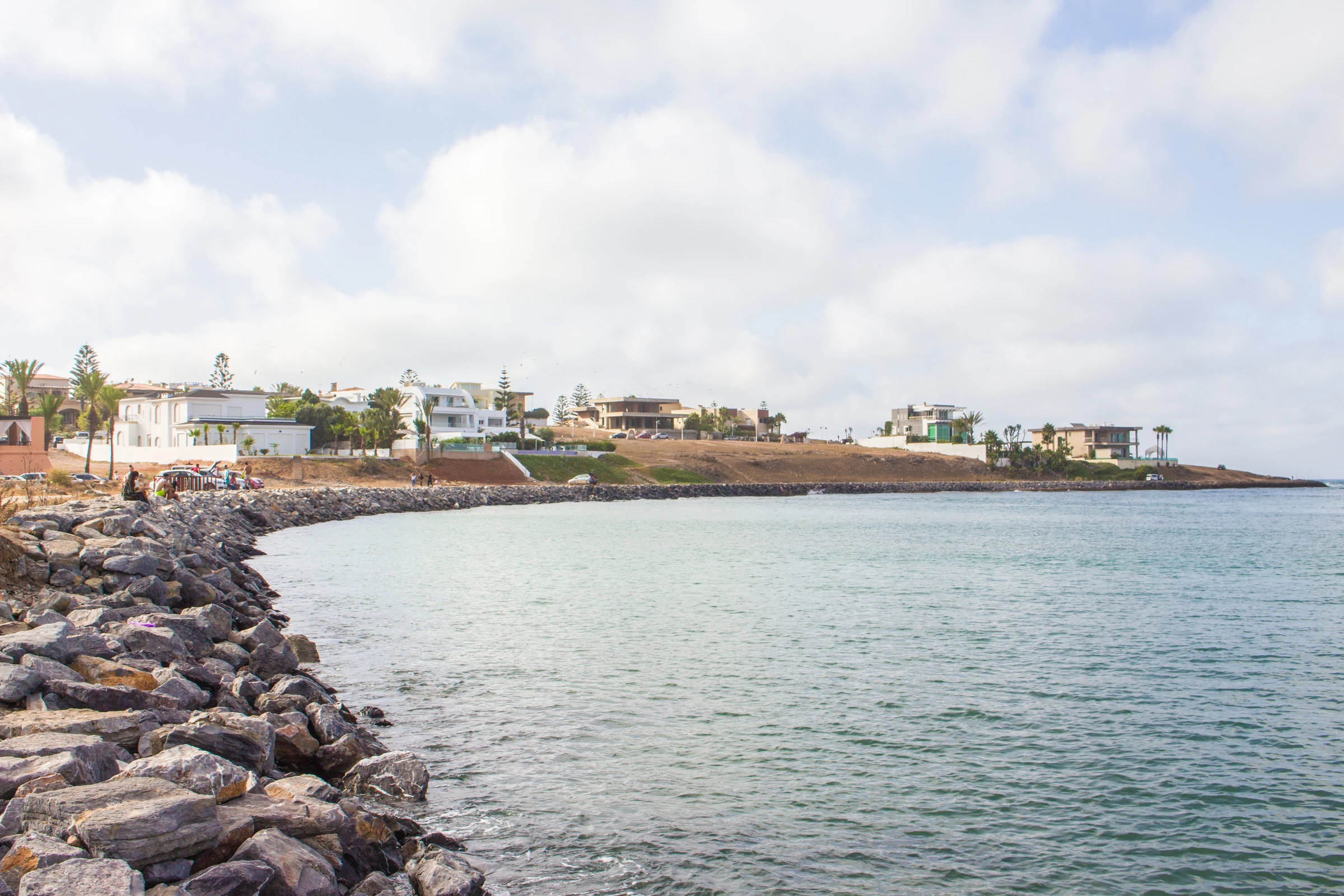
Available photographs from the area show beaches, rocks and a river mouth identified in its source as that of Oued Bouznika. Keep that location distinct from Oued Cherrat references in Skhirat's history. Neighbouring names do not prove the same place or entrance is meant. For illustration, a carefully named coastal scene is more informative than an impressive but approximate label attached later. The image used in this dossier remains explicitly located around Bouznika. It is not evidence that Skhirat's archaeological context is visible in that view or that a route between the two has been confirmed.
A river mouth should not be interpreted as a protected swimming area. Currents, depth, water conditions and crossings need specific information. Remain in permitted positions and do not attempt to cross a channel because it looks narrow in a picture. Tides and water flow can alter conditions. The landscape can be appreciated from a distance through the meeting of water, land and buildings. This article guarantees no nature circuit, species sighting or navigation service. The strongest observation may simply be a clear account of the setting, without adding activities that the source photograph cannot establish.
Choose beach time according to actual conditions
Bouznika is known as a seaside destination, but reputation does not certify every activity on every day. Older references to cleanliness awards or labels do not confirm their status for your travel date. Examine information present at the chosen location and the real sea before deciding to swim. Do not assume supervision, equipment or hire throughout the coast. If a facility is essential, seek a recent confirmation for exactly where you intend to go. The same care applies whether the trip is planned for several hours or only a brief stop during a wider stay in the region.
For walking, consider sand, rock, exposure and wind. Keep simple limits and continuous attention with children; for reduced mobility, check the particular access and resting points. Arriving close to the water by car does not guarantee a route without steps or uneven ground. If weather is unsuitable, choose a town stop or postpone. The excursion still has value without swimming. Coastal observation and a well-planned meal may provide enough for the day. A destination should be chosen for what works at the time, not for a fixed image of a perfect beach outing that must be reproduced.
Give the food tradition a practical place
The Bouznika overview presents the town as a known stop for grilled meals on the Rabat–Casablanca route. That culinary reputation offers a relevant theme without certifying any individual establishment. Select according to actual offer, communicated prices and observable conditions. Ask what is available, how portions are offered and which ingredients affect dietary requirements. No restaurant is described here as personally tested, and a menu from an old page is not guaranteed to remain current. A useful meal choice depends on specific information rather than a general claim that every address shares the town's reputation.
If lunch is the main aim, confirm an address before choosing a distant coastal point. That avoids unnecessary trips between shore and centre when the group is ready to rest. With children, bring water and a small fallback. For allergies, a clear answer from the responsible person is more useful than a deduction from a dish name. A food-focused outing does not require a long list of businesses. It needs an understood order, suitable conditions and a location compatible with the rest of the day. Leave enough time to enjoy the meal rather than placing it between two hurried transfers.
Approach heritage without inventing access
The encyclopaedic source relates Bouznika's history to a kasbah and also mentions a national stud farm. Those references do not establish unrestricted visits, horses always visible or a demonstration programme for travellers. If this interest motivates the trip, obtain information from the relevant institution and confirmation of reception. Without it, do not build the day around assumed admission. A marked point can have a purpose other than tourism. Historical association, present function and visitor arrangements must be checked separately instead of being combined into one confident claim simply because a site appears in a town overview.
It is also important to distinguish an establishment's name from the monument it evokes. A hotel offer using the word kasbah is not, by itself, historical evidence or permission to enter surrounding land. Read descriptions carefully and keep places separate. For a straightforward Bouznika visit, town context, a meal and coast already make a coherent programme. There is no need to add poorly documented heritage to make the outing worthwhile. A limited visit based on confirmed possibilities is more useful than an elaborate circuit whose principal attraction turns out not to receive independent visitors at the chosen time.
Prepare transport, stops and meeting points
If rail covers part of the journey, check stations and actual stops for the date through ONCF. Two names along one railway axis do not guarantee a useful direct service at the desired time. You must also reach the departure station and complete the last transfer after arrival. Compare this whole chain with another transport arrangement, rather than only the principal train's duration. Luggage, children and breaks can change which option is most comfortable. The appropriate solution depends on your actual Skhirat address and the Bouznika point chosen, not on the destinations' names alone.
With a taxi or arranged driver, specify a recognisable point and agreed conditions. With your own vehicle, find authorised parking rather than stopping where an image shows other cars. Retain a margin before returning to Skhirat, especially when an appointment fixes the time. Fares and durations are not invented here. That restraint allows you to construct the excursion using current information rather than a theoretical route detached from the chosen day. Save both the meeting point and accommodation address in an accessible form, so the final return is easy to communicate if a connection becomes weak or a street entrance is unclear.
Return with a comparison rather than a forced circuit
The interest of Bouznika from Skhirat may lie in comparison: two Atlantic-corridor towns, different relationships between centre and coast, a culinary pause and another landscape. There is no need to continue to Casablanca or visit every neighbouring beach to complete the experience. A lighter day leaves room for real conditions and the group's preferences. If museums and recognised urban heritage matter more, the Rabat article helps select a different outing. Both choices are legitimate; they need not be combined simply because the coast links their names on a regional map.
Keep captions accurate when sharing memories: Bouznika is not Skhirat, Oued Bouznika should not be renamed Cherrat through resemblance, and an establishment seen is not a personally tested visit. These distinctions make advice more useful for the next traveller. Linked articles continue with Skhirat beach, town history and practical organisation. They help assemble a stay according to interests without promising continuous coastal access, guaranteed swimming or admission to every property. A successful outing can remain simple, with a few places correctly understood and a return that does not depend on uncertain services or an improvised last-minute route.
