
Contents
Reading the town through its landmarks
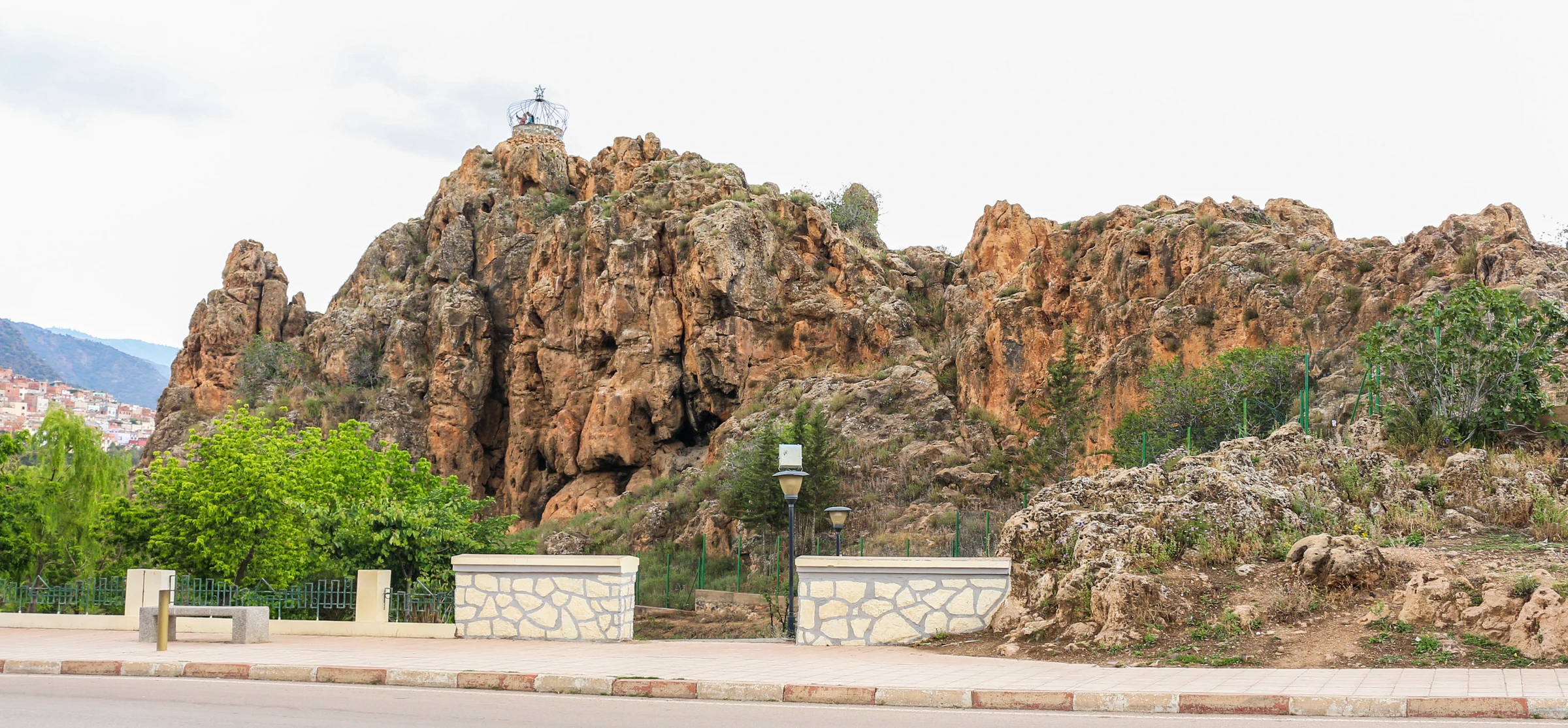
The rock marking central Azrou provides a first way to understand the town. The Amazigh word aẓru means stone or rock, making the relationship between name and landform more than an advertising image. Notice how streets, buildings and views relate to this feature. You do not need to climb a passage to appreciate it: begin with views from accessible public spaces and consider how the outcrop belongs within the inhabited town around it.
Photographs use several spellings for the rock, including Akchmir and Akechmir. These variations can complicate a map search or a meeting arrangement. Connect the name with a precise location rather than assuming everyone uses the same spelling. A shared reference to a street, square or recognisable business makes starting a walk easier. It is more useful than saying simply “at the rock”, since its surroundings may have several approaches and different places where people can wait.
Looking without inventing a route
The presence of the rock does not establish an equipped route to its summit. Steps visible in an old image may also lead somewhere else. Use passages that are actually open, considering slopes and everyone’s ease of movement. For a photograph, find somewhere you can stop without obstructing others. This approach allows the rock to be appreciated in its urban setting rather than treated as an obstacle to conquer or an attraction whose access can be inferred from a photograph.
A short central loop can connect a few landmarks you can easily recognise again. Alternate a square, a shopping street and a view of the landform, then return to your starting point. Time depends on pauses and conversations as well as distance. If arriving with luggage, first arrange somewhere to leave it. Walking lightly makes it easier to notice facades, street uses and changing atmosphere instead of concentrating on getting bags through an unfamiliar place.
Understanding how Azrou differs from its neighbour
Azrou and Ifrane belong to the same province, but their urban landscapes are not interchangeable. Azrou serves as a crossroads and service town for the surrounding Middle Atlas. Shops, markets and everyday movement are essential parts of that role. Do not expect to find Ifrane’s most widely circulated images everywhere here. Observing the differences offers a more accurate understanding than grouping both towns under a single comparison with a European mountain resort and overlooking what makes each one distinctive.
Tiled roofs and building forms contribute to Azrou’s appearance without all telling the same historical story. A renovated facade, recent shop and altered house may share the same view. Before assigning a date, former function or precise style to a building, seek published information. Architectural observation remains rewarding without turning every balcony or roof into certain evidence of an undocumented past. The mixture of changes and continuing uses is itself part of how an inhabited town should be read.
Placing the former college in context
The former Berber college of Azrou, now known as Lycée Tarik Ibn Ziad, is a landmark in the town’s educational history. Its story relates to the colonial period and generations of students. This deserves to be distinguished from quick accounts presenting Azrou solely as a forest destination. It is nevertheless an educational establishment: a travel guide provides no right to enter buildings, courtyards or areas used by students, even when their architecture attracts your interest from the street.
When considering this heritage, separate what can be seen from public space from an organised visit. A facade photograph does not establish opening hours or an exhibition. If access is proposed, confirm its nature with a responsible person instead of relying on an older reference. This respects the place’s current uses while retaining its historical importance. It also avoids building a walking programme around interior access that has never been established and might not be appropriate for an operating school.
Discovering markets as places of exchange
Markets connect Azrou with its rural surroundings. They bring together urban needs, agricultural products and everyday objects. Confirm the actual location and day when planning a visit. The word souk can refer to different spaces and rhythms, and a photograph of a crowd is not a timetable. Give yourself time to look without requiring an exceptional spectacle. An ordinary trading day can explain the relationship between town and countryside without matching the busiest image in a brochure.
Begin with products you understand or might use. Asking an ingredient’s name, how to store it or where it comes from can create a more concrete exchange than immediately taking a photograph. Stalls are workplaces rather than motionless scenery: sellers work and customers move through. Keep passages clear and ask before framing a person. This makes it possible to appreciate the market as an active place, with its own priorities, rather than simply a travel image to collect before leaving.
Choosing something with a practical use
A small purchase can be worthwhile when it responds to a clear wish. Check the price, quantity, condition and transport requirements, especially for fragile or edible products. Buying close to an assumed production area does not remove these questions. For fruit or prepared foods, ask about storage. A modest, carefully chosen purchase can extend the Azrou experience better than a bulky object whose purpose remains unclear. Leave time to compare rather than treating every interesting stall as an obligation to buy.
For a break or meal, distinguish market products from services offered by a neighbouring business. A possibility described in a travel account is not automatically available during your visit. Ask what can be prepared, for what price and with which ingredients. The meals guide explores these choices without claiming an independently tested directory of addresses. Keep enough time to return to the centre, particularly if you later need to reach a separate departure point or collect something agreed with a seller.
Comparing craft objects precisely
Textiles, carpets and wooden objects feature in descriptions of Middle Atlas crafts. Their presence in an Azrou shop does not prove manufacture in the town or a particular village. Ask where the piece was produced and what information supports that origin. A cautious attribution is preferable to inventing a workshop, producing community or specific tradition from appearance alone. A seller may provide useful details, but the history of the actual object should remain separate from general ideas about regional craftsmanship.
For a textile, examine dimensions, stated material, finish and care requirements. A pattern you like should also fit the use planned at home. Compare pieces using similar questions so the discussion concerns concrete features. A style or regional name does not replace inspection of the item offered. If shipping is important, establish arrangements and cost before assuming the sale includes that service. The practical consequences of size and weight can matter as much as the initial appeal of a design.
Separating a shop from a workshop
An object on display does not imply an opportunity to watch it being made. Some sellers know its production history; others have only their supplier’s information. A workshop visit therefore needs confirmation as a separate activity with an identified place and agreement. This prevents a general craft description becoming a promised demonstration. It also allows time for questions about material and work without interrupting an activity that may not be set up to receive visitors or provide explanations on demand.
For wood, ask about the claimed species, origin and care. Do not identify every object sold near a cedar forest as cedar: materials and commercial routes vary. Colour and smell alone do not prove provenance. Choose a piece whose characteristics you understand and which can be transported properly. A souvenir’s interest can come from a clear history rather than a vague association with a famous forest. This gives you something more precise to remember than a label that cannot be supported.
Giving the town walk a comfortable rhythm
A half-day can be a flexible framework for finding your bearings, with a shorter loop if pauses last longer. This is neither an imposed minimum nor a promise to see everything. First place the centre and rock on your map, then choose another priority such as a market, architectural observation or a purchase. The plan remains coherent if somewhere is occupied, closed or less accessible than expected, because the walk has a structure rather than a list that must be completed.
The town is also worthwhile when conditions restrict a mountain outing. Instead of immediately replacing a forest with another lengthy drive, explore streets and exchanges already encountered more deeply. A warm break, unhurried meal and another perspective on the landform offer a different reading of Azrou. Adapt walking to ground conditions and weather: urban spaces do not escape cold or rain. A slower day can reveal how the town works without being treated as a disappointing substitute for a landscape trip.
Connecting the visit with other articles
If exploring the centre accompanies a forest outing, keep the two parts distinct. Transport arrangements and access to a cedar sector should not force you to rush through the market. Equally, a conversation or purchase does not mean the excursion’s return can be postponed without consequences. The main guide helps distribute the stay, while the forest and journeys articles explain those activities’ particular needs. Linking them thoughtfully is more useful than treating the whole day as one uninterrupted and supposedly flexible visit.
Before leaving, retain useful details: return point, accommodation contact, any meeting and arrangements for collecting a purchase. This dossier’s captioned photographs show places on identified dates; they do not replace information from the day. Looking at the rock, streets and objects with this attention reveals a town connected to its relief and exchanges. Azrou then becomes a destination you have begun to understand, rather than merely a halt between two Middle Atlas landscapes whose names dominate the travel programme.
