
Contents
Reading an inhabited medina and recognised heritage
The medina of Essaouira, formerly Mogador, has held World Heritage status since 2001. Recognition concerns a historic urban ensemble, not permission to enter every courtyard or home. Streets accommodate residents, businesses and deliveries. Observe routes, gates and ocean relationships while keeping passages clear. Choose a few landmarks and a return point instead of pursuing every lane. If arranging guidance, clarify content, language and conditions before starting. A spontaneous conversation is not the same as a reserved tour and should not imply a compulsory purchase. Understanding that distinction allows encounters to remain comfortable while the group knows which service, if any, has actually been agreed.
Choosing gates and straightforward landmarks
Bab Doukkala, Bab Marrakech and Place Moulay Hassan help organise different sections of a walk. They are not interchangeable points: choose according to accommodation, transport and the area visited. Save a map and recognisable entrance, especially with bags. Phone positioning can vary between streets and cannot replace observing gates and squares. Agree where to meet if the group separates. With children, limit stops and include rest. A short understood route can reveal more than constant navigation between saved pins without looking at their setting. Knowing an exit also makes it easier to stop early or change the walk without depending on an approximate arrow into an unfamiliar or private passage.
Distinguishing the two Skala ensembles
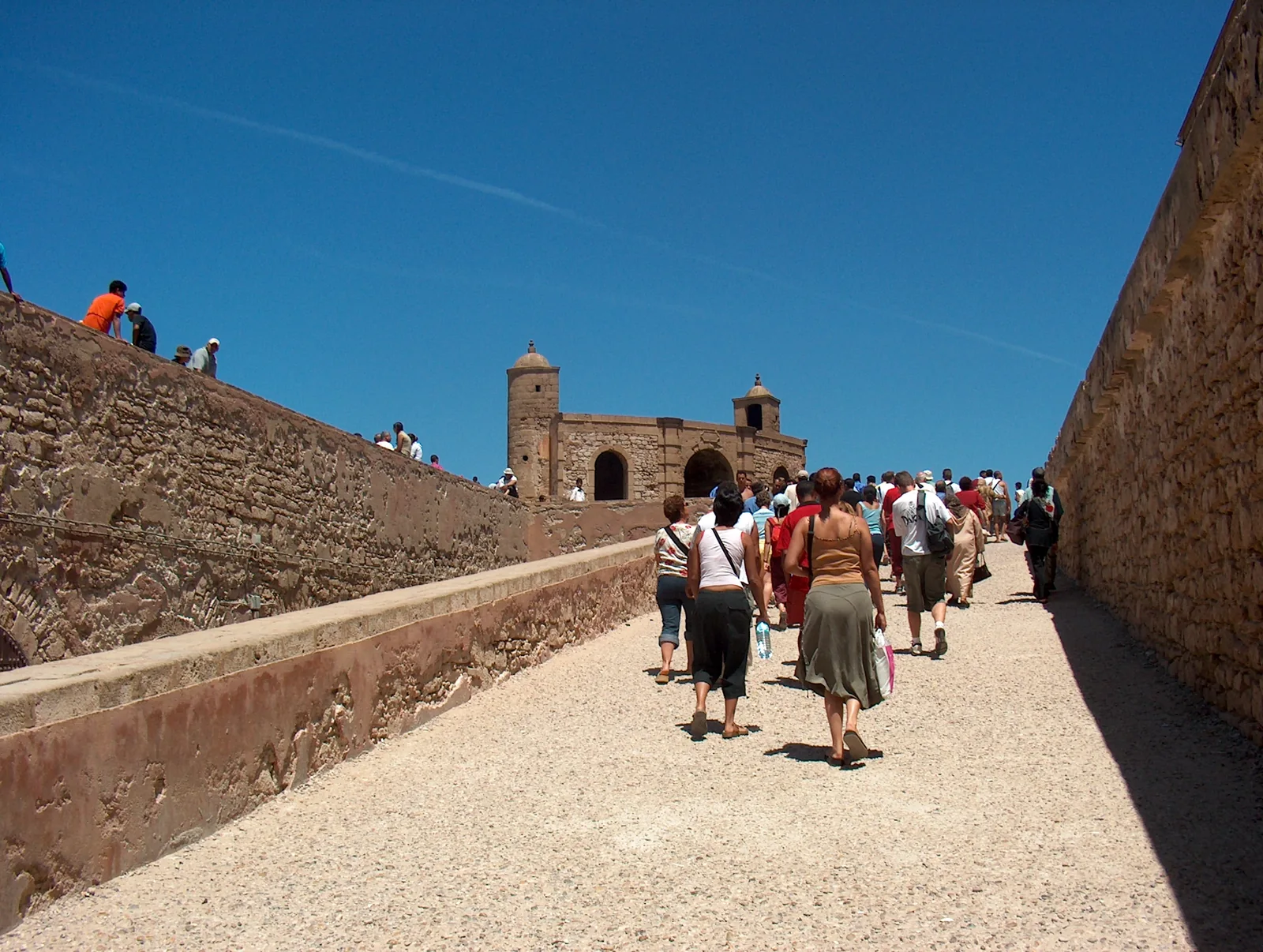
The medina Skala, also called Skala de la Ville, and the harbour Skala are different ensembles. Confusing them can create expectations of a view, entrance or visit located elsewhere. Identify the exact place on a map and check current arrangements before planning an interior or route over fortifications. Cannons and walls are understood through defence and coastal relationships; a photograph does not guarantee access to every level. Remain in permitted spaces and do not climb structures for a better frame. Wind and wet surfaces can change comfort. An accurate name is a useful starting point, but the actual entrance and permitted path still require attention when you arrive.
Seeing the harbour without obstructing work
Blue boats are familiar Essaouira images, but the harbour remains a professional space. Follow authorised access, keep clear of equipment, handling operations and vehicles, and leave passages open. Ask before portraits or close photographs of people working. A landing time mentioned elsewhere is not a guaranteed programme: activity and conditions change. If a section is inaccessible, observe from permitted areas rather than following another visitor beyond a boundary. With children or limited mobility, choose a short safe passage instead of assuming every surface and edge is suitable. The harbour’s interest includes its real operation, so respect for workers is part of understanding the place rather than a restriction separate from the visit.
Discovering workshops and cultural places carefully
Businesses may offer worked wood, textiles, decorative objects and other creations. Ask about origin, materials, care and order conditions before paying. An object displayed in Essaouira was not necessarily made in the workshop you are passing. Cultural places, including the Sidi Mohammed Ben Abdallah Museum according to visiting possibilities, can add historical context. Check programme and access with the institution or National Foundation of Museums. An open door alone does not permit entering a home or photographing inside. Encounters work better with clear expectations and an accepted refusal to buy or be photographed. Compare the actual object and service rather than relying on a broad claim that every item is locally produced.
Building the walk around breaks and the return
Medina, ramparts and harbour can be combined, but time depends on access, pace and stops. Place any booked visit first, then construct a short loop with food or rest. Keep the beach or excursion for another slot if adding it creates a race. Before a coach departure or airport transfer, allow the luggage route and meeting margin. The main guide locates areas; transport advice helps choose drop-off and collection. Understanding a neighbourhood matters more than preserving the planned number of stops when conditions no longer suit. A flexible walk can end at a known point with time to retrieve bags instead of finishing in an unfamiliar lane just before departure.