
Contents
- Begin with a practical point of orientation
- Treat Bilal mosque as an exterior reference
- Read civic buildings without promising visits
- Notice commerce and street movement
- Take clear photographs with considerate positioning
- Adapt walking to the actual day
- Separate the centre from regional scenery
- Keep the visit at a useful scale
Begin with a practical point of orientation
Exploring central Jorf El Melha starts with understanding an urban space in Sidi Kacem province. Do not assume that a small town necessarily has a monumental medina, fortifications or a signed heritage trail. The sources consulted do not establish such an offer. The useful starting point is your actual arrival: an address, drop-off point or agreed reference. Identify a return route that you can explain before extending the walk. This initial orientation can also help locate shops or services you may need, without expecting every useful building to be a tourist destination.
A short walk can still be attentive. Notice how housing, movement and commercial activity occupy the same street, without assigning a story to every façade. Stay where passage is permitted and do not enter private premises simply to improve a photograph. A map helps with direction but may not show a passage’s status or the steps at an entrance. With children or someone who walks with difficulty, prefer an understood route to a series of improvised shortcuts between points only visible from a distance. The objective is to discover the town comfortably, not to complete an arbitrary line on a screen.
Treat Bilal mosque as an exterior reference
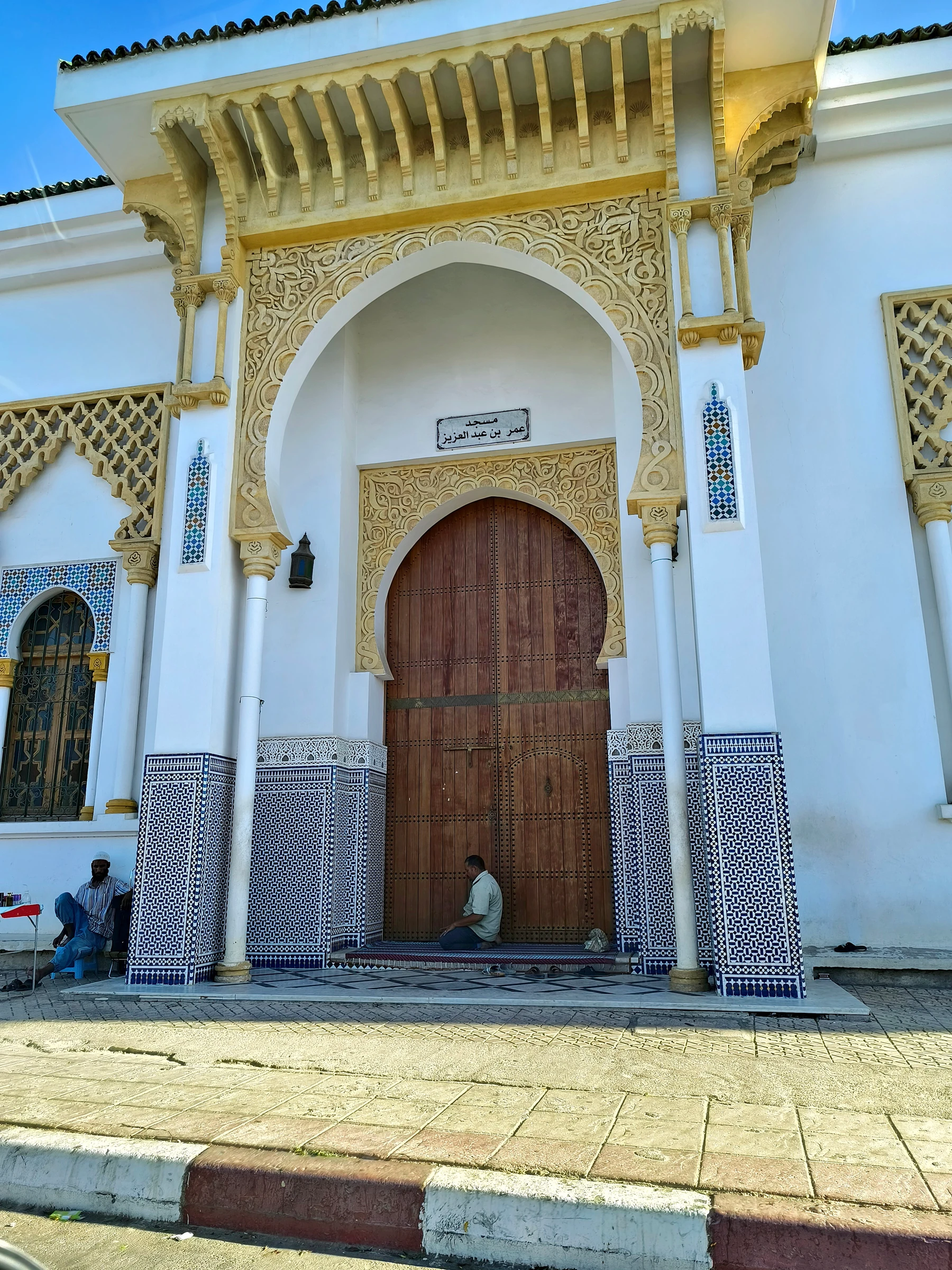
The selected photographs document Bilal mosque in Jorf El Melha in August 2024. The minaret view and entrance image show an identifiable building and its surroundings. They establish no construction date, heritage designation or right to enter. Observe the exterior from a permitted public position. If religious activity is taking place, keep an appropriate distance and leave access clear. An attractive door does not justify occupying the entrance, photographing people without agreement or expecting a building to open specifically because it has appeared in a travel guide or an online image collection.
Observation can focus on visible features: proportions, the relationship of entrance and street, or the minaret’s position in the urban scene. You need not invent a dynasty or precise architectural attribution to describe them. Looking calmly from a suitable position can reveal more than quickly collecting an image. If you want technical interpretation, seek a dedicated source rather than deriving a construction history from appearance. A present-day landmark can have visual interest even when its chronology is not established here. Separate what is recognisable in the photograph from what would require further research about the building itself.
Read civic buildings without promising visits
Another photograph identifies its subject, through the photographer’s description, as Jorf El Melha’s territorial community building. It adds civic context and illustrates the market article without being described as a market image. The photographed building is not offered as a tourist attraction. Inclusion in a guide confirms neither visitor reception nor unrestricted entry. Administrative business requires information appropriate to the actual procedure; an exterior view is enough for a town walk. This distinction prevents an ordinary public function from becoming an invented sightseeing service simply because a clear reusable photograph happens to be available.
The distinction matters where documentary images are more plentiful than detailed visitor notices. A carefully composed photograph does not turn a municipal office, school or shop into an attraction. Describe functions only where the source supports them, and remain cautious about present operation. Signs, hours and entrances may change after an image was taken. Keeping the date visible separates evidence from a current directory. A visitor can understand the town’s organisation without expecting every identifiable building to provide an experience specifically arranged for a passing group or to maintain the exact appearance recorded several years earlier.
Notice commerce and street movement
Permanent shops and a weekly souk follow different rhythms. A busy commercial street is not necessarily the event site mentioned in a source. If you seek something specific, ask its name and location rather than following crowds alone. During a general exploration, remain aware of deliveries, shopping and conversations sharing the space. Avoid gathering in front of an entrance or treating goods as photographic props. Giving everyday users priority allows encounters to happen more naturally. It also provides a more accurate impression of the place than attempting to clear ordinary activity from a supposedly picturesque frame.
For purchases, ask the price for the chosen quantity and the item’s exact nature. An agricultural regional setting does not establish municipal origin for every product. Ask if origin interests you and distinguish the answer from independent checking. This article guarantees no workshop visit, cooking lesson or craft demonstration. You can appreciate an object or ingredient without attributing a town-specific tradition to it. Accurate observation helps describe a real encounter rather than reconstructing a tourist experience afterwards. If a special visit is actually offered, it needs its own identified location, responsible person and understood conditions before being added to the programme.
Take clear photographs with considerate positioning
For a sharp image, first choose a stable permitted position and check focus. Enlarging a poor frame afterwards cannot establish missing detail. A composition showing the building in relation to the street may communicate more than an isolated doorway. Ask agreement when an identifiable person becomes the main subject, and respect refusal. Do not enter property, move merchandise or climb street furniture to reproduce an internet angle. Your perspective can differ while remaining informative. A successful photograph explains something visible without requiring others to interrupt their work or change the surroundings for your benefit.
The photographs published here are real and have visible sources and licences. Their colours and lighting belong to documented moments. An August 2024 image does not guarantee identical surroundings during your visit. In your own captions, distinguish known information about a building from simple observations. Avoid dating it from appearance or naming an interior room you have not visited. A modest correct description is more useful than a seemingly complete account built on assumptions. Keeping the location and date makes the photograph easier for others to interpret without encouraging them to infer an opening arrangement or service that was never confirmed.
Adapt walking to the actual day
A walk depends on current conditions, available shade and the group’s abilities. Detailed climate figures in a general notice do not replace a forecast for your visit date. Carry water and personal essentials, then adjust duration as needed. A pause can help you understand relationships between streets, movement and relief without accumulating distance. If the route proves harder than expected, return along a known way. There is no need to complete an imagined loop when its passages are not understood. The quality of the visit depends on attention and comfort, rather than the length recorded on a phone.
For reduced mobility, ask concrete questions about the pavements, steps and entrances your programme would use. Central or nearby does not explain a route’s accessibility. An address may be straightforward by vehicle yet require additional effort on foot. If assistance is arranged, clarify where it begins, its scope and the return, without assuming spontaneous help will be available. A limited number of well-chosen positions can still provide an interesting understanding of the centre. What matters is that those positions match actual needs and confirmed possibilities, rather than a broad assertion that the town is small and therefore easy for everyone.
Separate the centre from regional scenery
The Ouergha and Al Wahda provide essential geographical context, but they do not automatically extend an urban walk. Before adding a river sector or reservoir view, verify the exact destination, transport and a permitted stopping point. A photograph from the Taounate area is not a plan of central Jorf El Melha. A series of articles can gather subjects at very different scales. Their purpose is to explain those scales, not suggest that everything can be reached in a short walk from one starting point or during the same small gap in a longer travel day.
Ouezzane is another separate destination. Its medina and history should not be attributed to Jorf El Melha to expand a programme artificially. If combining the towns, prepare a distinct road stage and allow time for each. The same principle applies to Fez and Meknes. A linked guide helps arrange the continuation of a journey; it guarantees neither immediate proximity nor a direct service at a particular hour. Keeping those distinctions allows appreciation of the centre on its own terms, without measuring its interest against monuments belonging elsewhere or presenting a regional relationship as a local walking connection.
Keep the visit at a useful scale
A satisfying exploration can combine an exterior landmark, commercial streets and a pause, according to actual access. If the souk is the priority, use its dedicated article and confirm current arrangements. If merely passing through, limit the walk to the time remaining after vehicle or onward travel has been settled. The centre does not need a sequence of must-see attractions to be interesting. Its organisation and relationship with countryside already offer subjects for careful observation. A small amount of well-understood material can leave a stronger impression than a long checklist with uncertain names and invented historical explanations.
Before leaving, confirm the route back to luggage or the meeting point. Record names you know and leave undocumented elements open. The main guide connects this urban approach to market, water and stay planning. You can choose a next step without turning a short walk into a promise of a complete circuit. Aim to understand a few relationships between places and uses rather than collecting façades supplied with speculative stories. This also respects Jorf El Melha as a lived-in town. Its ordinary functions are part of the subject, rather than obstacles to be removed from the visitor’s preferred scene.
