
Contents
Understand the Souk El Tnine reference
The town notice mentions a large weekly souk associated with Monday and reports the name Souk El Tnine. This helps explain commerce within Jorf El Melha’s identity. It does not confirm unchanged arrangements for a future date. Before a dedicated journey, ask which day currently applies, where the market takes place and how to reach an appropriate entrance. A familiar name may persist in conversation while practical details, access or occupation of space have changed since an account was written. Treat the historical reference as a reason to ask useful questions, not as a complete present-day schedule.
Distinguish everyday shops from the weekly event. A street with stalls or stores need not be the particular site you seek. If time is limited, explain your request with the full town name and market subject, then identify the arrival point. Asking only for the market may be understood as another commercial area. The main guide places Jorf El Melha in Sidi Kacem province. Keep that location in mind when comparing travel-platform results or information from different towns, so that a useful market reference elsewhere is not accidentally adopted as a description of your intended destination.
Look for exchange rather than performance
A souk is a place of transactions serving people who work and shop there. It is not necessarily organised for tourist observation. The province’s agricultural setting gives context, without guaranteeing particular goods on your visit day. Do not expect a permanent demonstration, parade or fixed-time entertainment. First find a position where you can understand circulation without obstructing it. Relationships between products, transport and everyday needs are interesting in themselves. They can explain the place more effectively than searching only for a picturesque moment or expecting all activity to follow a visitor-friendly sequence designed for photographs.
When activity is dense, avoid stopping in the middle of a passage to consult a phone or gather your group. Watch from a suitable side and move if handling begins. Space available now may be needed immediately afterwards. Ask before touching goods or lifting an object for a photograph. If conversation starts, leave the seller free to serve customers. A short considerate exchange can be rewarding without turning someone into an unpaid guide or spokesperson for every regional product. The objective is to understand an actual transaction environment while allowing its ordinary work to continue around your visit.
Make arrival manageable
The appropriate drop-off depends on your transport and belongings. With bulky bags, arranging somewhere confirmed to leave them first can make exploration easier. Do not assume a locker, tourist car park or special entrance exists; none is confirmed here. If a driver waits, agree on a workable, clearly understood meeting place and duration. A saved address or reference can reduce confusion on return, particularly where several entrances are described by the same broad market name. The journey should end at an actual point both parties recognise, rather than at an undefined area described as near the souk.
Scale the visit to your day. Arriving late does not guarantee that activities described elsewhere remain present, while arriving early does not prove every sector is ready for visitors. Ask for a current indication rather than adopting theoretical hours. If operation cannot be confirmed, keep the centre as an alternative. A town walk and meal can make a worthwhile stop without chasing an image taken on another occasion or in another locality. This flexibility is especially useful during a longer route, when an extra detour would otherwise depend entirely on finding one particular event in precisely the form expected.
Buy with quantities and prices understood
Before paying, clarify the quantity, stated quality and corresponding price. A price by weight differs from one for an individual item or a whole group of goods. If an answer is unclear, rephrase and ask to see the portion concerned. The purpose is shared understanding, not turning a purchase into confrontation. No amount given here is presented as a current benchmark. Actual terms depend on the goods, date and transaction. A short precise exchange before agreement avoids more uncertainty than trying to compare the purchase afterwards with a price quoted in an old travel account.
Ask separately about origin if it matters to you. Being sold in an agricultural town does not necessarily mean grown within the municipality. A seller’s answer is received information rather than independent certification. Avoid inventing labels or superlatives in your account. For fragile products, consider remaining travel time and storage conditions. A purchase suited to your journey is more useful than a large quantity chosen mainly for a photograph or because a story describes it as essential. You can show interest without buying beyond what you can transport responsibly or attributing a distinctive local origin that has not been established.
Fit meals around the actual visit
If planning to eat during the visit, choose an option genuinely operating and ask what is served that day. Establish what the price includes and which parts are ordered separately. Particular dietary requirements need questions about ingredients and preparation, rather than reliance on a dish name alone. This guide claims no personally tested table and guarantees neither a town-exclusive speciality nor fixed opening hours. A straightforward understood meal may suit you better than a prolonged search for food mentioned in an older source without an exact address or confirmed availability for the date of your visit.
Allow time to return to your meeting place after eating. A pause that appears brief can expand with waiting, ordering and movement through the area. With children or people who tire quickly, keep the option to shorten observation. Carry water and personal essentials without assuming every required service will be available at every moment. The souk is part of a functioning town, not a route in which every stage has been arranged around the comfort of a passing group. Recognising that reality helps you decide duration and priorities while still leaving room to appreciate a relaxed encounter or meal.
Photograph without constructing a false scene
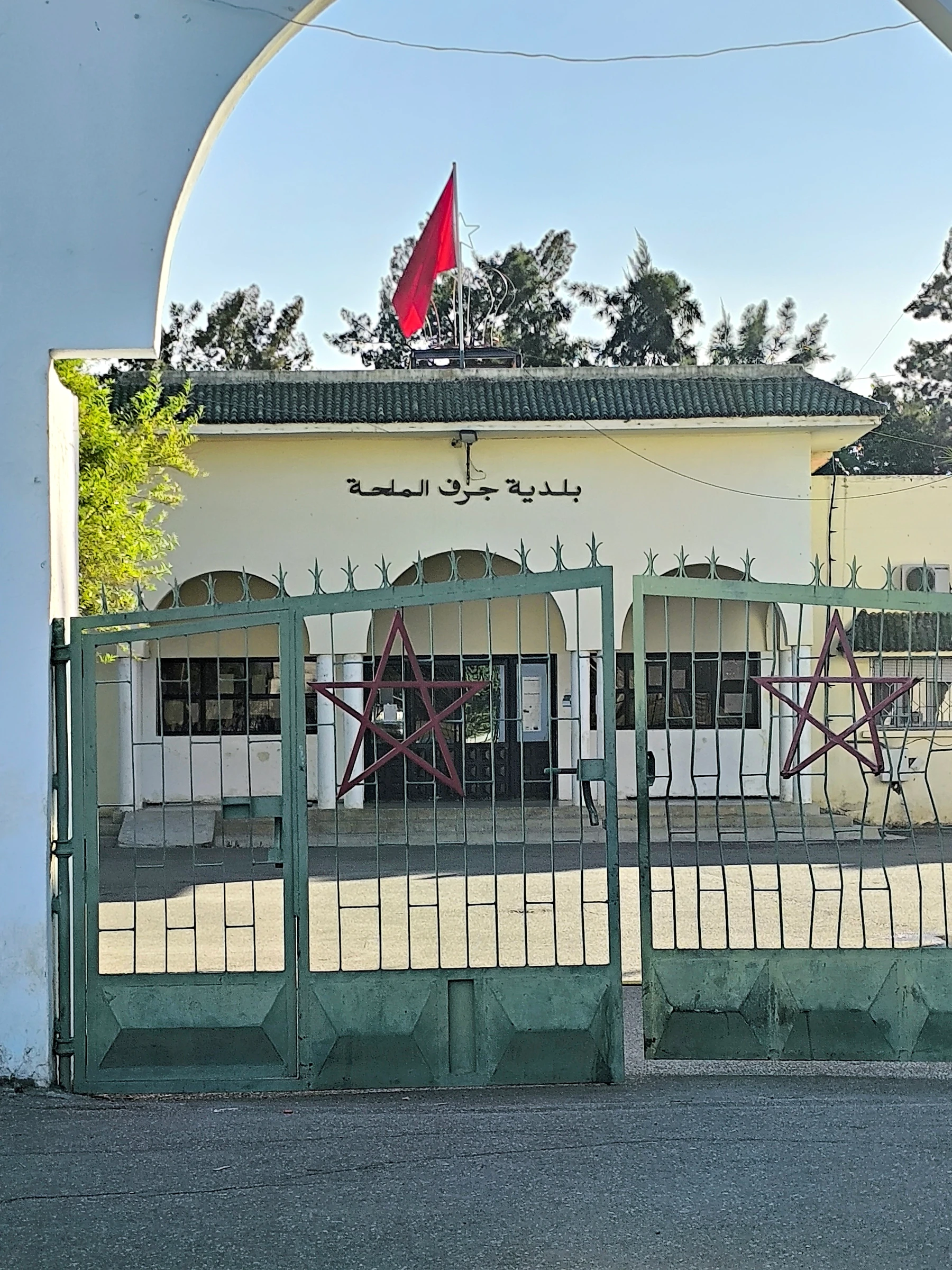
The image illustrating this article shows a building identified by its photographer as Jorf El Melha’s territorial community premises in August 2024. It is explicitly urban context, not a market view. No photograph from another souk has been relabelled to fill a gap in the verified selection. This choice provides a real local reference while keeping the subject accurate. A contextual illustration should remain recognisable as such even when it accompanies an article about trade. The presence of a photograph on the page must not be mistaken for proof that it records the event described in the text.
During your own visit, ask agreement before making an identifiable person the main subject. Do not rearrange goods to make a stall look more dramatic or interrupt a transaction. Wider views may explain organisation without imposing a scene on people present. Keep place and date in captions, distinguishing a sector actually observed from information received. Old photographs guarantee neither the same goods nor the same sellers and installations on another day. Precision is more useful than a promise of authenticity based on generic imagery. A clear description allows another traveller to know what the photograph does and does not document.
Relate the market to farming country carefully
Sidi Kacem province has an important rural and agricultural setting. This helps explain why local trade can interest a visitor to Jorf El Melha. It does not establish a public farm visit, production tour or workshop included in a walk. If an activity outside town is proposed, identify its location, responsible person and conditions before adding it. Cultivated land is not automatically accessible, and meeting someone at a market does not authorise freely following them to a property. A regional economic relationship needs to be distinguished from a specific visitor service actually offered for your dates.
The Ouergha valley gives another perspective on water, land and movement. Its article remains separate from the souk visit. A river photograph taken around Taounate does not show an outing route from the stalls. If combining subjects, arrange a separate journey to a permitted destination with a return. You can connect the ideas without inventing practical proximity. Understanding a territory does not require visiting all its components in one day or presenting every economic connection as a bookable excursion. Sometimes the town observation and a regional reading complement each other without any additional movement being necessary during the actual stop.
Leave with a precise experience
Before extending shopping, verify your departure time or conditions. A reserved ride, shared vehicle and continuation in your own car require different arrangements. Clarify the meeting rather than relying on an unconfirmed last opportunity. If the market is not your only objective, keep additional wishes proportionate to remaining time. Centre, pause and a well-managed journey may be enough. The stop becomes better when it respects the rhythms of people encountered as well as your group’s needs. Not every interesting conversation needs to become a longer visit or an extra commitment beyond what has actually been agreed.
When describing the visit, say what you saw or bought and what someone explained. Do not turn one transaction into a general truth about every Jorf El Melha product. The main guide, centre article and stay guide offer other questions for preparation. An interesting souk need not become a monumental attraction or a compulsory sequence of highlights. Its value lies in real exchanges at an identified place, with a date and understood conditions. That precision makes future planning easier and memories more accurate, while leaving room for a later visit to reveal different goods, circumstances and experiences without contradicting a falsely universal account.
