
Contents
Begin with an inhabited neighbourhood
Ksar El Kébir’s medina is a place where people live and work. Streets, thresholds and shops have purposes independent of travellers passing through. It is not one monument with every part open to the public. A respectful walk begins on authorised routes and keeps an alternative when a passage appears private. An open doorway or visible courtyard is not permission to enter. Ask before crossing a boundary and accept the response. This leaves residents control of their space while visitors still learn from what can be seen outside.
The town appears under several spellings, including Alcazarquivir in Spanish sources. These variations can connect older reading with today’s place, but cannot date every building. Nor does ksar advertise a single palace to visit. For orientation, associate a sector name with a precise point and retain a recognisable return. An understood plan is more useful than a collection of historical names with uncertain locations or current uses. Practical bearings help preserve attention for the town rather than turning the walk into continuous searching for a vaguely described landmark.
Read transitions rather than seek a stage set
Notice how a commercial street, narrower passage and open space organise different movements. Shade, thresholds and façades offer clues without requiring a historical attribution for every detail. A recent repair can belong to the neighbourhood’s life. Avoid imagining a medina frozen entirely in one period. Changes make observation more interesting when older forms, adaptations and uncertain details remain distinct. There is no need to identify everything immediately. Looking carefully at a short section can explain relationships better than attaching an unsupported century or architectural label to each wall.
Keep the first outing limited. Choose an identifiable start, one main area and a pause instead of improvising a loop through passages with unclear access. With children or less mobile companions, check surfaces, obstacles and return possibilities concretely. A photograph of one flat street does not establish accessibility throughout a route. A short, understood walk leaves more attention for urban uses than a long journey dominated by searching for exits. The programme should fit the people present rather than requiring everyone to continue across uncertain ground simply to complete a planned circuit.
Observe commerce without interrupting it
Commercial spaces reveal products, tools and exchanges that contribute to the town’s character. Watch circulation and avoid occupying a whole passage for photographs. A seller is not automatically available to explain every object. One specific question at a suitable moment may produce a rewarding exchange, and a brief answer can be enough. Let business continue rather than expecting each person to become part of an arranged visitor programme. Respect is also shown by moving aside, accepting limited time and recognising that a working setting has priorities beyond the interest of travellers.
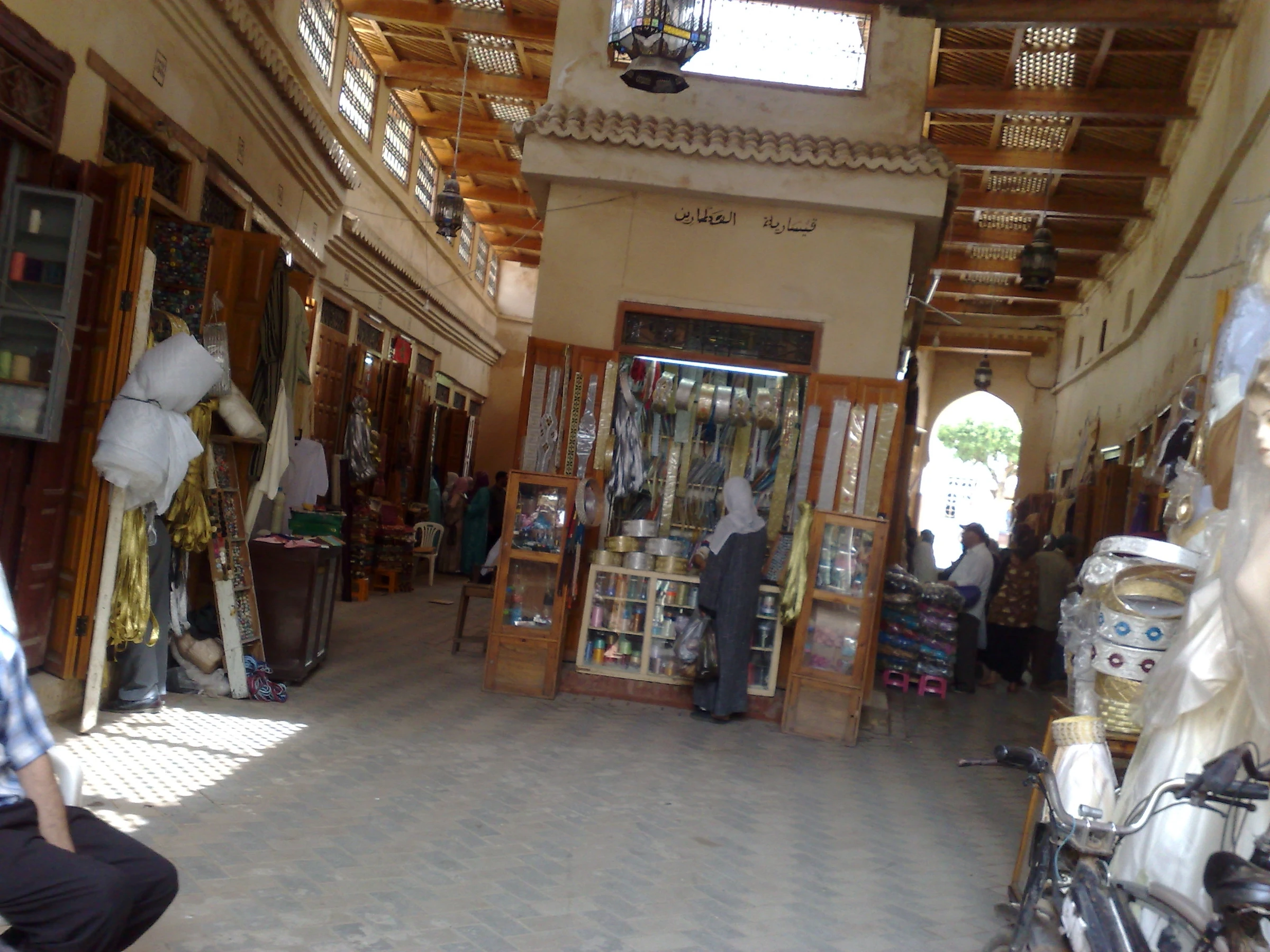
The photograph illustrating this article documents a market space in Ksar El Kébir. Its date and credits are visible, but it guarantees neither current shops nor stock. Before buying, clarify quantity, relevant materials and total price. No seller is described as personally tested. An older setting does not certify local production or quality. Information about the item actually offered should guide the choice rather than the atmosphere around it. A careful purchase can remain enjoyable without turning the market’s appearance into evidence for claims that have not been confirmed for the particular product.
Give purchases and meals their own attention
Separate browsing from deciding to buy, so a business is not kept occupied while the group is still working out what it wants. Agree a meeting point without obstructing entrances. For food, ask about ingredients, packaging and storage. An artisanal appearance does not answer an allergy question. Make specific enquiries and keep an appropriate alternative if information is uncertain. The place where something is sold also does not prove its origin. Clear details help connect an encounter with an informed decision instead of a general assumption about everything offered in an old neighbourhood.
Meals require direct confirmation too. A speciality mentioned in a cultural description is not necessarily available everywhere or at every hour. Ask what can be served, when and under which conditions before making the day depend on it. No fixed price, permanent menu or inspected restaurant is invented here. A pause arranged from current information makes the programme more flexible, especially with children or a group. It prevents the end of a long walk being dominated by a search for a service that had only been assumed to exist at the right place and time.
Approach heritage with proportionate sources
Ksar El Kébir has medieval history and varied inheritances, described with different degrees of certainty in general sources. A useful reading does not turn a foundation hypothesis into fact or architectural resemblance into an exact date. If interested in a building, ask for its identity and the basis of the explanation. A local story can be valuable while remaining a story. Keep documented information, reported tradition and personal interpretation distinct. A wall or name seen during a walk cannot by itself establish the full history of a structure or its association with a particular episode.
Religious buildings have their own access rules. A mosque or shrine cited in a text does not automatically provide entry, a minaret climb or an accompanied interior visit. Remain in authorised spaces and avoid obstructing people attending for religious purposes. An exterior explanation may satisfy architectural curiosity. No interior is promised here. Another traveller’s earlier experience does not replace present permission at a specific place. Conditions can differ, so the programme should adapt rather than treat a published anecdote as a continuing right of access for everyone arriving later.
Write captions that remain honest
Ask before including identifiable people and before photographing inside private property where you have been invited. Permission to approach an entrance does not imply permission to publish everything visible beyond it. In captions, name only places you have actually identified. A simple street view in Ksar El Kébir is better than an invented palace or period. Record the date so your image does not become evidence of an assumed permanent state. Accuracy matters because later readers may use shared photographs to prepare routes or repeat historical attributions that you never intended to certify.
Site photographs show author, source, licence and changes. These details support lawful reuse, but are not building expertise or current access confirmation. An older view can remain useful when its scope is understood. Use it to prepare questions and recognise context, then check what can actually be observed during your stay. Repeating an image across several pages does not make it newer or validate every attached caption. Visual references and practical arrangements complement one another without becoming equivalent, and the distinction helps keep expectations matched to what a source can genuinely establish.
Connect the medina with regional history
The Battle of the Three Kings on 4 August 1578 is linked with the area around Ksar El Kébir and Wadi al-Makhazin. It should not be placed arbitrarily in a present medina street. Alcácer-Quibir connects the town with Portuguese accounts, but not every visible building becomes a battle survivor. The history article explains principal protagonists and limits of localisation. Reading can deepen the subject without turning an urban walk into an undocumented military route. A contemporary setting can provide context while remaining distinct from the exact topography of a sixteenth-century encounter.
The Loukkos is another reference at territorial scale. Its mouth is at Larache, a separate town. Ksar El Kébir’s medina is therefore neither an Atlantic port nor the ancient site of Lixus. Keeping this clear prevents transferring places between destinations. Guide links support separate preparation. Their closeness in a regional account does not mean they can be joined without transport, time or access checks. The relationship becomes more interesting when each setting retains its own history and practical requirements, rather than being compressed into one imagined walk around a single town centre.
Choose a coherent continuation
After urban walking, a pause and historical reading may suit the day better than another journey. Attention matters as much as distance. For Larache or Lixus, keep one main objective and verify current arrangements. Lixus’s UNESCO Tentative List entry does not become World Heritage status for Ksar El Kébir’s medina. Every reference should remain attached to its actual place. Such precision enriches neighbouring discoveries while preserving their identities. It also avoids a programme shaped by impressive labels instead of understanding where a site is and what is currently possible there.
If accompaniment is offered, clarify language, subject, duration, cost and included locations beforehand. A general town discovery does not mean access to every property or religious building. Ask what will be explained outside and which permissions are confirmed. This article guarantees no regular departure or provider availability. A concrete agreement for your date is more useful than a broad phrase interpreted differently by traveller and companion. It allows the content to match the group’s interests without relying on imagined interiors or a route whose actual conditions were never discussed.
Return easily to your base
Locate accommodation before setting out and keep a contact available offline. An address described only within Larache Province is too broad; confirm the town and final approach. If someone wants to return earlier, provide an understood option rather than an approximate direction. This flexibility contributes to comfort. A recognisable base lets companions observe at their own pace without requiring identical energy and interests throughout the day. It also makes a shorter outing easier to choose when the group discovers that conditions differ from the original expectation.
Carry drinking water and adapt duration to the weather. Surfaces, exposure and pause opportunities should be assessed for the people present. Do not promise universally easy walking from a memory or one photograph. Shorten the programme if conditions do not suit. A thoughtful visit to one sector can be complete in its purpose without crossing the entire medina. Staying on understood routes prevents a search for shortcuts that may lead to private or unsuitable places. The walk remains rewarding when practical decisions leave enough attention for what can be observed respectfully.
Use the connections between articles
The main guide relates urban discovery to history, Loukkos landscapes and separate Larache and Lixus stages. The stay article covers transport, address and departure arrangements. Changing language retains the same subject, making preparation easier to share with companions. Use the structure for choices, not a compulsory checklist. Places mentioned in a source are not all advertised visits; some provide context for what can be seen from public space. A flexible reading allows the programme to remain coherent when a location stays private, an activity is unavailable or a shorter route fits better.
Ksar El Kébir’s medina becomes more meaningful when its present uses are accepted. A closed door, busy shop or short conversation does not reduce its interest. They show that the neighbourhood continues independently of a visitor programme. Asking before entering, captioning accurately and retaining an easy return support a respectful discovery. The purpose is to understand a few relationships between forms, activity and history, without inventing exceptional access or expecting every visible feature to become an organised service. This approach can produce a precise memory even from a limited area explored with care.
