
Contents
Locate the extension west of the medina
The Ensanche lies west of Tetouan medina. The name identifies an urban extension associated with the Spanish protectorate and a fabric different from the old town. Begin by locating the transition instead of treating every white façade as part of one period. Differences involve building lines, street width and apartment forms, but current uses connect both ensembles within one inhabited city. Looking at the change in street structure is a useful introduction even without detailed architectural knowledge, and avoids expecting an entirely separate museum district detached from the rest of contemporary Tetouan.
Spellings and local names can vary; Ensanche also appears in Spanish-language accounts. Save an exact point for meetings, such as an identified square and the side where you will wait. A district name covers too much space for a reliable drop-off. This exploration uses public streets without assuming access to buildings. It offers ways to read architecture, rather than an exhaustive inventory of open interiors or a timed route personally checked on foot. Select a few observations suited to your interests, keeping the freedom to pause or shorten the session when conditions change.
Connect the district with the protectorate period
Tetouan was the Spanish protectorate's capital and returned to independent Morocco in 1956. This explains an extension with forms different from the medina, without reducing the entire city to a colonial episode. A façade needs its construction context and subsequent uses. Some buildings have been rehabilitated or altered. Observe surviving elements and visible changes rather than describe every street as an untouched early twentieth-century setting. The historical importance of a place does not require denying maintenance, new uses or the changes made by people who have continued living and working there.
Compare ways of arranging space: regular axes, buildings' relationship to the street, façade height and shops at pedestrian level. These make urban history legible without entering offices or homes. They do not independently attribute every property to an architect, year or precise movement. If those details matter, seek documentary references or a specialist visit that identifies evidence rather than accepts a date based on resemblance. You can take useful notes about windows and entrances while leaving uncertain attribution open; a good architectural walk need not turn every observation into a definitive historical classification.
Use Moulay El Mehdi square as a landmark
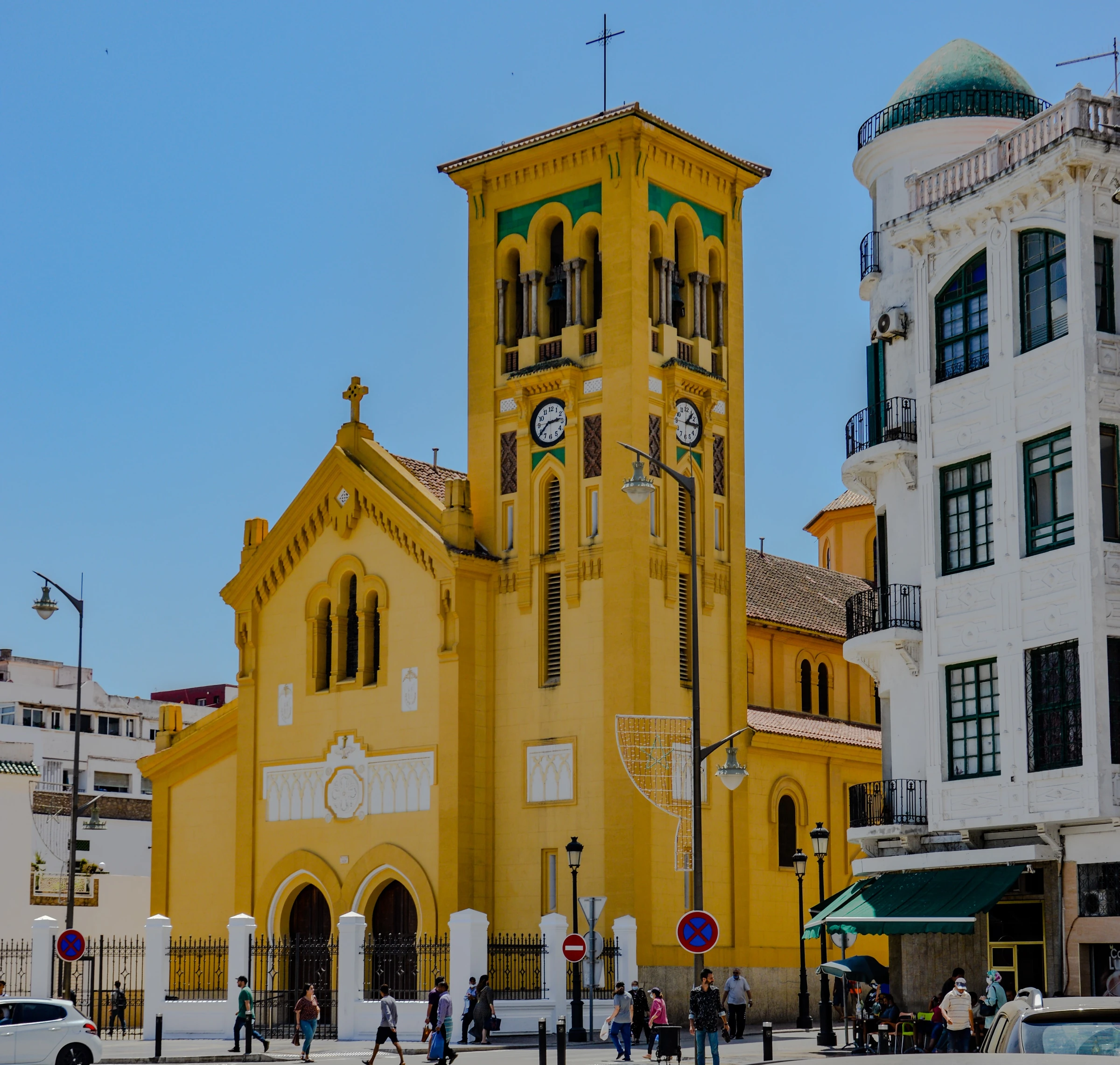
Moulay El Mehdi square is an Ensanche reference point. The Church of Our Lady of Victory is identifiable there in sources and photographs. Observe its façade within the wider space and the way adjoining streets connect. A broad view explains urban role better than an isolated tower frame. Choose a safe stopping place: a favourable angle does not justify standing in the carriageway or interrupting ordinary passage. Looking at the whole square also helps distinguish the building's architecture from the present arrangement of traffic, shops and people using the surrounding area.
The square is not only a monumental scene. It supports movement and contemporary neighbourhood life. Shops and terraces have operators: ask directly about a break or a specific facility. An old image may show different traffic or landscaping. For comparison, concentrate on enduring volumes and relationships instead of expecting identical scenery. Specify a side or accessible point when meeting someone, because the square's name alone leaves several possibilities. A screenshot can clarify the arrangement without depending on live geolocation, especially when travellers arrive from different streets or one person is returning from a museum while others have rested.
Observe the church from permitted space
The consulted encyclopaedic account dates the church's consecration to 1925 and identifies it as an Ensanche landmark. That is historical evidence, not confirmation of services, visiting hours or interior access on your date. From outside, look at composition, frames, volumes and the relationship with the square. The encounter can remain entirely exterior. If entry is offered, check conditions with the person responsible and respect religious use rather than treat the building as an unrestricted museum. A closed door does not prevent studying the façade or understanding how the building contributes to the district's structure.
Architectural interest benefits from precision. A motif or form suggesting several traditions does not justify reducing the whole building to one simplified label. A photograph documents an exterior at a particular time, rather than proving each detail's authenticity or the interior's present condition. Avoid excessive wide-angle distortion when studying proportions. Step back only where pavement or square allows it, and clean the lens to preserve details in bright surfaces. A smaller, accurately framed view from safe ground is better than a dramatic composition made while blocking access or stepping into moving traffic.
Learn to read ordinary façades
The Ensanche is not limited to its church. Buildings and ground floors show how trade and housing interact in the extension. Compare repeated windows, balconies, entrances and occasional setbacks. A modest façade becomes informative within the line of its neighbours. Ask concrete questions: where do stairs begin, how is the street edged, what room remains for pedestrians? These observations need neither jargon nor unverified claims about original functions. They can also reveal why the current shopfront and the upper façade should not automatically be dated or interpreted as the same architectural intervention.
Halls and staircases may be private or professional spaces. Do not enter simply because a door is open or photograph through residential windows. For an arranged specialist visit, establish permissions and content. Present signs do not reconstruct every previous activity. This article encourages attentive reading from accessible places, allowing understanding without making residents responsible for welcoming every visitor inside. Leave ordinary entrances clear, including when stopping to compare photographs. The town's continuing use is part of its interest, not a practical inconvenience to remove from the scene before it can count as architectural heritage.
Compare the Ensanche with the medina
Comparison becomes useful when you choose a theme rather than a value judgement. In the medina, consider passage hierarchy and residential access; in the Ensanche, look at alignments and façades along more regular streets. Both include commerce, housing and circulation but organise them differently. This avoids opposing a living old town to a characterless new one. The twentieth-century district also has history and transformations worth exploring. A shared question, such as the relationship between street and home, can create a stronger connection between the two walks than a long list of unrelated buildings.
UNESCO inscription concerns the medina within the framework and characteristics described by the organisation. It is not a general label for the whole Ensanche or municipality. When sharing photographs, name the ensemble shown. That distinction helps other visitors choose routes and understand Tetouan's layers. It does not require artificially separating the day: you can pass between districts with rest and a map while preserving historical precision. Keep notes on where a comparison was made, rather than later combining photographs under one broad caption that suggests every building belongs to the same period or protected urban fabric.
Compose a comfortable walk
Choose a clear start, a few observations and a return point instead of a lengthy address sequence. Moulay El Mehdi square can anchor exploration of nearby streets according to map and interest. No times between points are guaranteed here. Crossings, stops and traffic affect comfort. With a pushchair or mobility aid, ask about pavements and continuous crossings. A street wider than a medina lane is not automatically accessible throughout. Specify the approach you need rather than assume the district's more regular plan removes steps, kerbs or other practical obstacles for every traveller.
Adapt timing to actual light and weather. Pale façades can create strong contrast; another camera orientation may make volumes clearer. Carry water, schedule rest and ask about necessary facilities before settling in a business. Groups can agree on a meeting point when interests diverge. You may combine an architecture session with a museum without expecting everyone to walk continuously beyond comfort. Allow time to sit and review a few images or notes: this can improve understanding more than an extra block visited while tired, especially when the next part of the day involves another unfamiliar journey.
Connect the walk with a cultural stay
The arts and museums article extends built-form exploration through creation and collections. It helps choose visits around interests while checking current exhibitions and arrangements with institutions. A façade cannot explain all of a town's cultural life. Connections between craft, teaching and visual art offer another perspective. For specialist accompaniment, specify expectations and ask how buildings or works will be documented rather than accept only a promise of secret places. A reliable explanation of an accessible ordinary building may be more valuable than exclusive access whose permissions or historical claims remain unclear.
For later stages, Tamuda introduces antiquity and the coast a separate Mediterranean programme. Avoid overloading a day already containing medina and Ensanche: a good comparison depends on time for each. The main guide supports accommodation and arrival choices. Links to companion dossiers preserve subject when changing language, helping travellers continue together. You can leave with a clearer understanding of Tetouan's urban layers without reducing its identity to one style or isolated monument. The aim is a coherent reading of the town, with enough room for contemporary life and the questions that individual streets raise during the visit.
