
Contents
- Read a late nineteenth-century fortified town
- Use a gateway as a practical starting point
- Observe El Mechouar as a changing square
- Understand the spring and the role of water
- Study thresholds and architectural details
- Build a loop that works in practice
- Work with the light and photograph respectfully
- Link heritage with daily life
Read a late nineteenth-century fortified town
Tiznit's medina belongs to the urban initiative of Sultan Hassan I, with foundation in 1882 and the enclosure associated with 1883 in the consulted account. These dates establish a useful historical scale: the ramparts should not become an undated medieval backdrop. The territory had an earlier history, and street uses continued to evolve after the fortified ensemble was built. Exploring is more rewarding when you connect that documented framework with visible forms, while accepting that a present façade may reflect repairs, altered uses or a later stage of development.
Look at the continuity of walls, their interruptions and the passages through them, rather than seeking only a gateway photograph. An enclosure arranges relationships between inside and outside, neighbourhoods and approaches. Its presence does not imply that a public path runs along its top or around the entire perimeter. Stay in open areas, respect barriers and do not treat a gap as an invitation. Works and contemporary traffic may require a change of route; that is part of visiting a living town rather than a site frozen for tourism.
Use a gateway as a practical starting point
Bab Aglou is identifiable in photographic documentation of Tiznit. Its name can help anchor the beginning or end of a walk, but is not a complete instruction for meeting a vehicle in traffic. Save which side of the passage you mean and agree on a place where stopping is permitted. To study the architecture, observe the gateway's volume, the visible depth of its passage and its connection to the adjoining wall. Avoid standing in the middle of an access route still used by residents and other vehicles.
Gateway names may appear in different transcriptions on signs and applications. Show a photograph or exact map point when a direction is ambiguous. Do not arrange an exhaustive sequence of gates merely to fill a circuit: what connects them and the time available matter too. A short loop that you understand and enjoy is preferable to an unnecessarily long peripheral walk, particularly when sun, baggage or your group's needs affect comfort. Keep the option to return to the same clear landmark if you decide to shorten the visit.
Observe El Mechouar as a changing square
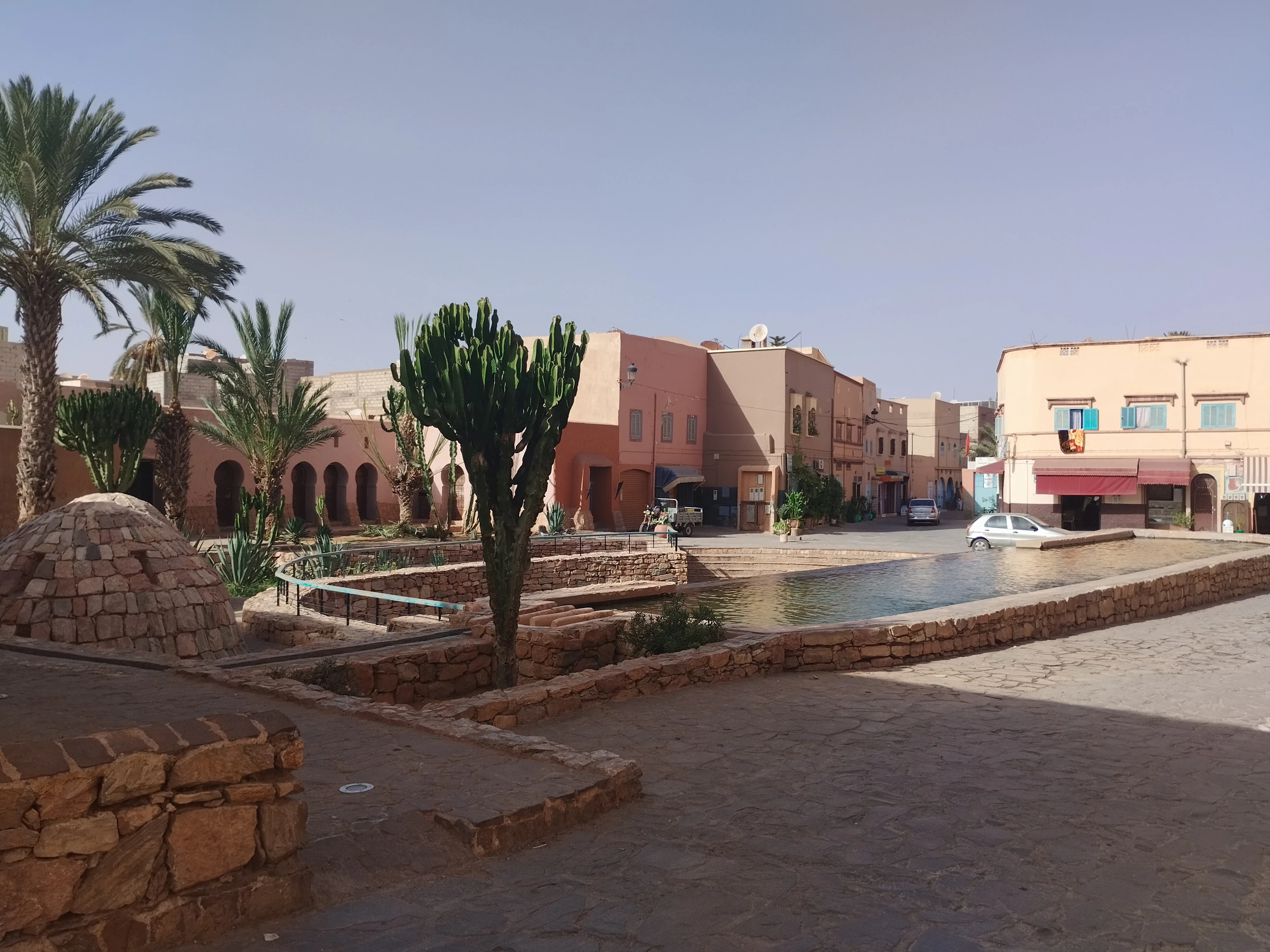
El Mechouar is one of the town's central spaces. The historical source discusses Hassan I's palace and buildings associated with the protectorate around the square. These references support questions about political and urban functions; they do not prove that every entrance welcomes visitors. From permitted public space, study façades, proportions and the way streets open onto a wider breathing space within the medina. Avoid assigning a current function to a particular doorway unless you have checked it independently, especially when the building has undergone changes.
A square is also a place for ordinary movement and exchange. Activity photographed several years ago may no longer describe the present layout. Consult your map or prepare a photograph somewhere that does not obstruct passage. Shops and terraces, when open, belong to operators whose conditions should be asked directly. A drink or meal does not automatically include a rooftop view, toilets or access to an interior courtyard. If one of those facilities is important to your visit, establish it before sitting down or agreeing to any charge.
Understand the spring and the role of water
The Blue Spring is a historical landmark in the medina. The Tiznit account connects the arrangement of neighbourhoods to a source that once irrigated gardens, while also noting a reduction in flow. Treat the relationship between water and town as a history to understand, rather than promise abundant water or an unchanging colour. Basins, planting and built surfaces visible today may reflect successive interventions. A careful description can distinguish the historic role of the spring from what is actually visible during a particular visit or photograph.
Approach it as an urban place to observe, rather than a bathing area or a source of necessarily drinkable water. Reflections, level and maintenance vary. A clear photograph helps locate a basin but should never override restrictions present on the day. When seeking a fuller historical explanation, ask your interlocutor to distinguish a local tradition from a dated documentary fact. Both can contribute to understanding a place, but they do not have the same evidential status. Record an uncertain story as a story, instead of repeating it as an established event.
Study thresholds and architectural details
Photographs of Kasbah Aguenaj show a doorway within an ochre façade. They document a particular exterior, rather than an exhibition open permanently to visitors. Such a detail encourages attention to frames, steps and plaster textures without inventing a tour. If entry is offered on site, ask who organises it, which parts are accessible and what photography rules apply before crossing a threshold or paying. A known building name does not establish today's opening arrangements, and an exterior picture cannot support claims about rooms you have not verified.
Along residential streets, doors and windows also belong to inhabited spaces. Step back without aiming into a home and ask permission before photographing a person. An attractive setting does not make a private passage public. Avoid touching old plaster or leaning against fragile details to compose a shot. Architectural details often make more sense when related first to their whole façade and then to the street, rather than isolated as ornaments. Leave room for residents to come and go without having to navigate around a visitor's equipment or group.
Build a loop that works in practice
A simple proposal is to connect a chosen gateway, El Mechouar and the Blue Spring, then return through trading streets. Check their order on a map against your own starting point; this guide supplies neither a measured track nor guaranteed times between landmarks. Keep a return option if a passage is closed. Several street alternatives may exist, and asking a short question towards a named destination is often clearer than reciting an entire itinerary. Save useful points offline rather than depending on a continuous data connection throughout the walk.
Schedule a break before extending the loop. Perceived distance depends on sun exposure, stops and ground surfaces as well as metres covered. Travellers with reduced mobility should ask about steps, kerbs and possible nearby drop-offs; no general accessibility certification for the medina has been established here. With children, agree on a visible meeting point and explain how to regroup after a temporary separation. Keep any instructions age appropriate, and avoid allowing the desire to see one more gate to override the comfort or attention of the group.
Work with the light and photograph respectfully
Side lighting can reveal the volume of walls and relief of façades, while a high sun may hide detail in a gateway's shadows. Adapt to the actual scene rather than a supposedly ideal hour valid all year. Clean the lens, steady the camera and avoid excessive digital zoom. A well-exposed photograph with a secure location is more informative than a dramatic effect that erases the wall's material. If the contrast is difficult, try a different viewpoint instead of forcing an image from the middle of a busy passage.
Portraits and working scenes require prior consent. If somebody declines, put the camera away and continue. Do not block a shop or step backwards into traffic for a composition. You can ask and record a building's name, but do not turn an unverified answer into a historical certainty later. Photographs in this article identify creators, sources and licences; they may come from a different period and therefore establish neither the current condition nor today's access. A useful caption describes the scene and its limits as carefully as the image itself.
Link heritage with daily life
The medina is more than its enclosure. Shopping, conversations and residents' journeys give meaning to streets connecting architectural landmarks. Observe the relationships between a gate, an open square and commercial activity while remaining discreet around private spaces. You can add an introduction to silverwork, but distinguish looking at a display from visiting a workshop. The dedicated craft article develops this dimension without assigning services to unverified businesses. A slower pace can reveal patterns of movement and scale that disappear when you hurry from one named sight to another.
Finish at your starting point or an agreed vehicle pickup, allowing a margin before any regional departure. A medina walk can be the main focus of a half-day without requiring Aglou or Tafraout as additional objectives. If staying overnight, return to a detail in different light rather than walking beyond your comfort. The main guide covers arrival and local transport, while companion articles discuss meals, purchases and separate excursions. Plan from the time and energy actually available, not from an assumption that every nearby name must fit into one sightseeing session.
