
Contents
Choose a walk that fits your group
A Youssoufia walk need not begin with a monumental itinerary. Start from your accommodation or a public place whose address you understand, then choose a loop the group can shorten. The interest is the inhabited town: façades, planted spaces, movement and shops. This particularly suits a travel stop when you want an introduction without devoting the entire day to transfers between distant places or following an unverified list of attractions.
Save two or three return streets on an offline map before leaving. Every stop need not be planned, but know how to return if heat or tiredness develops. Straight-line distance says little about crossings and pavements. With a pushchair or reduced mobility, ask about the actual route rather than accepting a general assurance that the centre is nearby. The final entrance and the street approach can matter as much as distance.
Travel lightly and choose your pace
Travel lightly with water, a charged phone, sun protection and accommodation details. After a regional arrival, leave luggage somewhere agreed rather than carrying everything through the walk. Being able to stop easily improves the experience. No specialist equipment is needed for an ordinary urban outing, but personal habits and group needs matter, especially when different generations travel together. Prepare for a comfortable discovery rather than packing for every possible activity at once.
The right pace is not measured by street count. Looking closely at one area can reveal more than crossing the town quickly. Agree whether companions most enjoy buildings, photographs, small purchases or sitting down. A shared priority makes detours easier to choose. It also avoids discussing an undefined programme at every junction, with one person trying to cover ground while another expects a slow afternoon and regular breaks.
Specific scenes in the townscape
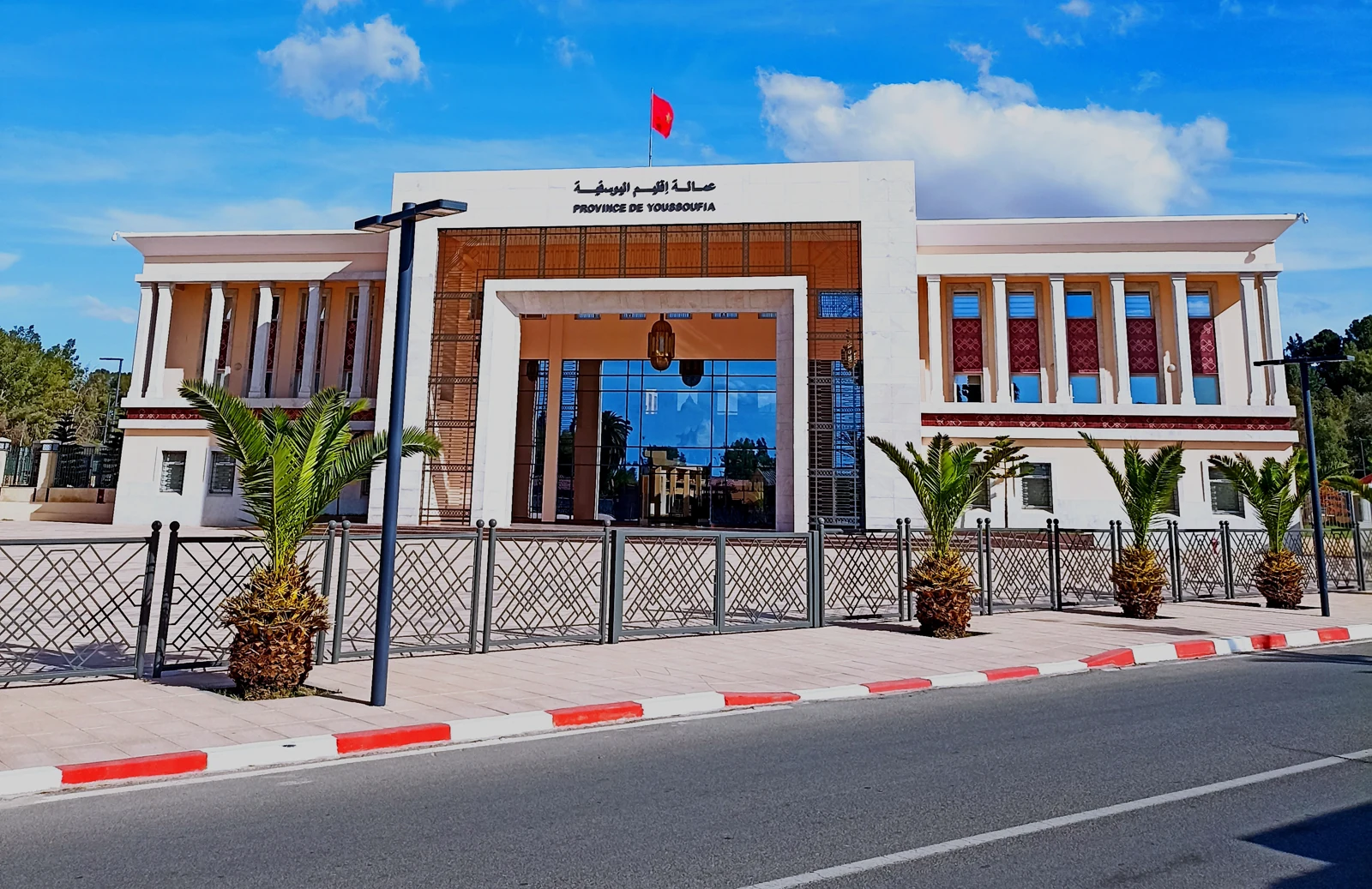
A photograph taken in 2023 shows a white and ochre building clearly bearing the words Province de Youssoufia. Its glazed central entrance, broad surrounding frame and planting in front offer a view of the town's administrative role. Youssoufia is the seat of a province created in 2009. The image identifies a building without establishing its construction date or any tourist reception. It is a distinct visual reference, rather than evidence that every civic structure belongs to an older mining period.
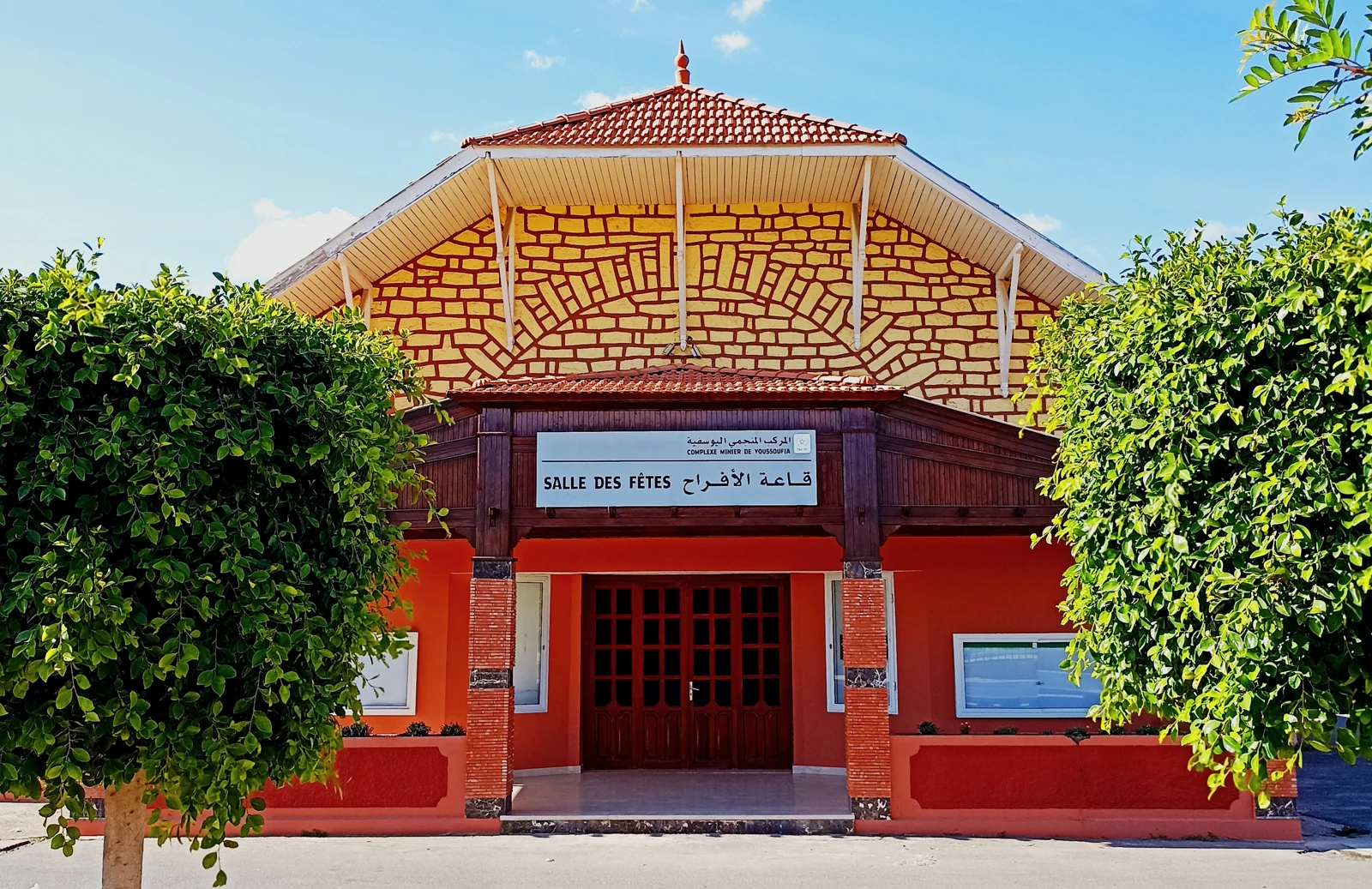
The events hall appears in another image from the same series, with its name legible above the entrance. A red façade, geometric decoration beneath the roof and trees framing the doorway create a different scene from the provincial building. Colour and volume are worth observing without assuming an exhibition or performance on your visit date. The sign documents what was photographed in 2023, rather than confirming a current programme or a visitor service.
Red roofs, palms and a minaret
Another building is recognisable through its sloping red roof, light walls and angled elements around its exterior. Paving, trees and outdoor furniture establish the scene's scale. Assigning an undocumented function is unnecessary because its shape already supplies something specific to notice. Comparing that roof with the events hall's roof brings out real architectural differences. The distinction rests on visible forms rather than a claim that the buildings share an architect, age or original purpose.
The series also records rows of palms in a planted space and, in a separate view, a light-coloured minaret partly framed by vegetation. These provide several ways of reading Youssoufia: administrative representation, collective facilities, greenery and religion's presence in the townscape. They are subjects for observation, not a measured route between addresses. The photographs alone cannot establish distances or the entrances needed to move between the pictured places during a real walk.

Respect the town's ordinary uses
A shopping street is not a fixed backdrop. Deliveries, purchases, work and meetings have their own rhythm. Leave room for others when looking at a window, and ask before photographing inside a business. A conversation can be enjoyable without ending in a purchase, but explain your interest and respect the person's available time. Courtesy makes an encounter more comfortable than treating every shop as an attraction waiting to perform for visitors.
Practical purchases can structure a walk: water, food for later or replacement of something forgotten. They do not establish a traditional-market circuit with an assumed location or market day. Find the business that meets the real need, clarify the price and keep purchases proportionate to the stay. A calmly chosen souvenir is more meaningful than a list of products labelled uniquely local without documentary support for that claim.
Photograph people respectfully
Consent matters more than lighting for portraits. Ask before close photographs and accept a negative answer. Be particularly attentive when children are involved and respect the expectations of responsible adults. Architectural details and general views offer other ways to describe the town without isolating an unwilling person. A successful image does not require placing someone in its centre against their wishes, even when the public setting seems visually appealing.
Avoid describing every unfamiliar daily use as unusual. School journeys, breaks and neighbourhood activities primarily belong to residents. Understand the difference between public and residential space; an open door may serve a private purpose. Respectful curiosity permits discovery without intrusion. It also helps maintain a natural conversation, where a person can decide what to share rather than feeling required to represent an entire community or explain every visible local habit.
Plan breaks and different walking needs
Identify a break before it becomes urgent. Find somewhere whose entrance and terms suit the group, then ask what is available. A visible terrace alone establishes neither menu nor continuous service or accessible toilets. The whole day need not be booked, but understanding these details prevents a simple pause becoming difficult just when someone grows tired. Choosing a comfortable stop can be part of enjoying the town rather than merely an interruption.
With children, suggest a small observation task: find a colour, compare roof forms or notice trees along the way. The activity stays connected to visible surroundings and requires no special access. Alternate walking and rest while retaining the option to return. Everyday urban details can sustain curiosity without inventing a family attraction, promising a particular playground or assuming that an unspecified public building offers an organised children's programme.
Mobility needs and meeting points
For someone who walks less, investigate the break's entrance and route to any pickup point. A nearby address can still contain a step or narrow passage. Ask about the obstacle relevant to the traveller instead of relying on a general accessible label. If information remains unclear, reduce the route or choose another option. The purpose is enjoying Youssoufia together, not testing how far companions can manage before the return becomes uncomfortable.
If separating, agree a clear meeting place and share the return address. Near the centre is too vague for visitors learning the town. Everyone should be able to contact another companion and find the accommodation. This gives those who want longer observation some freedom while allowing others to rest. It avoids making a relaxed walk depend on a single person's navigation, battery charge or willingness to continue until everyone else has finished.
Connect the walk to another experience
Afterwards, note questions prompted by the townscape. A former name, collective building or phosphate connection may invite further reading. The industrial-history article explores such questions without dating a structure by appearance alone. Linking observation to evidence can deepen the visit while preserving the distinction between personal interpretation and a sourced statement. Keep unanswered questions rather than filling every gap with the first appealing explanation found in a search result.
Alternatively, keep Youssoufia as an urban day and plan Echemmaia with Zima separately. Streets and saline landscape offer a clearer contrast when each has time of its own. Do not automatically attach the outing after a long walk. Travel, an authorised observation position and return all need preparation. Decide whether that extra journey still fits the group's energy and interests rather than treating every nearby name as a compulsory extension.
The evening and the rest of your stay
An evening meal near the accommodation leaves a flexible end to the day. Share photographs and impressions, then check what departure requires. If you covered several areas, recover addresses rather than relying on an unexplained image sequence. Records become more useful when you can explain where and when they were made. They also help distinguish Youssoufia itself from another provincial town visited on the same day or included in the wider trip.
This is not a claim to cover the whole town through one complete circuit. It is a way to look at a place whose interest develops through time spent there. Adapt it to a few hours or several short outings. Return to the main guide for accommodation and transport connections, using other articles to deepen a chosen theme rather than turning every free moment into another visit you feel obliged to complete.
Sources and useful information
- Wikipédia · Youssoufia
- Wikipédia · Louis Gentil
- Wikipédia · Groupe OCP
- Wikipédia · Province de Youssoufia
- Wikimedia Commons · Yous 4.jpg
- Wikimedia Commons · Yous 5.jpg
- Office National Marocain du Tourisme · Safi
- Office National Marocain du Tourisme · Marrakech
- ONDA
- ONCF
- CTM
- NARSA
- Wikimedia Commons · Yous 7.jpg
- Wikimedia Commons · Yous 2.jpg


