
Contents
Begin with a historical reference
Phosphate offers a stronger starting point for reading Youssoufia than an invented monument list. The town's documentary notice dates the beginning of exploitation to 1931 and records Louis-Gentil as its former name. Search both names when reading older material, while using the current town and precise address for bookings. Historical naming helps identify documents; it is not a substitute for explaining where a driver should take you today.
Industrial development is accompanied by everyday needs: homes, movement, shops and collective facilities. These provide questions for looking at the town without dating every building automatically. Ask how a street connects activities or how a public space is used. Begin with visible relationships and add information whose author and period you understand. You can build a meaningful visit from careful observation without claiming to know the origin of every structure.
Extraction, processing and historical figures
Phosphate is a mineral resource whose processing contributes, among other uses, to fertiliser production. Distinguishing extraction, treatment and transport prevents describing all operations as one factory. It does not imply that each stage is accessible to visitors. The vocabulary mainly helps you read documents and ask clearer questions about photographs, accounts or historical descriptions. A basic understanding of the chain can be useful without turning an urban visit into a technical inspection.
A processing capacity is not the same as measured production, and a historical figure does not necessarily describe the current year. This article therefore avoids turning tonnages from an older notice into a present economic report. Keep the industry's importance as the reliable organising reference, then seek dated publications for contemporary details. The question of what a number actually measures matters as much as whether it appears impressive in a travel account.
Observe without assigning unsupported stories
Start with forms: alignments, building volumes, street width and the relationship between entrances and pedestrian space. These observations need no invented builder or date. Symmetry alone proves neither an administrative origin nor a construction period. In your notes, separate what you saw from what you still want to research. That simple division helps prevent a personal impression gradually becoming an unsupported claim when you later describe the visit to others.
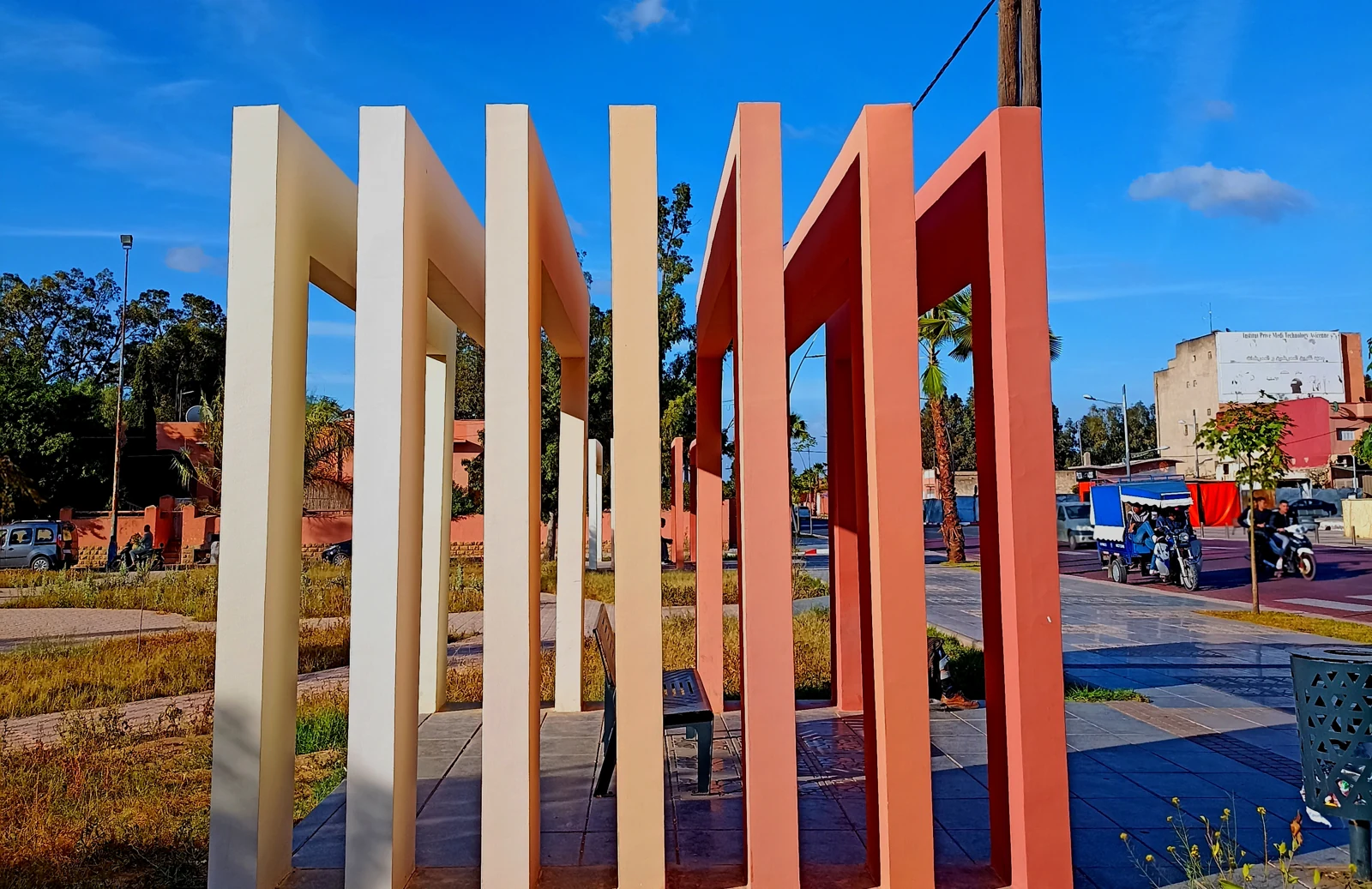
The photographs used here individually identify Youssoufia on Wikimedia Commons. They provide visual context without assigning a function to an unexplained sculpture or building. Compare the pictured setting with what is actually present when visiting: traffic, furniture or surroundings may have changed. Those differences can be interesting in themselves. An image records a moment rather than guaranteeing that the whole street will look or function identically during your stay.
Community buildings and present-day uses
A collective building may reveal more about daily scale than a distant industrial installation. An entrance, however, does not establish visiting hours. If a cultural venue particularly interests you, find an identifiable contact and current programme. An exterior can remain worthwhile even when entry is unavailable. This avoids making the success of a walk depend on an assumed museum or performance that has never been confirmed for the date in question.
Notice contemporary uses as well as older appearances. A building can change function, while a newer public space can become important to residents. Describing everything as a surviving industrial relic would erase that continuity. Combine memory with present work, movement and leisure. The town then becomes more understandable without a monumental narrative assigning exceptional heritage status to every place where you happen to stop or take a photograph.
Louis-Gentil: the geologist and the industrial timeline
The former name Louis-Gentil refers to Louis Émile Gentil, a geographer, geologist and mineralogist born in 1868 who died in 1925. His biography is therefore separate from phosphate exploitation at Youssoufia, which began in 1931. That distinction matters when reading older material: the town's name honoured a scholar who had already died. It does not mean he was then managing a mine or living in the town shown in later photographs.
Gentil's work places the name within a wider history of geographical knowledge about Morocco. He became interested in the country from 1902, subsequently travelling through the western Atlas with the 1904–1905 Segonzac expedition. Mogador, now Essaouira, and Marrakech appear along that scientific journey. They are references in his research rather than stops on an old Youssoufia sightseeing circuit. Separating the scientist's travels from the mining town's history gives both subjects a clearer chronology.
Maps, publications and scientific research
Rocks, fossils, photographs and field surveys formed the material of that exploration. Gentil published an account accompanied by a map in 1906, followed by a geological outline in Le Maroc physique in 1912. This relationship between mapping, resources and observation explains more about Youssoufia's former name than simply translating it. It places the person within the geographical and geological practices of his period, while providing a useful starting point for further historical reading.
In 1913, Gentil proposed an Institut scientifique chérifien whose responsibilities would include geological mapping and understanding water resources; the institution was founded in 1920. This should not be turned into a visitor facility located in Youssoufia. The reference instead explains his scientific interests and the role of the underground environment in that history. A scientist's biography can illuminate the town's former name without making every episode of his career part of local urban history.
Stages in phosphate exploitation
Industrial development then has its own documented stages: phosphate exploitation in Youssoufia from 1931, followed by development of drying and calcination installations in Youssoufia and Khouribga between 1951 and 1961, according to the Groupe OCP notice. Those dates give concrete meaning to the description phosphate town. They concern specific historical periods rather than current output, and they do not establish the construction dates of buildings you might observe on today's streets.
Keep industrial discovery outside workplaces
A professional installation does not become a public attraction because it appears on a map. Any organised visit would require confirmation from an authorised contact, including access rules and actual content. None is announced here. An interesting economic-history stay can be built without finding an improvised entrance or approaching working infrastructure from an unsuitable road. Public urban observation and documentary exploration are sufficient foundations for the type of visit described in this article.
Choose viewpoints that do not interrupt activity. Do not stand in a carriageway to photograph equipment, and do not treat an absent visible barrier as permission. Assess traffic and terrain rather than relying on an apparent route in an image. If a viewpoint is not normally accessible, replace it with another walk or reading. Reaching a facility boundary is not a required achievement that makes the rest of the visit authentic.
Industrial transport and family discovery
The same distinction applies to industrial transport. A reference to phosphate moving by rail towards Safi explains economic context but confirms no passenger train for tomorrow. Public timetables and tickets must be checked separately with the operator. This matters if your historical interest influences departure planning: a freight connection is not a visitor service. Always move from the documentary description to the actual booking conditions before making a travel commitment.
With children, begin simply: a resource is extracted, processed and transported for use. A photograph and suitable questions may be clearer than a sequence of production figures. Let them notice materials, shapes and movement in the town too. The experience can explain how economic activity contributes to a territory without making the whole walk a continuous technical lesson. Different interests within the family can still fit the same short outing.
Connect the subject with the wider stay
After a history-focused walk, choose a different kind of moment: a meal, rest or a separately planned provincial outing. This prevents reducing Youssoufia to one theme. The main guide connects phosphate interest with accommodation and time allocation, while the walking article looks at current public uses. Switching perspective helps retain attention. You do not need to keep seeking industrial references in every street simply because they shaped the initial research.
For Echemmaia and Zima, change your geographical interpretation as well. Another town and saline landscape are not extensions of the mining facilities. Include the road journey and an authorised observation point. Keeping those settings distinct makes the province's variety more understandable than placing every feature under a single industrial label. It also helps choose appropriate clothing, timing and expectations for an outing whose purpose differs from an urban walk.
Keep a record and connect the themes
For a personal record, attach place, date and a modest description to photographs. Write public space observed in Youssoufia when a precise function remains unknown. That is more useful than inventing a landmark name. Add references afterwards for claims extending beyond observation. Your notebook will become a reliable account to share or revisit, while preserving the difference between what you directly encountered and what documentary research subsequently helped explain.
The value lies in connecting historical naming with the present town, economic activity with urban life, and documents with observations. You need not explain everything in one day. Leaving with several reliable reference points and worthwhile questions is a complete outcome. Use the other articles for practical arrangements while keeping cultural curiosity, workplace access and actual service bookings separate. This produces an informed visit without pretending to have inspected the industry itself.


