
Contents
- Separate the town and provincial territory
- Locate Aït Sibern and historical references
- Read Aït Ikkou's landscape accurately
- Respect inhabited and working countryside
- Choose an outing with clear limits
- Prepare water, meals and current conditions
- Connect crafts and territory without inventing workshops
- Keep time for town and return
Separate the town and provincial territory
Khémisset province belongs to Rabat-Salé-Kénitra and has a substantial rural dimension. Its capital does not represent every landscape or commune. A search using Khémisset alone can combine a town hotel, lake photograph and historical place elsewhere in the province. Ask for commune, precise position and actual journey before choosing an outing. A shared administrative name guarantees neither proximity nor direct transport. This matters particularly when a short stay allows only one excursion. Knowing where a proposal actually goes is more useful than selecting the longest list of provincial names and leaving connections to be resolved after departure.
The provincial reference describes plateaus, valleys and relief as a transition between wider geographical settings. This supplies context rather than a marked route. You can choose scenery visible from a permitted road or space without treating the whole territory as freely accessible walking ground. The article connects documented references with practical questions. It offers no permanent access to properties or personally inspected farm. A well-located objective leaves room for observation instead of a succession of place names whose relationship is merely assumed. Keep town, commune and province distinct when comparing accommodation, transport and an excursion whose broad title might otherwise conceal very different practical arrangements.
Locate Aït Sibern and historical references
The town account mentions Gantrat El Fellous and Dar Oum Sultan in rural Aït Sibern commune. It presents the former as a historic bridge and the latter as a former royal residence. They are not moved into central Khémisset here. Dating in that account remains a documentary attribution rather than an independent study of each visible part. Heritage mention establishes neither present condition nor permission to approach, interior opening or usable crossing. A countryside photograph does not identify these buildings through resemblance, even when image and reference concern the same wider administrative territory.
If interested, begin by checking exact location and what can be observed from authorised space. Seek current information before building an excursion around them. This guide invents no museum, organised tour or completed restoration route. It does not recommend entering damaged structures or seeking an unclear passage for a better view. Documentary reading can remain worthwhile when access is unconfirmed. Distinguish the historical reference, explanation received and what you actually saw in your notes. Do not present the whole as a complete personally tested visit.
A limited observation described honestly can help another traveller more than a confident account whose practical parts have never been checked.
Read Aït Ikkou's landscape accurately
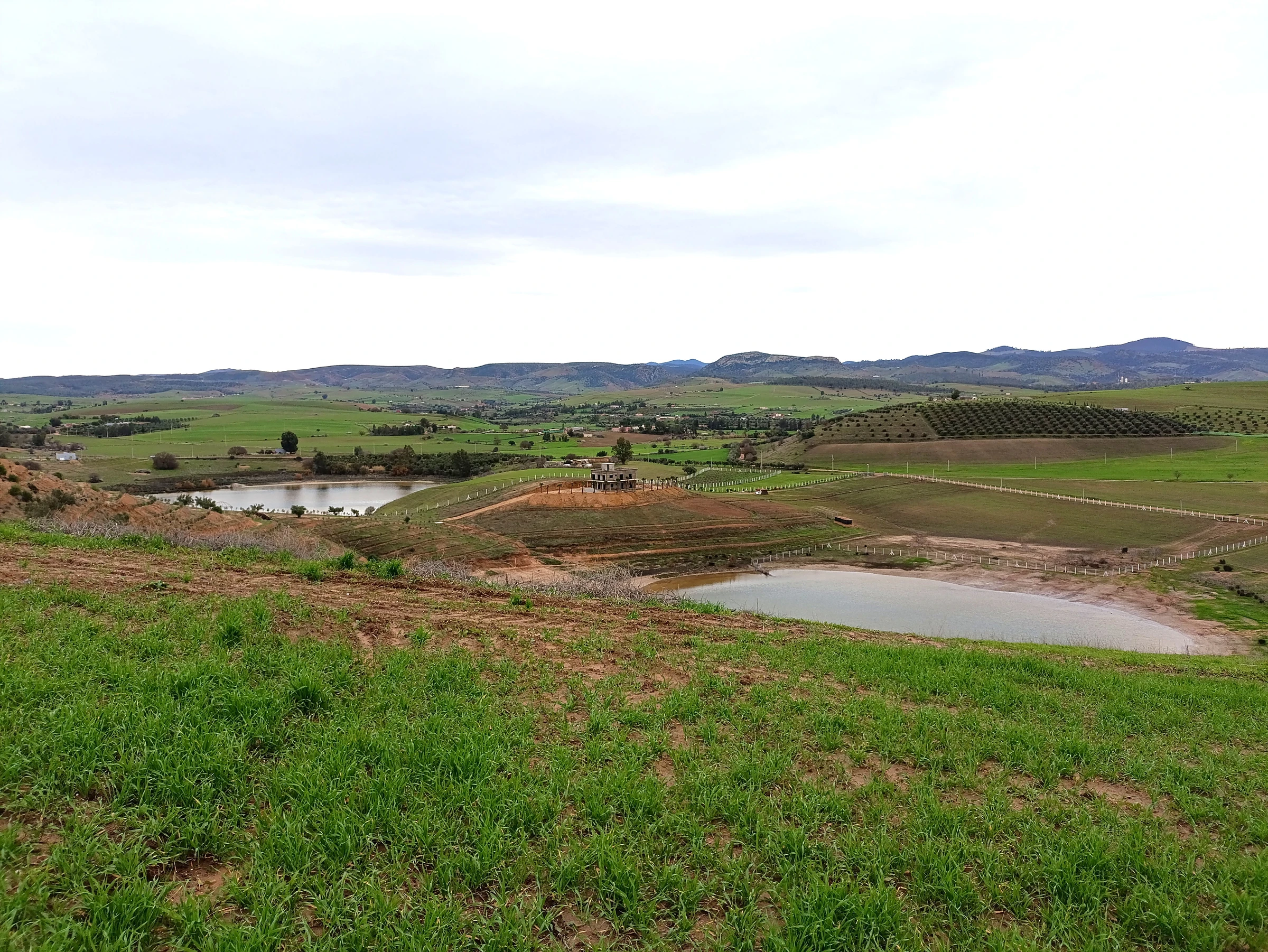
This article's photograph is described by its source as rural Aït Ikkou commune in Khémisset province. It identifies the Aguelmane Tiknwin lakes in the foreground and wooded relief associated with the Oulmès high plateaus behind. That description and source coordinates establish context; it is not an identification as Dayet Erroumi. The two lake landscapes are different. The picture dates from January 2026 and guarantees neither water level nor path condition or future access to the camera position. An accurately located view can introduce a territory without becoming a promise of the experience another visitor will have there.
Look at water, relief and land uses at provincial scale. The photograph establishes no beach, campsite or water activity. If you want to visit the commune, ask for a permitted observation point and return instead of treating camera coordinates as an automatic walking invitation. Visible land may be agricultural or private. An appropriate viewpoint can provide time to understand the landscape's successive layers without reaching every element in the image. The interest lies partly in relationships between those layers. There is no need to invent a recreational facility or public route simply to make a rural scene seem like a more conventional tourist attraction.
Respect inhabited and working countryside
Open spaces and plots belong to local life rather than an empty setting. Do not cross a field to shorten a walk or improve a camera angle. A working track does not become a public footpath because an app shows it. Ask about uses and conditions if your programme depends on passage. Someone's presence does not imply they organise visits or speak your preferred language. A brief, respectful question may help without converting their work into an improvised visitor service or expecting a free demonstration. Leave the other person control of their time and willingness to explain.
Distinguish a broad landscape photograph from a close scene centred on a worker or family, which needs agreement. Keep accesses clear and do not move tools or objects for composition. Preserving real uses helps understand the landscape instead of erasing activity to create supposedly untouched nature. If a production visit is offered, clarify location, responsible person, content and payment. This guide invents no welcoming farm or available tasting. Such activities can only enter the programme through an actual current agreement.
A landscape visit can still be complete when it consists of observation from appropriate space rather than entry into every property visible in the surrounding view.
Choose an outing with clear limits
Plan a rural journey through concrete points: departure, vehicle stop, walk, any further halt and final destination. Overall distance does not describe the approach. Ask about surface, slope, obstacles and turning back. A road on a map confirms neither present condition nor a secondary track's suitability. If driving, use recent information appropriate to the vehicle and avoid turning a digital estimate into guaranteed duration. No invented connection is supplied to make every commune sound immediately accessible from every other. Exact endpoints matter more than a route title that leaves the final approach and return undefined.
With children or less mobile travellers, choose an objective independent of a long circuit. An appropriate viewpoint and short observation may suffice. Check final metres, return to the vehicle and breaks. For walking accompaniment, specify identity, language and role; transport does not necessarily include it. Keep a short alternative if conditions differ from information received. A good outing is one whose limits are understood and whose return works for the group. An impressive programme without margin can provide less satisfaction when a modest difficulty or change of pace makes the rest unclear.
Decide which interest matters most before combining optional stops that may leave little time for it.
Prepare water, meals and current conditions
Check weather for the selected sectors rather than only central Khémisset. Relief, exposure and ground can change the experience. A green January image does not promise the same appearance throughout the year. Choose clothing and shoes for the real outing. If current forecasts or local information make it unsuitable, change plans before leaving understood services behind. Respond to people and conditions rather than an obligation to reproduce an old photograph or complete a list prepared without terrain knowledge. A shorter visit can preserve the main interest while avoiding demands that were never essential to enjoying the landscape.
Carry potable water and necessary food if no meal is confirmed. A spring, lake or clear water does not establish potability. For an offered meal, check content, essential ingredients and price before accepting. Retain packaging and leftovers and respect break rules. Old picnic images authorise neither fire nor camping. This preparation creates freedom: you can enjoy a useful stop without urgently finding an unconfirmed service. It also supports travellers needing predictable food and rest. Choosing a local offer then becomes a voluntary addition rather than a requirement imposed by missing supplies or a programme that left no room for basic needs and sensible changes.
Connect crafts and territory without inventing workshops
Khémisset is associated with carpets and Zemmour culture. A rural outing can add context but does not prove that every textile sold in town was made in the commune visited. Distinguish style, claimed origin, production and trade. If a workshop is advertised, ask for an actual agreement and content. A territory's craft reputation does not create a public workshop at every halt. The carpet article provides questions about material, technique, condition and transport independently of an excursion whose services remain unconfirmed. Both subjects can enrich the journey while retaining separate evidence and practical arrangements.
Festive and equestrian events also depend on places, dates and organisers. They are not permanent performances available on request. A Khémisset fantasia photograph from 2017 establishes no current provincial calendar. Seek a verifiable announcement if the event motivates travel. Residents are not required to represent heritage at a traveller's request. This distinction allows freer exchanges and more accurate accounts. Describe a welcome encounter as such rather than turning an isolated scene into a general rule about people or communes. The province can be appreciated through its contemporary uses without requiring every visit to produce a demonstration, celebration or traditional image that matches a prior expectation.
Keep time for town and return
A provincial outing can complement Khémisset without replacing all urban discovery. Leave time to understand your base, rest and prepare the next day. If combining Dayet Erroumi, forest and countryside, check order and actual visiting time. A common regional label does not make transfers cost nothing in time or effort. Ask what remains the priority if shortening is necessary. Fewer places with clear arrangements can provide a better experience than a tour where each stop becomes a quick photograph before another transfer. Value depends on attentive time and practical fit rather than the largest number of destinations printed in a title.
Save contacts and meetings offline and share them. Agree pickup and delay communication. The return includes reaching the vehicle, waiting and the full journey to the useful address, not merely a direction towards Khémisset. Record conditions, access and services actually used with their date afterwards. Rabat, Meknès and Fès introduce distinct stages without guaranteed direct connections. This preserves provincial diversity and the town's own role. It allows appreciation without relocating monuments or expecting everyone to repeat an immutable itinerary.
Another traveller can use your advice by recognising what is documented, what was particular to an agreement and what needs checking again for different dates, mobility and available transport.
