
Contents
Place Tamegroute within your journey along the Drâa
Tamegroute lies south of Zagora in the Drâa valley and deserves to be identified as a destination in its own right. Its association with green pottery and manuscript learning gives it a different focus from a town walk or a day among the dunes. When comparing possible outings, begin with those interests rather than treating every stop south of Zagora as part of one desert excursion. The village belongs to the inhabited valley, with its own cultural history.
The national tourism office also uses the spelling Tamgrout. Keeping both names in your notes helps connect descriptions, maps and the address supplied for a meeting. What matters most is the actual location of the visit you are considering: a pottery display, a workshop appointment and a place connected with manuscript heritage are different destinations within a broader village context. Choose a clear starting point so that the journey serves the subject you most want to understand.
A separate village with several connected interests
The direction towards Tamegroute also helps explain the regional sequence. Zagora is an urban base within an oasis landscape; Tamegroute adds religious learning, books and craft; M’Hamid and the approach to Chigaga belong to a further stage. These places can form part of a wider trip, but each changes the content of the day. Giving Tamegroute a defined purpose leaves room for observation and explanation instead of reducing it to a hurried pause between longer transfers.
A useful first choice is whether your strongest interest is knowledge heritage, pottery or the relationship between built settlement and cultivated surroundings. You may combine them when the actual arrangements allow, yet it helps to give one subject priority. Someone interested in the form and surface of a handmade vessel will ask different questions from a visitor interested in the circulation of books. This distinction makes even a relatively focused visit more satisfying and gives the rest of the day structure.
Understand the Nasiriyya connection and manuscript culture
Tamegroute is associated with the Nasiriyya, also written Naciria, a religious and scholarly tradition rooted in the village. The manuscript heritage linked with this centre brings together spiritual life, education and the transmission of written knowledge. It helps explain why a settlement in the Drâa can matter beyond its physical size. A book collection connects readers, teachers, copyists and places across time, making the village part of a wider intellectual geography as well as a local landscape.
Accounts of the manuscript holdings mention religious works alongside subjects such as mathematics, astronomy and medicine. That range is a useful starting point for understanding the collection’s significance. These fields show how the preservation and teaching of knowledge could encompass several kinds of enquiry within the same scholarly environment. Rather than concentrating only on the age of a single volume, consider what the diversity of subjects reveals about reading, study and the interests of the people who assembled and used books.
A centre of learning within a network of places
A manuscript is also a material object. Writing, page arrangement, binding and traces of use can provide different ways of looking at one when it is presented for viewing. You do not need specialist knowledge to appreciate the distinction between a text’s content and the work involved in preserving its physical form. If an explanation accompanies your visit, ask how the displayed object relates to the wider collection and which features are especially useful for understanding its purpose.
The religious setting and the presentation of manuscripts have their own practical conditions. Before making this the main reason for travelling from Zagora, establish which space can actually be visited and what will be shown on the day. Viewing an explanation or a selection of material is different from access to an entire collection. A clear arrangement helps you enjoy the encounter for what it offers, while leaving the care, handling and presentation of the books with those responsible for them.
Look closely at the green pottery of Tamegroute
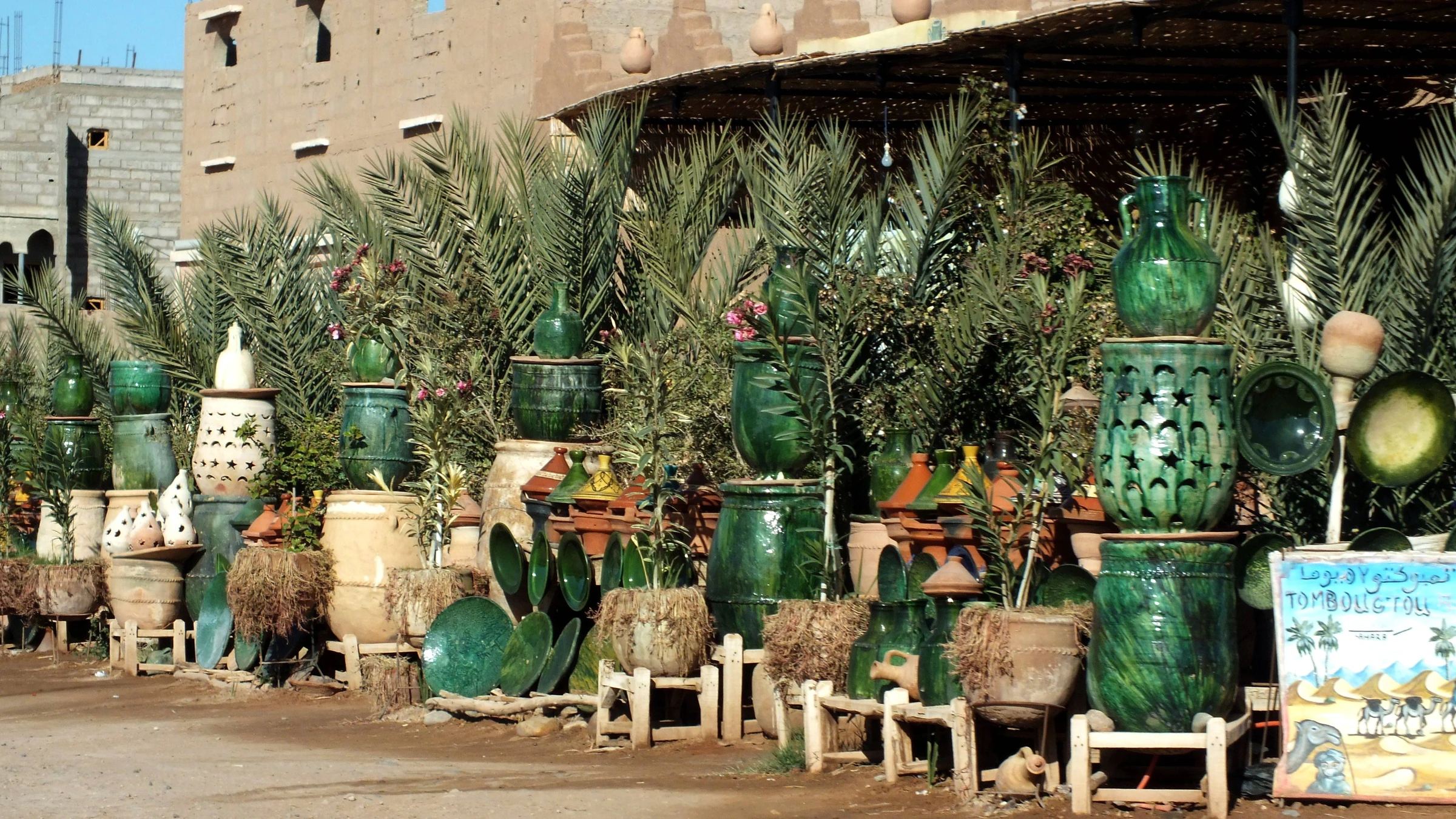
Green-glazed pottery is one of Tamegroute’s most recognisable craft associations. The forms described by the national tourism office include dishes, bowls, cups, tiles and vessels related to food preparation or presentation. This variety makes a pottery stop interesting even before you consider buying something. Start by comparing shapes and proportions: a wide shallow dish, a small cup and a taller vessel organise space differently and invite different uses, even when their surfaces share a similar green appearance.
The glaze is not the whole object. Look at the relationship between the coated surface, the edges, the opening and any handle or foot. Changes in tone or finish can become part of the visual character of a handmade piece, rather than something that needs to be judged from a distant photograph alone. Bringing several objects into comparison helps you describe what attracts you: colour, silhouette, size, surface texture or the way a vessel sits when placed on a table.
Form, surface and intended use tell different stories
A workshop explanation, when specifically arranged, can add another level to that comparison. Questions about shaping, drying, firing and finishing make the craft process easier to follow than a general request to see pottery being made. What happens during your visit will depend on the work actually taking place. You can still learn from finished objects or an explanation when a particular production stage is not being demonstrated; these offer different windows onto the same sequence of skilled decisions.
For a purchase, decide the intended purpose before settling on a shape. A decorative vessel, a serving dish and an object you hope to heat require different information. Ask about the recommended use of the particular piece, including any care instructions relevant to your plans. Then think about its size and how it will travel with you. This turns an attractive purchase into a considered choice, connected with both the maker’s explanation and the place the object will have at home.
Read the ksour as part of an inhabited village
Tamegroute is described as an ensemble of ksour associated with the religious centre. The singular ksar refers to a grouped, fortified settlement; the plural helps convey that the village’s built history is more complex than one isolated monument. This is a useful framework for looking at the relationship between groups of buildings, routes through the settlement and the wider valley. It encourages you to understand how parts belong together, rather than treating every older-looking wall as a separate attraction.
Earth-built architecture is another link with the Drâa landscape. Materials, wall surfaces and the placement of openings can give a walk a clear subject even when you are not entering a named building. Begin with the visible arrangement and ask how housing, movement and shared spaces relate to one another. An explanation tied to the particular place is more informative than assigning the same history to every structure that happens to use similar colours or materials across the region.
Built form belongs to daily life as well as heritage
A village walk can complement a pottery or manuscript visit by connecting cultural subjects with the space in which they developed. After an encounter centred on books or objects, the broader settlement brings those subjects back into an inhabited setting. Keep the route specific: an agreed walk and a visit to a particular interior are distinct arrangements. Choosing a defined area also makes it easier to spend time looking at relationships between buildings instead of continually searching for another entrance.
The cultivated Drâa remains an important part of this reading. Settlement, movement, water and productive land belong to a shared regional story, even though each location has its own details. Tamegroute helps bring that story into focus through the combination of built form, learning and craft. You can then compare it with the palm groves around Zagora or with the more open landscapes further south, recognising that each part of the journey reveals a different aspect of the valley.
Build a day around the subject you value most
When planning from Zagora, put the most important part of the Tamegroute visit first in your decisions. If manuscript heritage is central, organise the day around the actual visiting arrangement. If pottery is the main interest, give yourself time to compare objects and hear an explanation rather than leaving that choice until departure. A village walk may provide a useful connection between these encounters when the route and time available suit your group and the conditions on the day.
Match the return plan to the visit you have selected. A person collecting you needs an identifiable meeting place, and a pottery purchase may affect how you carry belongings for the rest of the day. Keep the final movement back to the vehicle or pickup point simple. These small practical choices protect the time spent on the subjects that brought you here, especially when conversation or close observation makes an encounter more rewarding than you expected at the outset.
Connect the village visit with a realistic return
A meal or a rest can also give the day a useful rhythm. Decide whether you will eat before leaving Zagora, use a meal arrangement confirmed for the outing or return to the town afterwards. That choice belongs alongside transport, not as an assumption hidden within the word excursion. Leaving space around the cultural visit makes it easier to absorb what you have seen and avoids forcing books, craft, food and a further long journey into one continuous sequence.
Afterwards, use Tamegroute to enrich the rest of your Drâa journey. A pottery form can lead you to notice objects elsewhere; manuscript heritage can change how you think about the movement of knowledge through the Sahara-facing region. Return to the Zagora guide to place those ideas within the wider stay, or continue with the oasis and caravan-history articles for another angle. A separate M’Hamid and Chigaga day then offers a different landscape, rather than repeating the purpose of this visit.
