
Contents
Reading the enclosure before choosing a route
Taroudant's walls create an immediately recognisable outline. Their interest goes beyond a façade photograph: they explain the boundary between medina, outside roads and gates organising movement. The Tourist Office describes an enclosure of roughly six kilometres with towers. This indicates scale rather than a continuous walking itinerary. First decide which sector you want to observe and which entrance will take you towards the centre. A short understood route may reveal more than completing a circuit simply for its length.
Official tourism sources connect the town with Saadian history. Visible walls have nevertheless experienced alteration, maintenance and successive uses. General history cannot date every element by appearance. An older walls photograph illustrates urban form without certifying every section's present condition. Follow entrances actually open and indications on site. A section closed or under works does not invite continuation through neighbouring land. Historical interest remains compatible with choosing a different passage and adjusting the walk when practical circumstances require it.
Distinguishing the outside contour from a wall walk
Walking beside a wall on a public road and climbing onto an enclosure are different activities. No continuous wall walk or open tower is guaranteed here. Battlements do not establish access to the top. An initial approach can remain at street level: observe apparent thickness, breaks, angles and relationships with housing. This needs neither an open defensive museum nor an accessible viewpoint in every tower. Look at how the structure sits within the inhabited town rather than assuming a visitor entrance.
Combine an outside section with an entrance into the medina instead of requiring a complete circuit. Establish how to recover your starting point without unnecessary extra distance. A gate close on a map may involve an inconvenient traffic crossing. With children, luggage or limited mobility, the side of the street matters as much as distance. Ask about the path, not only the monument's name. This provides more useful information for your group than a general recommendation to walk around the walls.
Using the gates as concrete reference points
Bab al-Khamis, Bab Zorgan, Bab Oulad Bounouna, Bab Targhount and Bab El Kasbah appear in descriptions of Taroudant's gates. Spellings change with transcription and local habits. Names help locate a meeting or lodging without implying identical entrances or access to the same district. Keep your contact's wording and clarify which side of the passage is meant. Meeting at the gate remains ambiguous when several vehicles stop nearby. A specific entrance or landmark makes arrival easier to arrange.
Descriptions of Bab El Kasbah and Bab al-Silsila can use related names for distinct passages. Rather than impose an equivalence, ask for an identifiable entrance and, if possible, a location shared by your contact. Gates are transport spaces as well as scenery. Stop where you do not obstruct movement when photographing a façade or passage. An effective image does not require standing in the opening or blocking a delivery. The daily use of the entrance is part of understanding it.
Moving from broad roads to medina streets
Passing a gate can quickly change atmosphere and street scale. Outside, the walls may be easier to read; inside, façades, shops and junctions offer other references. Choose a few place names instead of memorising a long sequence of turns. If aiming for a square or market, ask directions to that destination. Someone pointing to the nearest exit is not necessarily describing the walk imagined from your map. Keep the purpose of the route clear when requesting help.
The medina need not become an obligatory maze. You can leave a main street to look at a lane, then return to a known point. This leaves room for details without losing the return objective. Dead ends and private doorways are not guaranteed shortcuts. If uncertain, ask clearly and name your destination. Available time should shape exploration: a small loop you understand is preferable to rushing towards the opposite end of the centre when a meeting is approaching.
Understanding squares and everyday passages
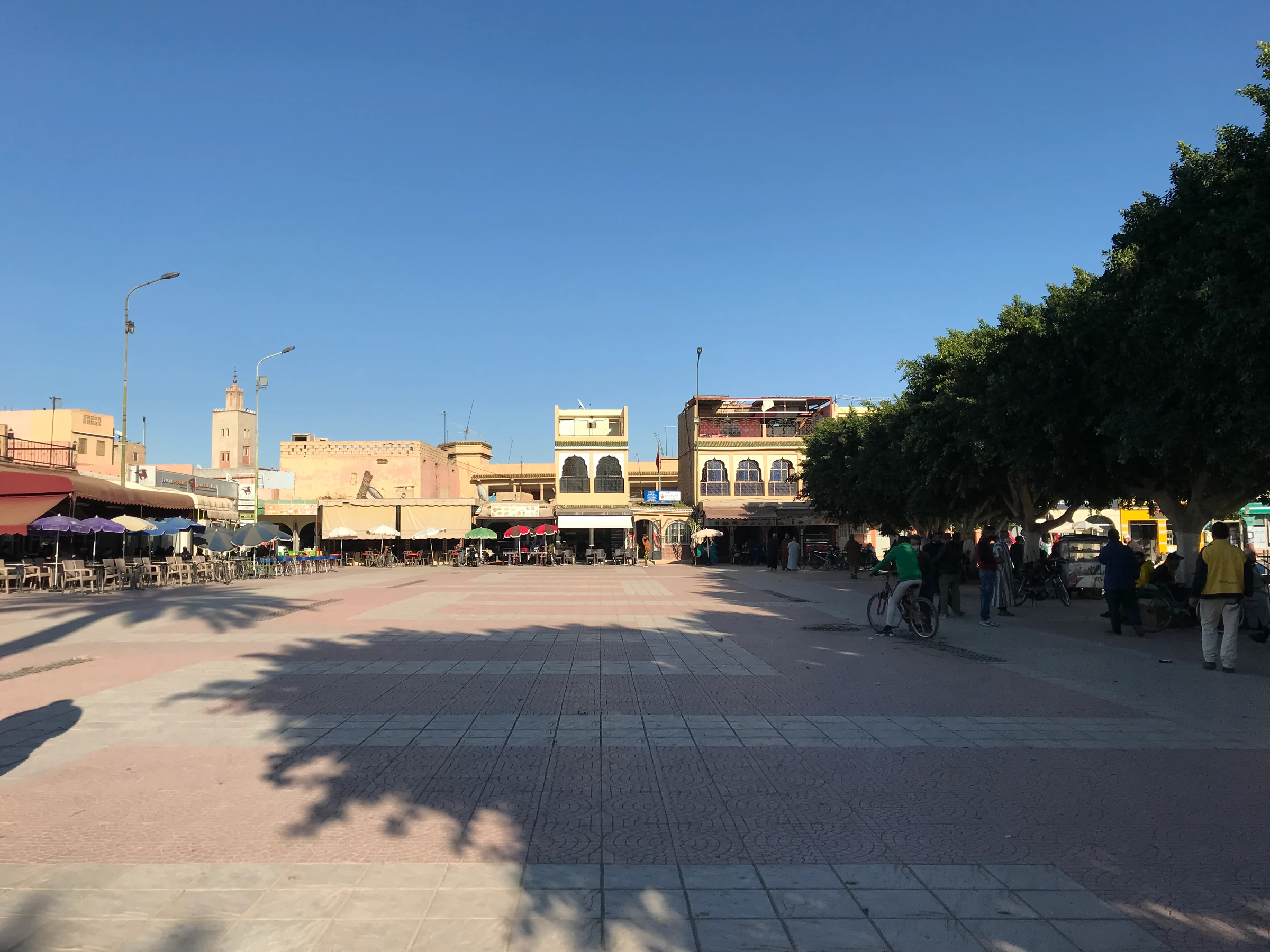
Assarag is a central reference documented in sources and this article's photograph. The February 2021 view shows the square and surrounding uses at that date; it does not guarantee today's terrace or traffic layout. Use the square for orientation, then choose a side or address for a meeting. Its role as a passage connects centre and shopping streets rather than reducing it to a photo stop. Observe how people cross, wait and use its edges during your visit.
Talmoklate also appears in market descriptions. These names matter as references for understanding the centre, not promises of a performance at a set hour. The same square can serve shopping, waiting and meetings. Pause where you are welcome, with any consumption or conditions understood if using a private terrace. Neighbouring businesses keep their own hours. Their appearance in a photograph does not prove opening on the day you pass, so arrange a specific appointment directly when needed.
Looking at details without entering private space
The medina offers doors, plasterwork, façades and relationships between houses and streets to observe. You need not assign a date or owner to every detail to appreciate it. Ask whether access is permitted before entering a courtyard, workshop or religious building. An open door may simply belong to a home. No interior is presented here as freely visitable from its exterior appearance or an old heritage account. Public streets already provide substantial opportunities to understand the setting.
Photography also depends on context. A general façade and a close portrait call for different consent. Ask before photographing an artisan or someone inside a shop. If refused, choose another subject without insisting. Workplaces are not displays arranged for every visitor. Street or walls views can record the route while activities continue and residents use passages at their own pace. The resulting image can show the town's character without interrupting the people who make it a living place.
Connecting history with an inhabited town
Taroudant's presentation as a former Saadian capital helps explain the fortifications within its urban story. It does not mean everything visible dates from one period or that change stopped afterwards. Neighbourhoods and businesses still use the enclosure and passages in everyday life. Compare original defensive purpose, present circulation and housing patterns. These different readings enrich discovery without requiring a detailed chronology for each section. A wall can be historically significant and part of a changing modern street at the same time.
Confirm building and gate names before attaching them to a photo caption. An ochre wall alone does not identify Taroudant; several Moroccan towns have enclosures and comparable gate names. Images selected here include creator, date, source and licence. Keep these together when comparing an archive and present site. An older view can document one stage of history without replacing a current access or architectural check. Location and subject evidence matter more than a visually attractive but unexplained filename.
Choosing your pace and pauses
The enclosure's length is not a distance everyone must walk completely. For a focused visit, select a gate, a medina sector and a return square. Extend the route if the group wants to. Shade depends on time and side of the street, so a photograph cannot guarantee it. Carry water and choose a pace suitable for the walkers. A timely pause often improves attention to the final part of the route instead of making it an exercise in finishing.
For a specific accessibility need, ask about the whole journey rather than only the main site. A step, kerb, uneven surface or crossing can change a route. Request a path description from your accommodation or a local contact. This dossier does not claim an entire area is accessible to everyone. Concrete information about obstacles and entrances helps choose between an easier outside contour and a denser medina exploration. It also makes a useful alternative possible before committing the group to a longer walk.
Finishing the walk with a clear plan
Walls and medina can form a discovery in their own right, followed by a souk if time remains. Keep a major purchase separate: comparing a carpet or craft object needs more attention than passing between two gates. The souks article helps prepare that stage. The main guide restores the wider picture before booking an excursion or changing accommodation. Connecting these subjects allows a visit to grow around your interests rather than around a requirement to complete every activity on one day.
When lodging outside the walls, identify the passage that simplifies return instead of always aiming at the best-known gate. If a vehicle waits, confirm where it can actually stop. A square name, business reference and contact make the meeting clearer than an approximate point inside the medina. Keep a return arrangement if the walk lasts longer than planned. The end deserves as much attention as departure, particularly when several people separate temporarily to follow different interests in the centre.
What the sources help prepare
Official references document the walls, medina and their place in Taroudant's identity. They do not grant universal access to towers, courtyards or buildings. No entry fee or visiting timetable is invented in this article. Confirm a particular service with an identified contact on your chosen date. A third-party guided visit should state its content, starting point and conditions independently of the site's appearance in a brochure. This is how a general heritage interest becomes a workable arrangement.
Afterwards, note genuinely useful references: the gate used, meeting square, pleasant passage or difficulty encountered. Specific details help prepare another walk and can improve the guide when accompanied by precise location. The walls remain a powerful framework, but discovery grows from their relationship with streets and living uses. Allow time to observe those connections without feeling obliged to walk everywhere or enter every building. A coherent, well-understood visit can be complete even when you leave another sector for later.
