
Contents
Locating the oasis before arranging the outing
Tiout, also written Tioute in tourism material, is a locality in Taroudant province. The Tourist Office presents its palm grove and kasbah as an excursion from town, not a medina district. Identify the Moroccan commune and meeting place because the name has namesakes. Searching Tiout alone can lead to another country or an unrelated photograph. A precise location should come before transport arrangements, particularly when comparing proposals that use the same destination name without describing the actual stop.
Town and province also differ for accommodation. A Taroudant advertisement may concern rural surroundings, while departure from the centre requires a transfer. Ask for the exact address and where you are expected. Time needed depends on origin, route and conditions on the day. Brochure distances offer geographical orientation rather than a universal duration or evidence of transport available at your preferred hour. A practical plan joins real meeting and return points instead of treating a provincial label as a complete journey.
Choosing an excursion by its actual contents
Before booking, ask what is included: travel, guiding, walking, a cultural stop or a possible meal. These can be organised separately. Oasis does not describe the activity by itself or guarantee access to every garden. A guided visit and a drop-off at an arrival point are different services. Establish the return and where to meet the vehicle again, especially if the group may separate temporarily. Compare the proposal's content with the experience you actually want rather than the photograph alone.
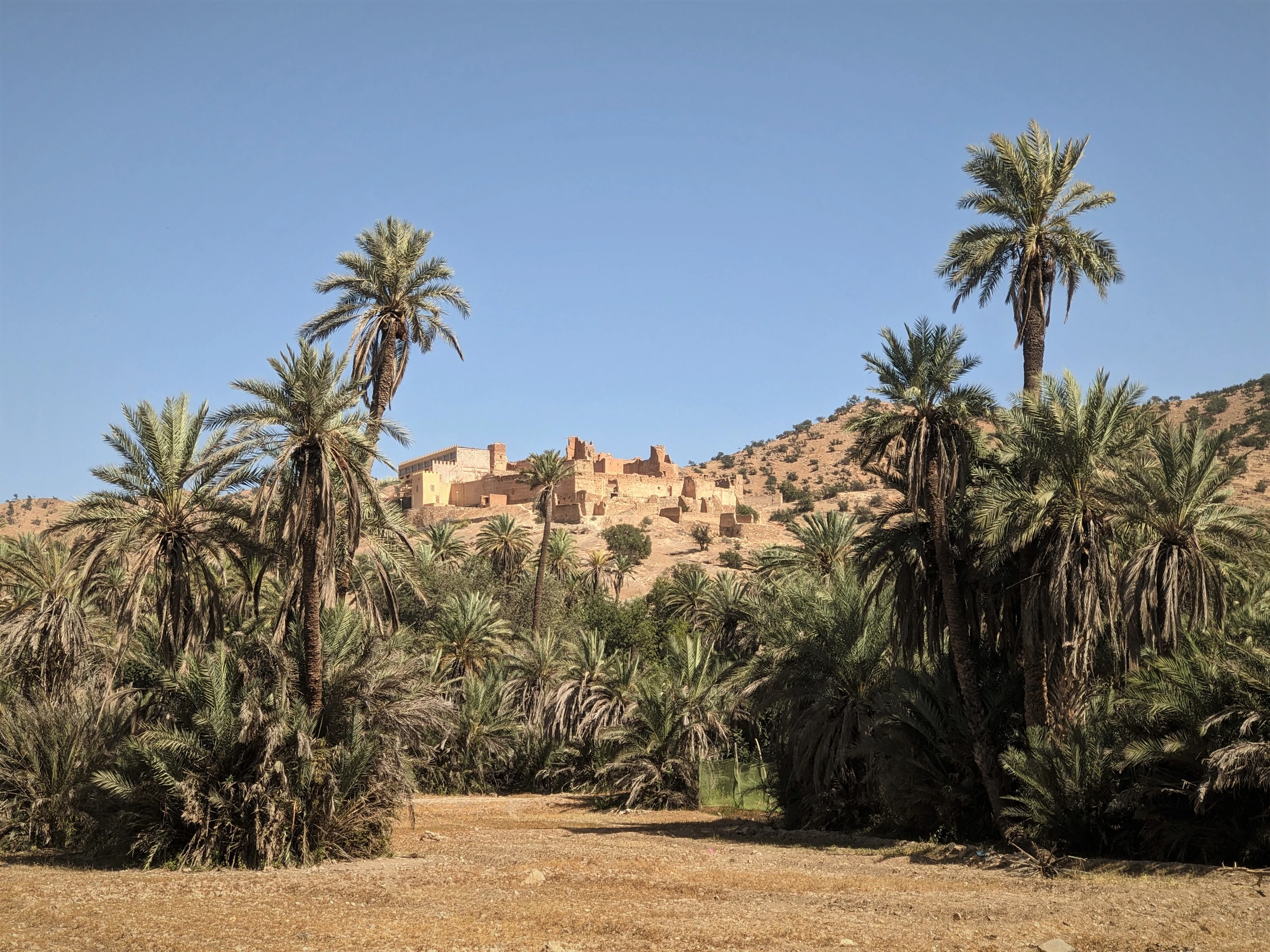
The selected image shows Tiout's kasbah and vegetation in April 2023, with a location supplied by its creator. It distinguishes the landscape from Taroudant without certifying current building entry. A visible façade or photographed terrace is not a promise of opening. Illustrated sources remain dated. Confirm a particular visit with an identified contact before making that interior the sole reason for travelling. The picture can support understanding of the setting while leaving practical access to be checked separately for your date.
Reading the palm grove as inhabited landscape
Official descriptions connect the oasis with crops and a lasting human presence. It expresses a relationship between water, plots, trees and settlement rather than a garden created only for visitors. Observe from permitted paths, remembering that each area has uses. A seemingly open passage in a picture may cross cultivated land. Ask about the accepted route and follow indicated access. Understanding the work maintaining the oasis makes the visit more informative than treating it simply as scenery arranged around a viewpoint.
Vegetation varies by plot and period. A palms photograph does not promise identical greenery across the area or at every date. Sources mention food crops and carob trees in Tiout's context but cannot identify each tree from a broad view. If a guide explains agricultural use, ask which plot and practice is meant. This avoids turning one local detail into a rule for the entire oasis. Keep the particular explanation attached to its place instead of assuming every garden is organised alike.
Walking without inventing a marked trail
This article supplies no hiking trace or guaranteed difficulty rating. A palm-grove walk may involve uneven surfaces, narrow passages and slopes. Ask about the actual distance, return options and obstacles relevant to your group. Children, inexperienced walkers and photographers seeking long pauses have different needs. Choosing a suitable route is more useful than following a standard programme simply because it is popular. A current description of the walk helps decide what fits the time available and whether a shorter option is preferable.
A panorama does not establish a right to reach the position from which it was taken. The view may come from private space or a building section not receiving visitors. Use a place with clear access for a pause or photograph. The kasbah on higher ground structures the landscape without making every slope a public route. An organised guide should be able to explain where walking starts and ends. A named destination is not a substitute for those details when agreeing an excursion.
Looking at the kasbah without mixing places
Tiout's kasbah belongs to this outing and should not be confused with Taroudant's urban enclosure. Images document different relationships between fortification and settlement. At Tiout, relief and palms frame the view; in Taroudant, walls directly accompany the medina. Comparing them enriches a stay without making every building identical. Kasbah, ksar and walls do not name one single site. Keep the locality attached to each term when asking questions or comparing photographs found under general provincial categories.
A general history or photo caption cannot announce an open museum, functioning restaurant or interior visit. If a nearby service is offered, clarify its provider and address. This dossier gives no assumed timetable or fee. You can plan around landscape and an authorised exterior view, adding a confirmed visit if available on your date. That avoids complete dependence on an older online reference. Historical interest can remain worthwhile even when the particular interior or service pictured is not part of the actual arrangement.
Photographing people and uses thoughtfully
Residents in an inhabited landscape are not scenery. Ask before close portraits, workplace photographs or images interrupting an activity. Refusal still leaves general views available as memories of the place. Agricultural work and everyday movement retain priority. If someone arranges an encounter, understand what is planned and what remains at participants' discretion rather than assuming availability. A thoughtful visit can recognise the people maintaining the landscape without expecting them to repeat a demonstration or pause their work for every arriving group.
Landscape captions also need precise location. A photograph from Taroudant province does not automatically show Tiout; a palm grove may belong to another valley. Files chosen for MOROCVIA are examined through descriptions and coordinates when supplied. This supports coherent attribution without claiming independent field expertise. Keep creator, date and place together when comparing views. Part of a documented image's value lies in what it does not claim to show, including access routes, present opening or the condition of every surrounding plot.
Putting Tiout within the Souss setting
The Souss plain and High Atlas and Anti-Atlas relief frame journeys from Taroudant. They are not a single walking territory. Tiout is one specific excursion choice among regional possibilities. Mountains on the horizon do not mean a summit can be reached with the time left that day. Choose the outing's purpose before counting stops, and distinguish an oasis visit from a mountain hike. Different interests require different approaches even when one brochure groups them under the same wider destination.
An Atlas day needs separate preparation: an identified itinerary, current access, weather and guiding arrangements if required. Pass roads and paths are not declared open here from an old brochure. If mountains are your aim, seek information about the particular route rather than only a generic transfer from Taroudant. A well-chosen rural outing can be modest in distance and rich in observation without adding stops whose value has not been defined. Decide what you want to understand rather than how many places to fit in.
Avoiding detours outside the programme
Tourism lists can combine town, surroundings and more distant places. A name on the same page does not make it a nearby Tiout stop. Tifnit, for example, belongs to a separate coastal setting and is not moved into the oasis here. Check location and the complete journey before adding a destination. Ask what the addition removes from time at the main place. A clear selection often allows better understanding than a succession of quick stops loosely linked by regional promotional material.
Arrange return before departure. Confirm pickup point, transport contact and what happens if walking takes longer. Leave a margin before another reservation or intercity departure. Kilometres exclude waiting, traffic and the group's pauses. Without your own vehicle, do not assume an improvised option always waits in the same place. Confirmed return arrangements make discovery simpler and more flexible. They also clarify how much time can realistically be spent looking at the palm grove instead of worrying about the next stage.
Connecting outing, meal and town stay
Check what food is actually offered at the chosen place and what requires advance arrangement. An old terrace image or restaurant mention proves no present service. If a meal is included in a booked excursion, ask what it contains and when it takes place. Clarify important ingredients before departure. No establishment is recommended as tested here, and no fixed menu is promised for every Tiout visit. A food arrangement should be as concrete as the transport and meeting information in the proposal.
Also decide what you still want to do in Taroudant that day. A long market session after a rural outing may suit some people and tire others. The main guide and articles on walls, souks and flavours help distribute subjects into separate sequences. Everything need not be combined. A calm town arrival, a distinct excursion and time for purchases can be clearer than a crowded programme of poorly located sites. Match the order to the group's interests and energy rather than a generic timetable.
What this page helps you decide
This page helps choose a separate Tiout outing, understand the palm grove and ask useful route questions. It books no transport, building visit or agricultural encounter. Any commercial links on the site search for external offers without guaranteeing they meet every expectation. Compare a concrete proposal with your project. An activity interesting to another group suits yours only after checking pace, access and conditions. The decision concerns the actual arrangement, not merely the recognised name of an oasis on a list.
Official sources and documented pictures explain landscape and cultural setting. Changing practical details still need confirmation for your date. Report a location error or useful development with a precise address or reference and a source. The aim is to keep Tiout in its proper place: a provincial locality with residents and uses, discovered from Taroudant without being confused with the town or promising access to everything visible in a picture. A well-defined outing leaves more room to notice what makes the place distinctive.
