
Contents
- Locate the town within its territory
- Understand a history linked to phosphates
- Begin with a walk in the centre
- Observe the plateau from authorised access
- Listen to memories without reducing them to anecdotes
- Compare neighbouring towns without mixing them
- Notice sport as part of collective life
- Choose a length suited to your purpose
- Confirm the few services you actually need
Boujniba belongs to Khouribga province in the Béni Mellal-Khénifra region. Its name is associated with former phosphate deposits and a history of work that helps explain inland Morocco. A visit can be especially rewarding when it allows time for the inhabited centre, observation of the territory and a documentary approach to mining history. It does not depend on a former mining tunnel being open to the public. Choose a purpose first: a meeting, an urban walk or a regional journey exploring relationships between industry and society. Those purposes lead to different arrangements and ways of looking.
Locate the town within its territory
Boujniba town and Khouribga province are different geographical scales. The province covers a wider territory, while Khouribga is also the name of another town, its administrative capital. When arranging travel or comparing accommodation, request the full address. An advertisement using the provincial name may concern somewhere outside Boujniba. The actual meeting location matters more than a broad claim of proximity. Save a precise point and arrival directions, particularly when travelling with luggage or meeting someone. That practical detail helps turn a regional description into a journey you can genuinely organise.
The phosphate plateau provides a geographical and economic setting without turning every site in the basin into an attraction within the commune. Visible installations and landforms may belong to different periods and functions. An industrial photograph made in Khouribga does not automatically show Boujniba. Captions should preserve what can actually be established: a town, sector or historical document. Accuracy also improves the visit because it prevents you from searching in the centre for something mentioned only at basin level. A useful picture can illustrate wider context while remaining clearly identified as belonging elsewhere.
Understand a history linked to phosphates
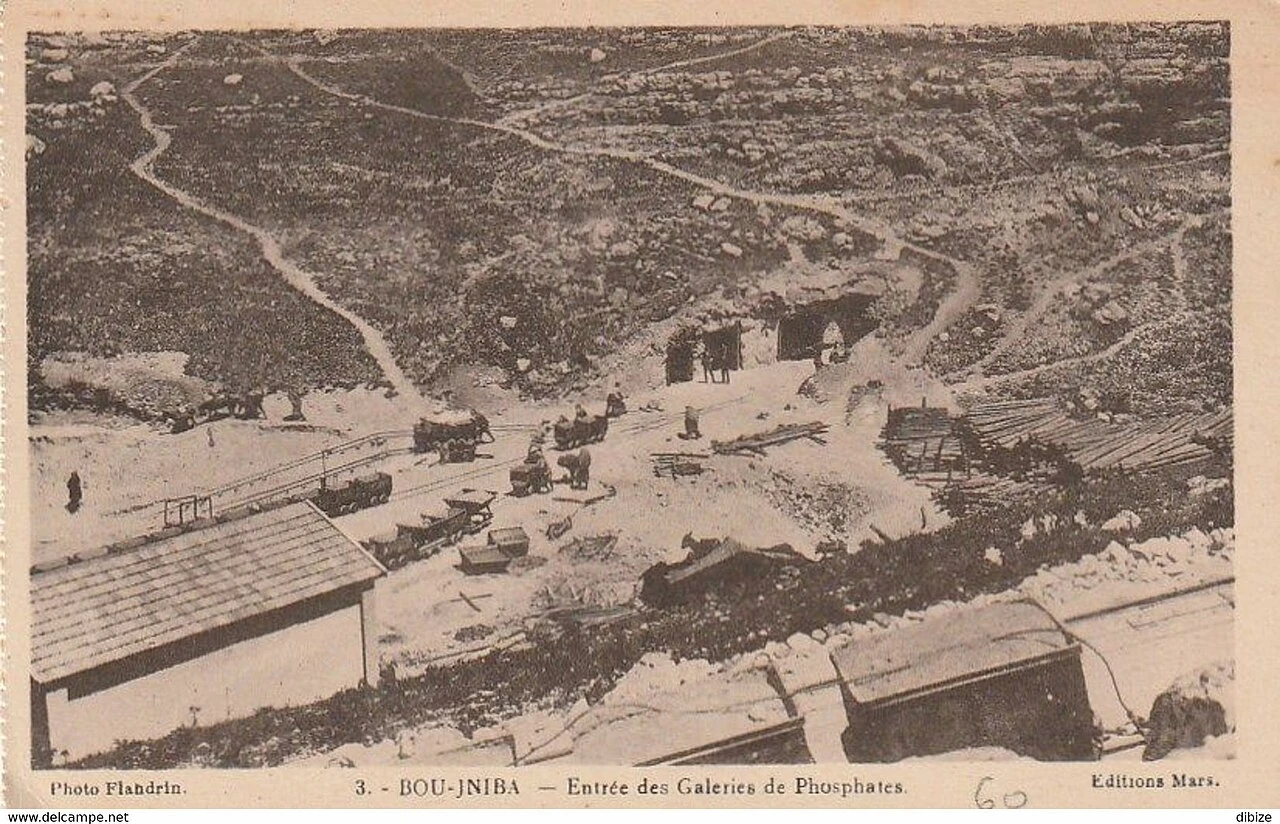
The creation of the Office chérifien des phosphates in 1920 and the beginning of extraction in the Khouribga basin in 1921 offer important regional reference points. They do not date every building in Boujniba or provide a complete chronology of its neighbourhoods. The more revealing subject is the relationship between extraction, housing, services and movement. Mining has an urban and social dimension beyond an image of a gallery entrance or an extraction landscape. Keeping those relationships visible gives the town a fuller history than one founding date applied to every place you encounter.
The phosphate memory article distinguishes basin chronology, documentary traces and current visiting possibilities. An old postcard may show an installation that has changed use, disappeared or remains private. It can enrich understanding without inviting you to find the exact site independently. Industrial history can be explored through sources and public spaces without claiming an underground visit or access to infrastructure whose visitor arrangements have not been confirmed. The aim is to understand how the place was represented and used, rather than to recreate an unverified route through former working areas.
Begin with a walk in the centre
A first walk helps you recognise the surroundings of your arrival point and streets that will be useful. Find the return meeting place, somewhere for a break and shops visible on the day. Choose a small, understandable area before attempting to cross the entire town. Everyday activity already provides things to observe: goods, movement and connections between business and housing. A specific question helps give the walk direction, such as how a centre meets the needs of people living and working there. The visit need not depend on finding a monumental attraction.
This approach does not require every facade to be described as old or a residential neighbourhood to be labelled protected mining heritage without evidence. Look at what is visible, then ask if you want to clarify a name or function. A conversation should let the other person continue working. Ask before making a portrait and respect private space. An open door, workshop or courtyard does not become a visitor site because it could make an attractive photograph. You can create a useful visual account from public positions without asking daily life to become a performance.
Observe the plateau from authorised access
Open spaces in the regional setting can offer a contrast with the inhabited centre. Choose a position where stopping is possible and access is clear. A map line or old photograph does not prove that a route is intended for walking. Agricultural, industrial and residential activities have their own entrances and conditions. Before a longer outing, ask where it begins, what ground it crosses and how the return works. The route should fit the group’s pace and the day’s conditions, rather than an assumed distance taken from a broad destination description.
Observation might concern relationships between open surfaces, roads and built areas where these are actually visible. You do not need to identify every installation to appreciate the view. If uncertain, keep the description simple instead of assigning a technical name at random. The things to do article suggests ways to organise this discovery. No public industrial viewpoint, marked trail or mining access permission is guaranteed here. An agreed exterior position and a precise explanation may be enough to give the landscape meaning without approaching places whose use or entry conditions remain unclear.
Listen to memories without reducing them to anecdotes
The history of a working town can be approached through residents’ memories when they wish to share them. Someone may describe a job, journey or family experience. A testimony matters because it has a situated perspective; it does not automatically replace an archive or represent every generation. Ask how the person knows the information and which period the account concerns. You can then distinguish personal experience, a transmitted story and present interpretation. These differences give the account more depth than treating every recollection as a statement about the whole town.
If taking notes or photographs for publication, explain that clearly. Agreement to talk is not automatically permission to use a portrait or attribute a quotation. An informal exchange can remain a private memory. For more detailed work, arrange the meeting and allow time to check names and dates. This gives people more room than searching for a dramatic phrase about a forgotten town. Boujniba is not reducible to a former installation or one worker’s story. A modest, accurately situated exchange can be valuable without producing a striking episode for a travel narrative.
Compare neighbouring towns without mixing them
Khouribga can form another stage for observing a different urban scale and understanding the wider phosphate setting. Boulanouare also has its own local development. Regional proximity does not make either place a neighbourhood of Boujniba. Give each an arrival point and enough time. You can compare urban forms and relationships with work without assigning identical monuments, services or experiences to every destination in the basin. Prepare the transfer from actual addresses instead of assuming that geographical closeness creates a convenient direct journey.
Oued Zem and Bejaâd answer different historical and urban interests. They deserve preparation in their own right rather than a hurried addition to fill the day. Transport and visiting conditions require separate confirmation. On a short stay, choose one useful comparison. A journey built around a clear question often produces more precise memories than a list of places where you stop only briefly. In your notes, preserve the real location of every image and meeting so that a shared travel day does not blur the identities of its destinations.
Notice sport as part of collective life
The Boujniba notice mentions the creation of a sports club in the 1930s and a football history connected with competitions of that period. This reminds visitors that an industrial town is not understood only through deposits: leisure and associations also contribute to collective life. A conversation may explore those memories when someone knows the subject. Do not infer a match during your stay, an accessible stadium or a club visit from an old sporting history. A current event requires recent information and confirmed public admission arrangements for the particular venue and date.
Choose a length suited to your purpose
A few hours may suit a meeting and a limited walk in the centre. A day leaves more room for observation and breaks if transfers are organised. A night makes sense when it supports a confirmed activity or simplifies onward travel. It should not depend only on hoping to find a mining visit after arrival. Choose the length from actual activities and the accommodation address. A room in another town can serve as a regional base without being described as a stay in central Boujniba or giving automatic walking access to the intended places.
Over several days, separate urban discovery, documentary reading and regional stages. Keep an adaptable slot for meetings or weather. Photography and conversations take time that road calculators do not include. A simple programme can remain rich if you allow yourself to continue an explanation or shorten a walk. The practical stay information helps organise that framework without inventing prices, regular departures or services available all year. What matters is the relationship between confirmed arrangements and the time you want to give the place, rather than the largest possible number of activities.
Confirm the few services you actually need
Check transport for the date, departure point and final address. Without a car, resolve the return alongside the outward journey. A service used locally does not necessarily offer a visitor timetable. With a driver, specify the route, waiting and possible stops before agreeing the amount. Apply the same clarity to food: what is offered, the preparation time and the group’s dietary needs. No address is presented as personally tested in this guide. Direct answers about the particular day provide a firmer basis than a general promise of easy regional travel.
For accommodation, ask about the facilities and access that matter to you instead of inferring them from an advertising category. Save confirmations and a location available offline. You can then give most of your attention to Boujniba, an inland Moroccan town whose interest lies in connections between work, housing and territory. The three associated articles extend that discovery through a thoughtful walk, realistic organisation and a reading of phosphate memory. They keep historical facts, situated observations and present possibilities distinct, allowing the visit to be informative without depending on an attraction that nobody has confirmed.
