
Contents
Sidi Hajjaj Oulad M’Rah is a small town in Settat province, in the Casablanca-Settat region. It grew up around the zaouia of a saint, Sidi Hajjaj, in the middle of the Chaouia countryside.
It is a quiet stop, far from the tourist trail, that comes alive mainly during the moussem. Our ideas for visits are gathered in Things to do in Sidi Hajjaj Oulad M’Rah.
Where is Sidi Hajjaj Oulad M’Rah?
According to Wikipedia, the town belongs to Settat province. As the crow flies, it lies about 35 kilometres east of Settat, less than 20 kilometres south of Ben Ahmed and some thirty kilometres west of Khouribga.
Two names for one town
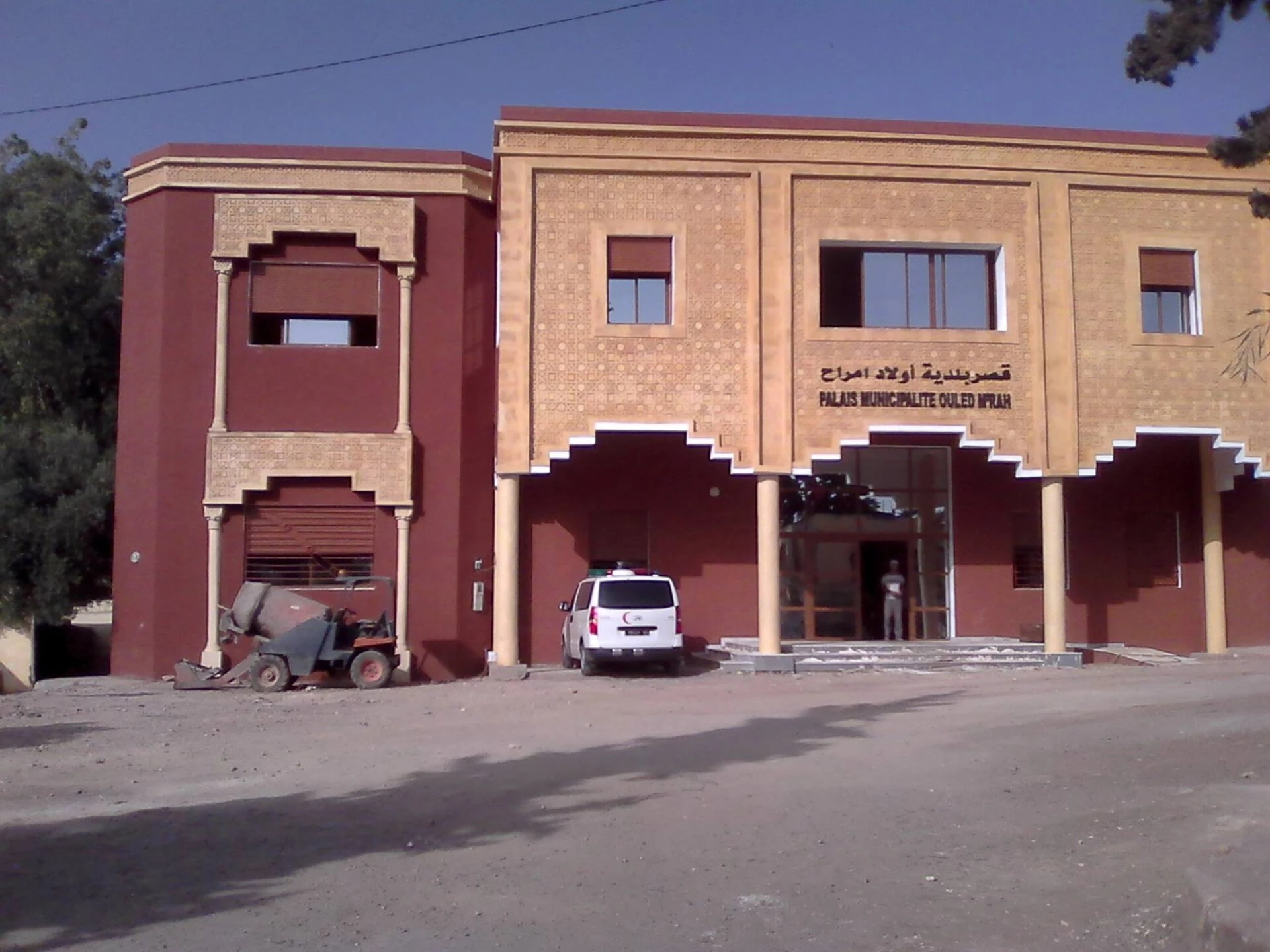
The name combines the founding saint, Sidi Hajjaj, and the Oulad M’Rah tribe. The English Wikipedia article lists the town as Oulad M’Rah. The municipal building bears the inscription “Palais municipal Oulad M’rah”.
Not to be confused
According to Wikipedia, a separate rural commune, simply called Sidi Hajjaj, also exists in Settat province, about twenty kilometres to the north-west. Another place, Sidi Hajjaj Oued Hassar, lies near Casablanca.
Population
According to the English Wikipedia article, the town has 9,166 inhabitants. The article’s infobox dates this figure to the 2004 census. It is a small town, the size of a large village.
A saint from Fez
According to the description of a photo published on Wikimedia Commons, Sidi Hajjaj arrived from Fez around 1492. He is said to have founded the zaouia that bears his name, then the village that grew up around it.
The zaouia
Photos from 2016 show the zaouia: a white horseshoe-arched gateway, walls covered in zellige tilework, a heavy studded wooden door and a courtyard shaded by a large tree. We devote an article to it: the zaouia of Sidi Hajjaj.
The moussem
A 2018 photo shows the Sidi Hajjaj moussem: riders dressed in yellow, on horses with embroidered saddles, surrounded by red flags. The fantasia is one of the highlights of the festival.
The town hall
A 2018 photo shows the municipal building: an ochre and red facade, arcades and saw-tooth decoration above the windows. It overlooks a beaten-earth square.
The centre
Another 2018 photo shows the centre: pink buildings with balconies, bank branches on the ground floor, a lorry and a horse-drawn cart. Rural tradition and modern life sit side by side.
Services
According to photos on Wikimedia Commons, the town has a post office, a secondary school and bank branches. They are the landmarks of daily life for the surrounding douars.
The Chaouia countryside
Around the town stretch the Chaouia farmlands, a land of cereals and livestock. The horse-drawn cart is still a common way to come into town.
The climate
The climate is temperate with a continental touch: cool winters, sometimes cold at night, and hot, dry summers. Spring is the most pleasant season.
Tips for your visit
- Check the date of the moussem.
- Respect the religious character of the zaouia.
- Combine the visit with Settat or Ben Ahmed.
For access and services, see our Sidi Hajjaj Oulad M’Rah practical information.
