
Contents
Skoura is a small town in Ouarzazate province, in the Drâa-Tafilalet region. It is best known for its large palm grove, dotted with kasbahs built of raw earth.
It is the first stop on the road from Ouarzazate to the Dadès valley. Our ideas for visits are gathered in Things to do in Skoura.
Where is Skoura?
According to Wikipedia, Skoura lies about 40 kilometres northeast of Ouarzazate, at some 1,220 metres above sea level. The road then continues to Kalaat M’Gouna, Boumalne Dadès and Tinghir.
The Road of the Kasbahs
Skoura sits on the route that guidebooks call the Road of the Kasbahs, between Ouarzazate and Erfoud. For many travellers, it is their first real encounter with the great oases of southeastern Morocco.
Where does the name come from?
An oral tradition says the oasis was once a lake full of partridges, called askur in Amazigh. The German Wikipedia article also mentions a tribe, the Haskoura, cited by Ibn Khaldun in the late 14th century, which may have given the place its name. Neither explanation is certain.
Population
According to Wikipedia, Skoura had 2,808 inhabitants in 2004 and 4,332 in 2014. The surrounding rural commune, Skoura Ahl El Oust, is home to many more people, spread across the villages of the palm grove. The population is almost entirely Amazigh.
A large palm grove
The oasis spreads where streams coming down from the High Atlas meet, 15 to 20 kilometres to the north. According to Wikipedia, the Oued el-Hajjaj, also called Oued Skoura, joins the Oued Dadès a little further south.
The kasbahs
The palm grove holds many kasbahs, large fortified houses of rammed earth that often bear a family’s name. The most famous is the Kasbah Amridil, whose towers appeared on the old 50-dirham banknote. We devote an article to it: the Kasbah Amridil.
Oasis farming
According to Wikipedia, Skoura grows dates, olives, almonds and fruit trees, as well as alfalfa and barley for livestock. Green fields stretch out in the shade of the palms.
The khettaras
Water reaches the gardens through khettaras, long underground galleries dug to tap the water table, and through dams and seguias, small open channels. This network is the heart of the oasis.
A turbulent history
According to the German Wikipedia article, rivalries between clans were fierce in the late 19th century. They only ended under the French protectorate or after independence in 1956. The fortified kasbahs recall that age of insecurity.
Drought and departures
The droughts of the 1980s and 1990s killed many palms. Since the 1970s, many residents have left to work in the big cities, and some kasbahs have been abandoned.
The centre
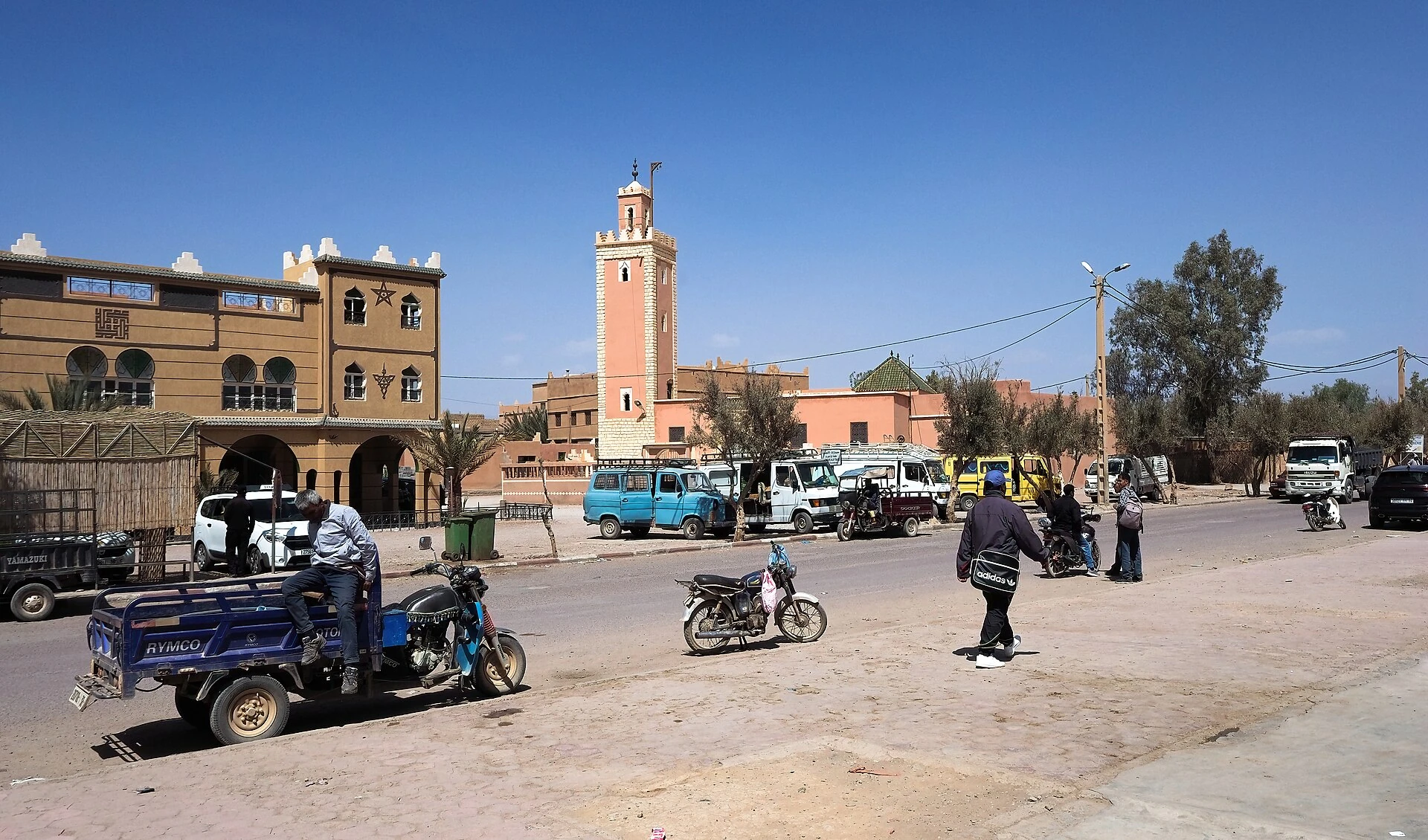
A 2024 photo shows the centre of Skoura: an open square, ochre buildings, the minaret of the mosque and three-wheeled motorbikes parked in the sun. This is where the shops, cafés and taxis are.
The climate
According to Wikipedia, about 170 millimetres of rain fall each year, mostly in winter. Summers are hot and dry, winter nights cold, sometimes with snow visible on the High Atlas peaks.
Crafts and tourism
Potters and basket weavers keep local crafts alive. Several kasbahs have been turned into guesthouses or hotels, and tourism has become a source of income for the oasis.
Tips for your visit
- Stay on the paths of the palm grove.
- Do not pick fruit from the gardens.
- Hire a local guide so you don’t get lost.
- Visit early in the morning in summer.
For access and accommodation, see our Skoura practical information.
