
Contents
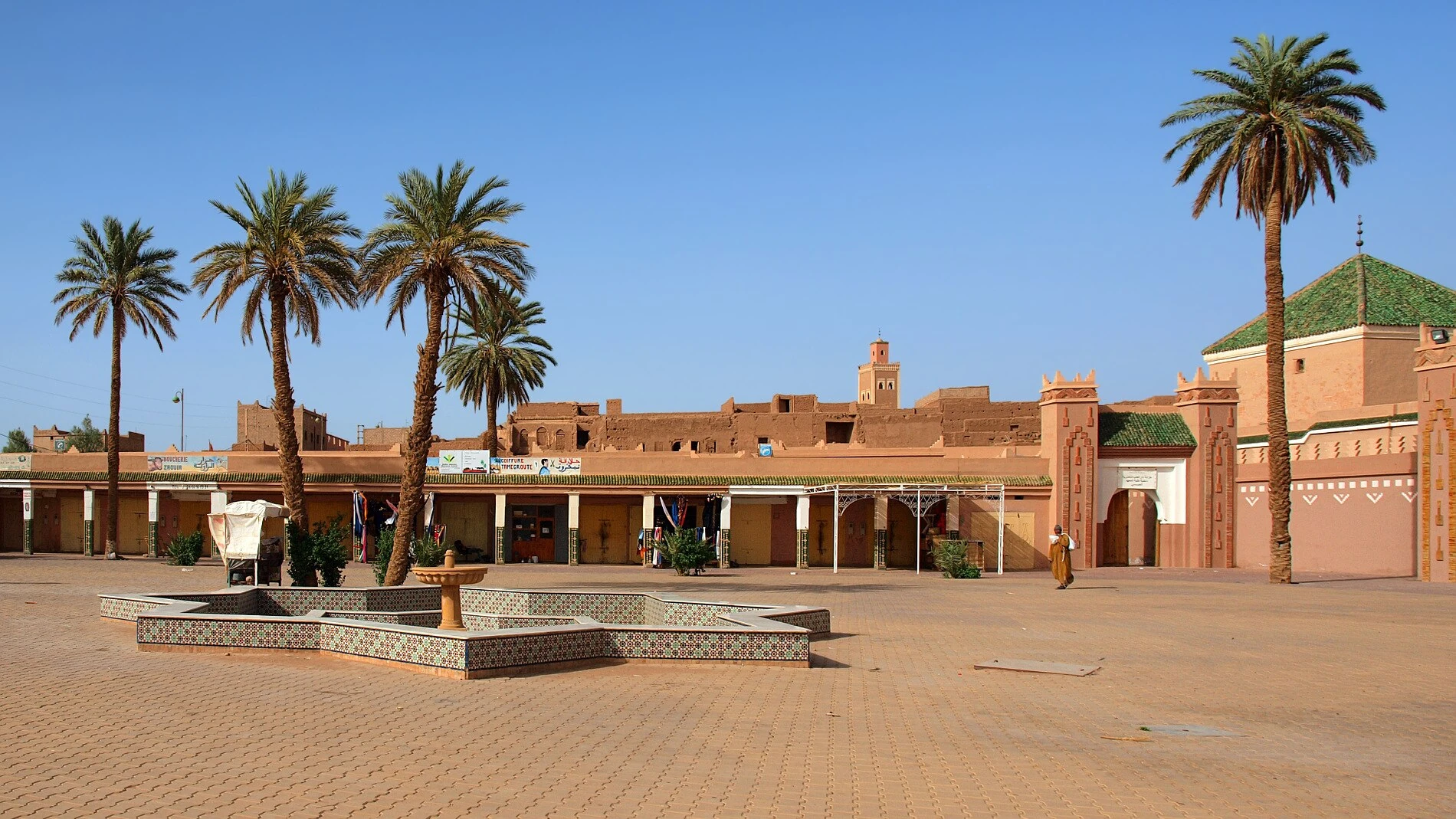
Tamegroute is a village in the Draa valley, in Zagora province. Famous for its zawiya, its manuscript library and its green pottery, it was for centuries a great centre of learning at the gates of the desert.
Most visitors come for half a day or a full day from Zagora. Our visit ideas are gathered in Things to do in Tamegroute.
Where is Tamegroute?
According to Wikipedia, the village lies at about 30°16′ north and 5°40′ west, some twenty kilometres from Zagora. It borders the Draa valley, on the old caravan route to Timbuktu.
A name linked to the desert
According to English Wikipedia, the name Tamegroute is said to mean "the last place before the desert". Beyond it, the valley indeed opens onto pre-Saharan landscapes and wide expanses of sand and stone.
Population
The commune had 21,603 inhabitants in 2014, according to Wikipedia. The village itself is much smaller: the French edition of the encyclopedia puts it at about 6,000 people. The rest of the population lives in the neighbouring ksour and hamlets.
An old religious centre
Tamegroute has been a religious centre since the 11th century, according to Wikipedia. A religious school became famous here in 1575 and 1576, in the time of Abu Hafs Umar ibn Ahmad al-Ansari, to whom the French edition attributes the founding of the zawiya.
The Nasiriyya brotherhood
In the 17th century, Muhammad ibn Nasir al-Drawi, who lived from 1603 to 1674, took over the teaching at the zawiya. He gave his name to the Nasiriyya brotherhood, whose mother house is Tamegroute and which spread across the whole of Morocco.
An earthen ksar
The heart of the village is a ksar of mud-brick houses, crossed by narrow and sometimes covered alleys. These passages stay cool in summer and give shelter from sandstorms. The ochre walls blend with the colour of the ground.
Green pottery
Tamegroute is also known for its green-glazed pottery, which owes its colour to copper. According to Wikipedia, the potters still fire their pieces with palm wood and dry wood: tagines, dishes, bowls and tiles.
The climate
The climate is desert. According to Wikipedia, average highs reach 31.6 °C over the year and average lows 14.6 °C, with barely 51 millimetres of rain a year. Summers are scorching and winter nights are cool.
The Draa valley
The Draa is one of the longest rivers in Morocco. Its valley forms a green ribbon of palm trees, gardens and earthen villages between arid mountains. Tamegroute lies in its lower part, where the valley widens towards the desert.
A village of learning
For centuries, students travelled from far away to learn at the zawiya. They studied the Quran, law, grammar and sometimes astronomy. Our article on the zawiya and its library tells this story in detail.
Tips for your visit
- Come in the morning, before the heat.
- Plan a Saturday for the souk.
- Dress modestly near the zawiya.
- Ask before photographing people.
For access and accommodation, see our practical information on Tamegroute.
