
Contents
Taznakht is a small town in Ouarzazate Province, in the Drâa-Tafilalet region. It lies on the road linking Ouarzazate and Agadir, amid the dry relief of the Anti-Atlas.
It is best known for its rugs, woven by women from the surrounding villages. Our visiting ideas are gathered in Things to do in Taznakht.
Where is Taznakht?
According to Wikipedia, Taznakht is in Ouarzazate Province, on the road to Agadir. Further west, the same road leads to Taliouine, the saffron town, and then to Taroudant.
Not to be confused
Wikipedia points out that Taznakht should not be confused with Tazenakht, a village near Errachidia more than 400 kilometres to the northeast. The two names look very alike, and maps sometimes mix them up.
A growing town
According to Wikipedia, Taznakht had just 3,813 inhabitants in 1994. A 2013 estimate gives 9,149. The town has therefore more than doubled in about twenty years, driven by trade and the road.
Moulay-Hassan avenue
The main street is named after Moulay Hassan. A 2013 photo shows it lined with ochre and pink buildings, with a hotel, taxis and lorries. Shops, cafés and services are concentrated here.
Old earthen houses
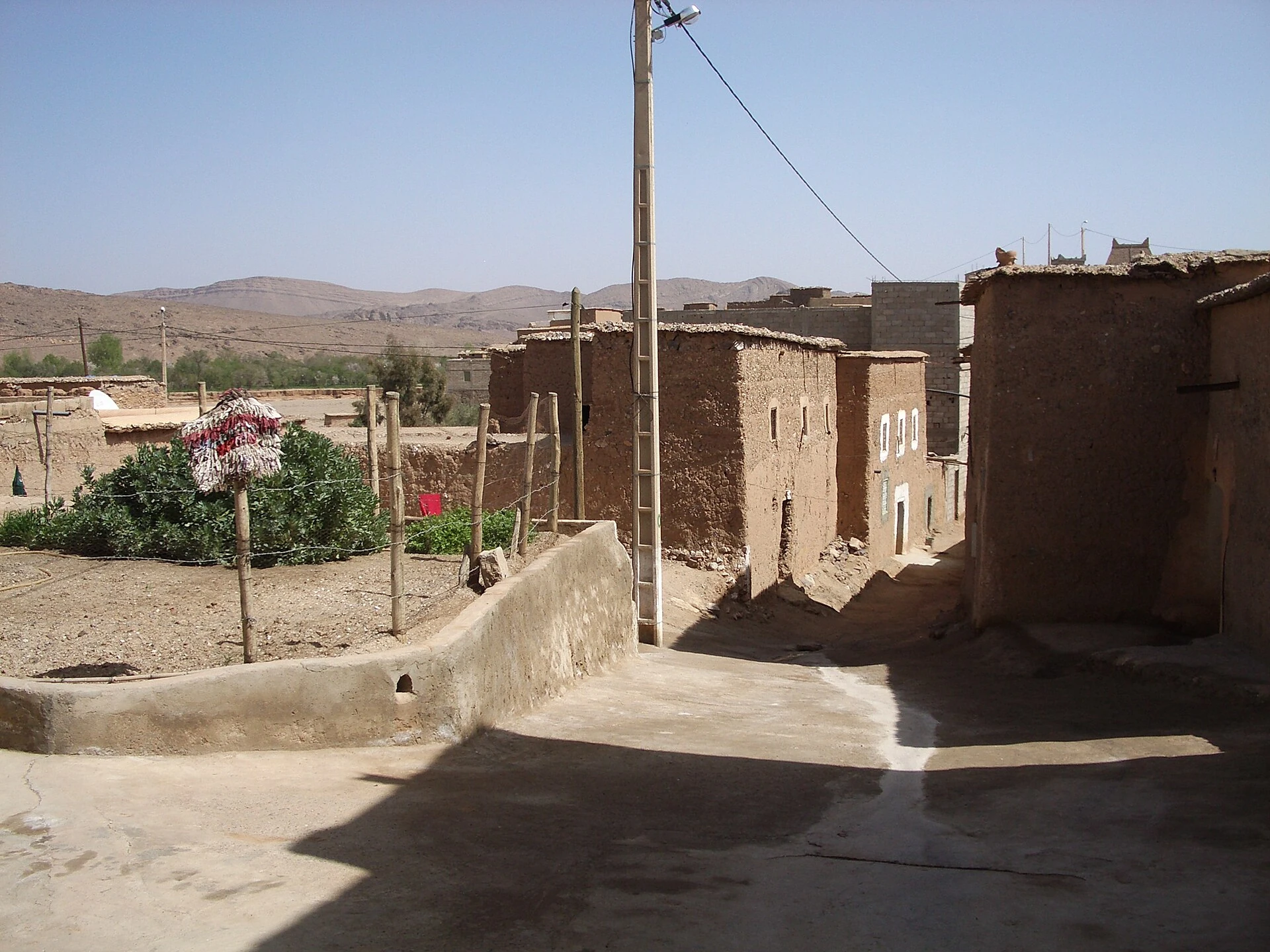
Away from the avenue, the old lanes keep houses of raw earth, with thick walls and small windows. These buildings stay cool in summer and warm in winter.
The town gate
At the entrance to Taznakht, two crenellated pillars frame the road. This symbolic gate welcomes travellers coming from Ouarzazate or Agadir.
The rug town
Taznakht is famous for rugs woven by women of the Ouzguita confederation. Shops and cooperatives display stacks of brightly coloured rugs. Our article on the rugs of Taznakht tells the story of this craft.
The surrounding mountains
The town is surrounded by arid mountains in shades of ochre, red and grey. To the northwest rises the Siroua massif, an ancient volcano that links the High Atlas and the Anti-Atlas.
A stop on the road
For travellers between Ouarzazate and Agadir, Taznakht is a natural stop. People pause here for tea, fuel and a look at the rugs.
Climate
The climate is dry and contrasted. Summers are hot, while winter nights are cold because of the altitude. Rain is rare and falls mainly in winter and spring.
Local life
The town lives from trade, crafts, livestock and services. Nearby villages come here to sell wool, sheep and rugs, and to buy what they need.
An Amazigh region
The population of the region is largely Amazigh and speaks Tashelhit. Traditions, music and crafts keep a strong identity, visible both in rug patterns and in earthen architecture.
Wool and flocks
Sheep farming is closely linked to weaving. The flocks that graze the surrounding hills provide the wool that the women wash, spin and dye. In spring, you may see shepherds moving their animals between pastures.
Tips for your visit
- Take time to compare rugs.
- Ask where each piece comes from.
- Pack a jacket for the evening.
- Fill up before leaving.
For access and accommodation, see our Taznakht practical information.
