
Contents
This article is part of our complete El Hanchane travel guide.
Around El Hanchane, the countryside of the Essaouira hinterland is best discovered on foot. Fields, hedges, trees and flocks make up a peaceful rural landscape.
This article complements our El Hanchane travel guide. To organise your visit, see also our El Hanchane practical information.
A landscape of fields
A 2006 photo shows a bright green cereal field, bordered by trees and bushes. In the foreground, dry branches and flowering stems recall the vegetation along the edges of fields.
Cereals
In the region, wheat and barley are sown in autumn, after the first rains. They grow through the winter and are harvested in early summer, when the fields turn golden.
Shepherds and their sheep
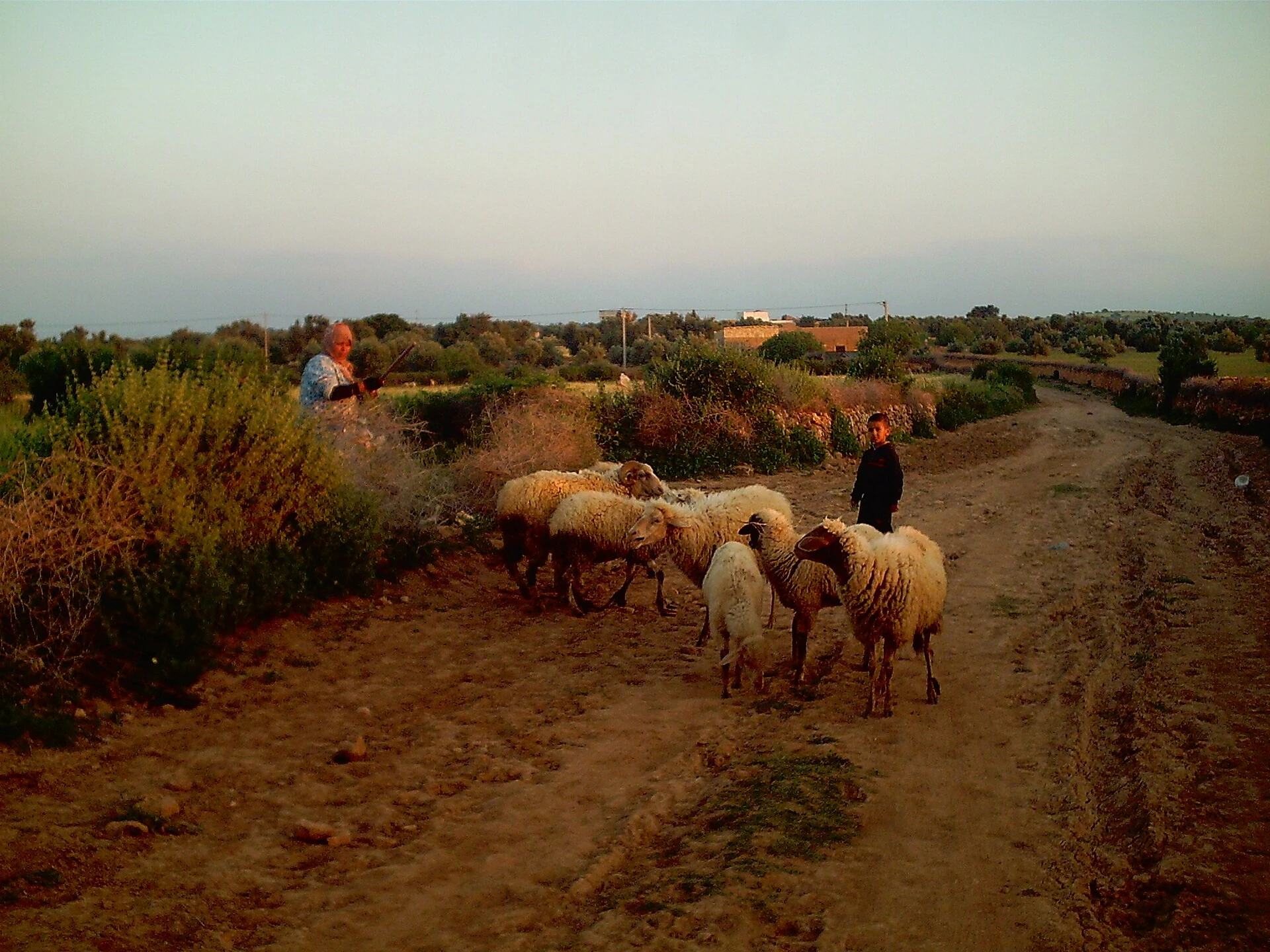
Another 2006 photo shows shepherds leading their sheep along a red dirt track in the evening light. Livestock remains an important resource for families.
Goats
Goats often go with the sheep. In argan areas they feed on the leaves and fallen fruit, and sometimes climb into the branches.
The argan tree
Essaouira province lies within the range of the argan tree. This tree grows almost only in southwest Morocco. Its oil, for cooking or cosmetics, is a flagship product of the region.
Olive trees
Olive trees also grow around the douars. Their olives give an oil used every day, and the harvest takes place in autumn and winter.
The seasons
In spring the countryside is green and full of flowers. In summer the harvested fields take on golden tones. In autumn the land is prepared and people wait for the rains. Winter is mild.
The douars
Around the town, the douars group a few houses, animal pens and small gardens. Life there follows the rhythm of the seasons and farm work.
Walk with respect
Fields and tracks belong to the families who farm them. Stay on the paths, close gates behind you and do not cross the crops.
Meet the people
A greeting in Arabic or Tashelhit often starts a conversation. You may be offered tea. Accept with pleasure or decline politely.
Photograph the countryside
Morning and evening light is the most beautiful. Always ask before photographing shepherds, farmers or houses.
Water, a precious resource
In the countryside, water often comes from wells and cisterns. The irregular rains decide the good and bad years. Do not waste water if you are offered some.
Donkeys and carts
On the tracks, donkeys and carts are still used to carry fodder, water and crops. Give them right of way and slow down if you are driving.
The livestock market
On souk day, herders come to sell and buy sheep, goats and sometimes cows. The bargaining is long and lively. It is a striking sight for visitors, best watched discreetly.
What to bring
Bring good shoes, water, a hat and a light jacket against the wind. Shops are rare outside the centre.
Key points
- Wheat and barley fields.
- Flocks of sheep and goats.
- Argan and olive trees.
- A countryside to respect.
