
Contents
This article is part of our complete Foum Zguid travel guide.
Where it leaves the mountains, the Zguid river has created a green oasis amid the stones. This oasis has kept Foum Zguid alive for centuries.
This article complements our Foum Zguid travel guide. To organise your visit, see also our Foum Zguid practical information.
The mouth of the river
The town’s name means "the mouth of the Zguid river". Here the river leaves the Anti-Atlas ridges and spreads out over the plain, and the oasis grew up around its bed.
An overview
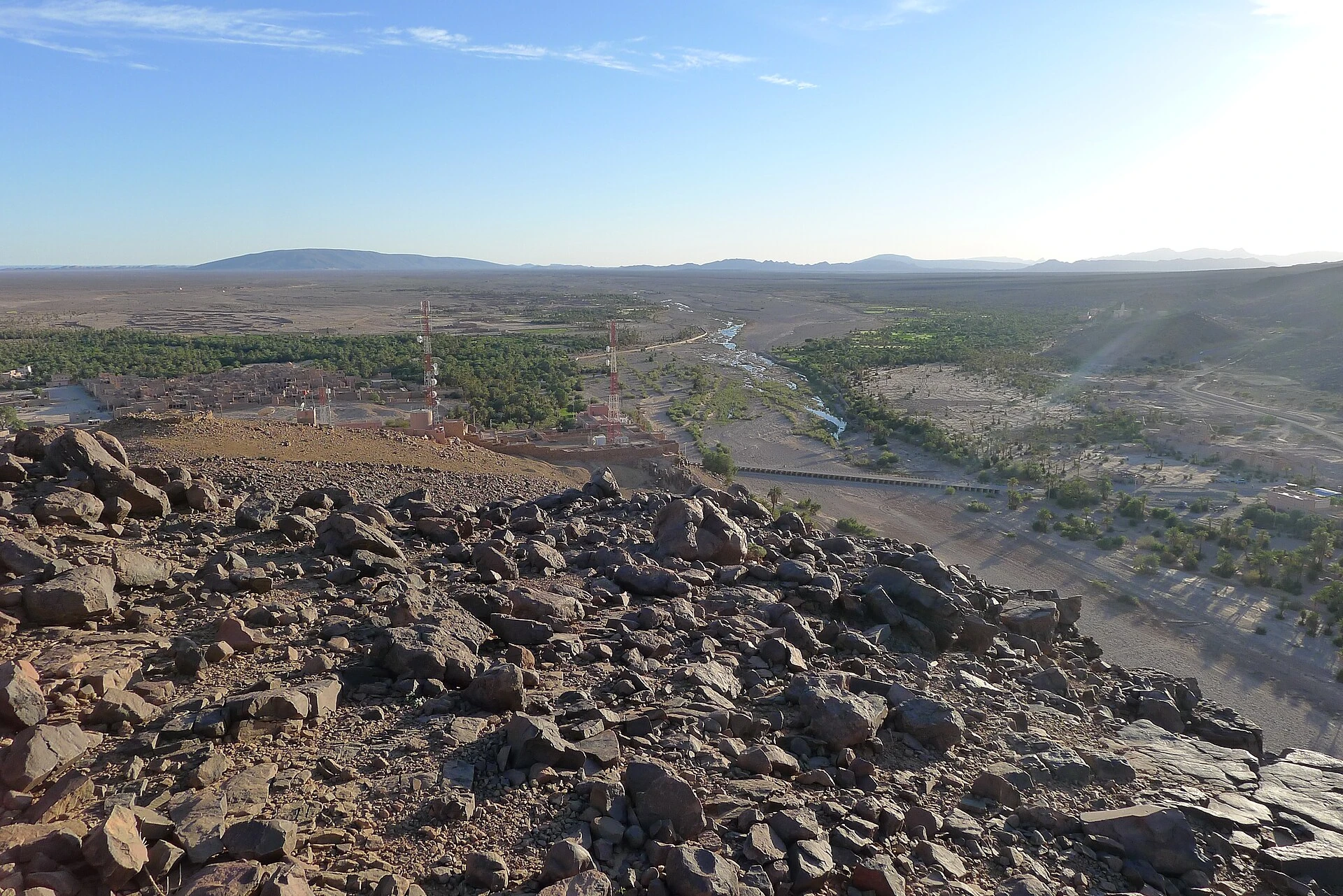
A 2013 photo shows the oasis from the rocky heights: a strip of palms and gardens follows the riverbed, surrounded by stones and arid plains stretching to distant mountains.
Palms at the foot of the mountain
At the foot of the ridges, the palms form a green curtain in front of the bare rock. Ochre houses slip between the trees, sheltered from the heat.
Oasis crops
According to Wikipedia, the oasis mainly produces dates, olives, pomegranates and figs. Under the trees, farmers also grow barley, wheat, maize, broad beans, carrots and tomatoes.
Precious water
With about 105 millimetres of rain a year, water is scarce. The gardens depend on the river and the water beneath its bed. Every drop counts, and sharing water sets the rhythm of farming life.
From nomads to farmers
According to Wikipedia, the oasis was probably settled by nomads who became sedentary. This sometimes led to conflict between the oasis dwellers and nomadic herders.
The old ksar
The ksar, an old fortified earthen village, stands at the heart of the oasis. Today it is decaying and only a few people still live there, while the modern town spreads along the road.
Leaving for the cities
Since the 1970s, many residents have left the oasis for the cities, because of the lack of rain and to find work, health care and schools. Some gardens are less well kept than before.
The gateway to the desert
South of the oasis begin the tracks to Lake Iriki, in Iriqui National Park, and then to Erg Chegaga. These routes are done by 4x4, with a guide.
The ridges as a backdrop
Around the oasis, the mountains reach about 1,500 metres. Their tilted rock layers form long parallel lines. They shelter the oasis and give it its unusual setting.
Seasonal fruit
In autumn, the dates ripen on the palms and the pomegranates turn red in the gardens. It is a fine season to visit the oasis and taste its produce at the souk.
Walk with respect
The gardens are private property. Stay on the paths, do not pick fruit and greet the farmers you meet.
The best time
Early in the morning and late in the afternoon, the light is soft and the heat bearable. The palms then stand out against the colourful ridges.
Photographing the oasis
Climb to a high point to see the contrast between the green gardens and the desert stones. Avoid photographing people without their consent.
Key points
- An oasis born of the Zguid river.
- Dates, olives, pomegranates and figs.
- A fragile old ksar.
- Starting point for desert tracks.
