
Contents
This article is part of our complete Sidi Hajjaj Oulad M’Rah travel guide.
The zaouia of Sidi Hajjaj is the historic and spiritual heart of the town. Sidi Hajjaj Oulad M’Rah grew up around it.
This article completes our Sidi Hajjaj Oulad M’Rah travel guide. To plan your visit, see also our Sidi Hajjaj Oulad M’Rah practical information.
What is a zaouia?
In Morocco, a zaouia is a place linked to a saint or a religious brotherhood. It often includes a shrine, a prayer hall and spaces to welcome pilgrims.
Sidi Hajjaj
According to the description of a photo published on Wikimedia Commons, Sidi Hajjaj arrived from Fez around 1492. He is said to have founded the zaouia, then the village that now bears his name.
The white gateway
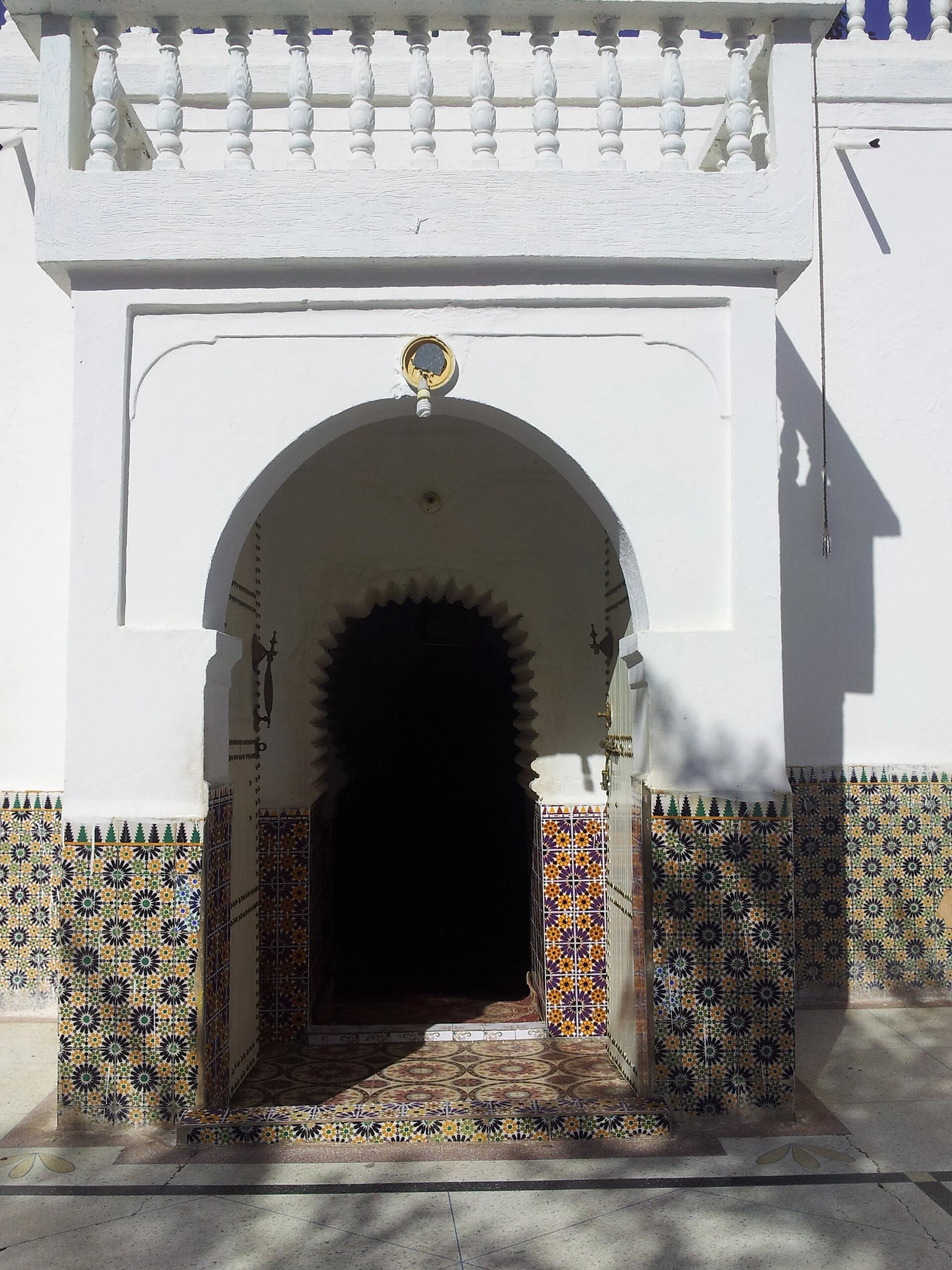
A 2016 photo shows the main gateway: a white horseshoe arch, topped with carved decoration and crenellations. The lower walls are covered in green, blue and yellow zellige.
The wooden door
Another 2016 photo shows a painted wooden door studded with large nails. It is framed by zellige columns and a mosaic floor.
The courtyard
Behind the gates, the 2016 photos reveal a tiled courtyard shaded by a large tree. A red carpet covers the entrance passage.
The shrine
A photo published on Wikimedia Commons in 2024 shows the tomb of Sidi Hajjaj, located in the Oulad M’Rah area. Pilgrims come to pray there.
The moussem
The moussem is the great annual festival in honour of the saint. According to a 2018 photo, it brings together troupes of riders for the fantasia.
The fantasia
The riders, dressed in yellow with white turbans, ride horses with saddles embroidered in red and gold. Morocco’s red flags fly around the track.
A living heritage
The zaouia is not a museum: it is an active place, where prayer and traditions continue. Visitors should behave with discretion.
Zellige
Zellige is a mosaic of small glazed terracotta tiles, cut by hand. Its geometric patterns decorate Morocco’s mosques, palaces and zaouias.
Visiting respectfully
Do not enter prayer rooms without permission. Take off your shoes if asked and speak quietly.
Photographing the zaouia
The entrance is easy to photograph from the street. Inside, always ask permission before taking a photo.
The best time
In the morning, the light falls nicely on the white facade. During the moussem, the atmosphere is at its strongest, but so are the crowds.
The zaouias of the Chaouia
The Chaouia countryside has many saints’ shrines. Many have given their name to a village, as here.
Pilgrims and offerings
During the moussem, families bring candles, sugar or tea as gifts to the shrine. These gestures express gratitude and a request for blessing.
Around the zaouia
Small stalls often set up near the sanctuary on festival days, selling sweets, toys, incense and religious objects.
Tips
- Dress modestly.
- Ask before entering or taking photos.
- Check the dates of the moussem.
For ideas for visits, read Things to do in Sidi Hajjaj Oulad M’Rah.
