
Contents
This article is part of our complete Skhour Rehamna travel guide.
Around Skhour stretches the Rehamna plain, an immense countryside between Marrakech and the plateaus to the north. It has given its name to the province.
This article completes our Skhour Rehamna travel guide. To plan your visit, see also our Skhour Rehamna practical information.
A province, a tribe
Rehamna province is named after an Arab tribe long settled on these plains. According to Wikipedia, it has 346,108 inhabitants in 2024, and its capital is Ben Guerir.
An open landscape
The plain stretches as far as the eye can see, dotted with villages, wells and a few trees. The sky takes up a large part of the landscape.
Cereal fields
Wheat and barley are the main crops. After the winter rains, the fields turn green, then golden before the harvest.
The orchards
According to the Routard guide, the orchards blossom in spring. They add a touch of colour amid the large fields.
Livestock
Sheep and goats graze on uncultivated land. Flocks and their shepherds are part of the daily landscape.
The rocky hills
To the south, the Jbilet hills form a mineral barrier before Marrakech. A 2014 photo shows bare, rocky relief beside the A7 motorway in the province.
The train on the plain
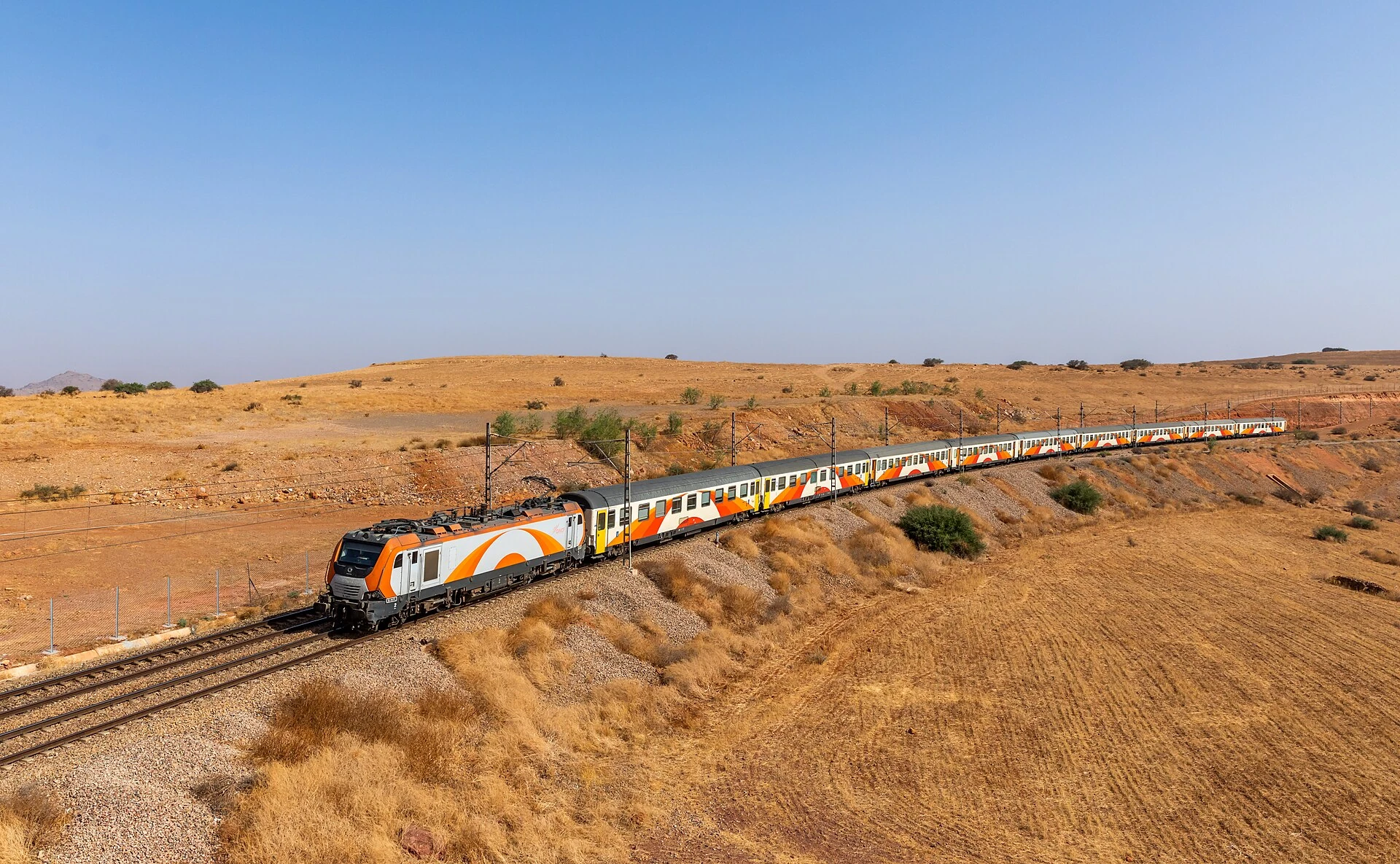
A 2026 photo shows a passenger train on the Fez-Marrakech line, between Sidi Abdallah and Les Skhours. The track crosses a sun-scorched plain dotted with a few bushes.
Phosphates
The province is also known for its phosphates, mined around Ben Guerir. This activity has profoundly transformed the region.
A town of knowledge
Ben Guerir is home to Mohammed VI Polytechnic University. Its modern campus contrasts with the villages of the plain.
The Rehamni rug
According to the Routard guide, women’s cooperatives weave the Rehamni rug. This skill is passed down from generation to generation.
The wells
On this semi-arid plain, water comes mainly from wells. Old stone wells recall how important every water point is for families and flocks.
The seasons
Spring is the most beautiful season, when the countryside turns green. Summer is scorching, and autumn brings back the ploughing.
Crossing the plain
The plain can be explored by car, via the A7 motorway or the secondary roads linking the villages. Drive slowly: carts and flocks share the road.
The villages
Families live in scattered villages made of low houses, animal pens and small gardens. Each village often has its own mosque and school.
The market, a link between villages
The weekly souk brings together the people of the plain. Harvests, animals and goods from town are sold there, and news is exchanged.
The trees of the plain
A few olive, fig and eucalyptus trees dot the plain. They often mark the site of a well, a farm or a village.
The sky over the plain
Far from the cities, the plain offers great sunsets and starry nights. In summer, the wind sometimes raises dust.
Tips
- Bring water and a hat.
- Do not cross cultivated fields.
- Ask before photographing shepherds.
For ideas for visits, read Things to do in Skhour Rehamna.
