
Contents
- A fortified house
- A history over several centuries
- On a banknote
- Rammed earth
- The corner towers
- The inner courtyards
- Life in the kasbah
- The view from the riverbed
- Maintaining the earth
- The other kasbahs
- The ruined kasbahs
- Preserving the heritage
- Visiting the kasbah
- Photographing the kasbah
- A stop on the Road of the Kasbahs
- Tips
This article is part of our complete Skoura travel guide.
The Kasbah Amridil is the most famous monument in Skoura. Its earthen towers, in the middle of the palms, have become the image of the oasis.
This article completes our Skoura travel guide. To plan your visit, see also our Skoura practical information.
A fortified house
A kasbah is a large fortified house, built by a powerful family for protection and to store its harvests. Amridil stands in the palm grove, at the edge of the riverbed.
A history over several centuries
According to the English Wikipedia article, Amridil is a 17th-century ksar to which a tower was added in the late 19th century. The German article instead speaks of an 18th-century building, renewed in the late 19th and early 20th centuries. The dates therefore remain debated.
On a banknote
According to Wikipedia, the towers of the Kasbah Amridil appeared on the old 50-dirham note. This choice shows how much the monument has become a symbol of Moroccan heritage.
Rammed earth
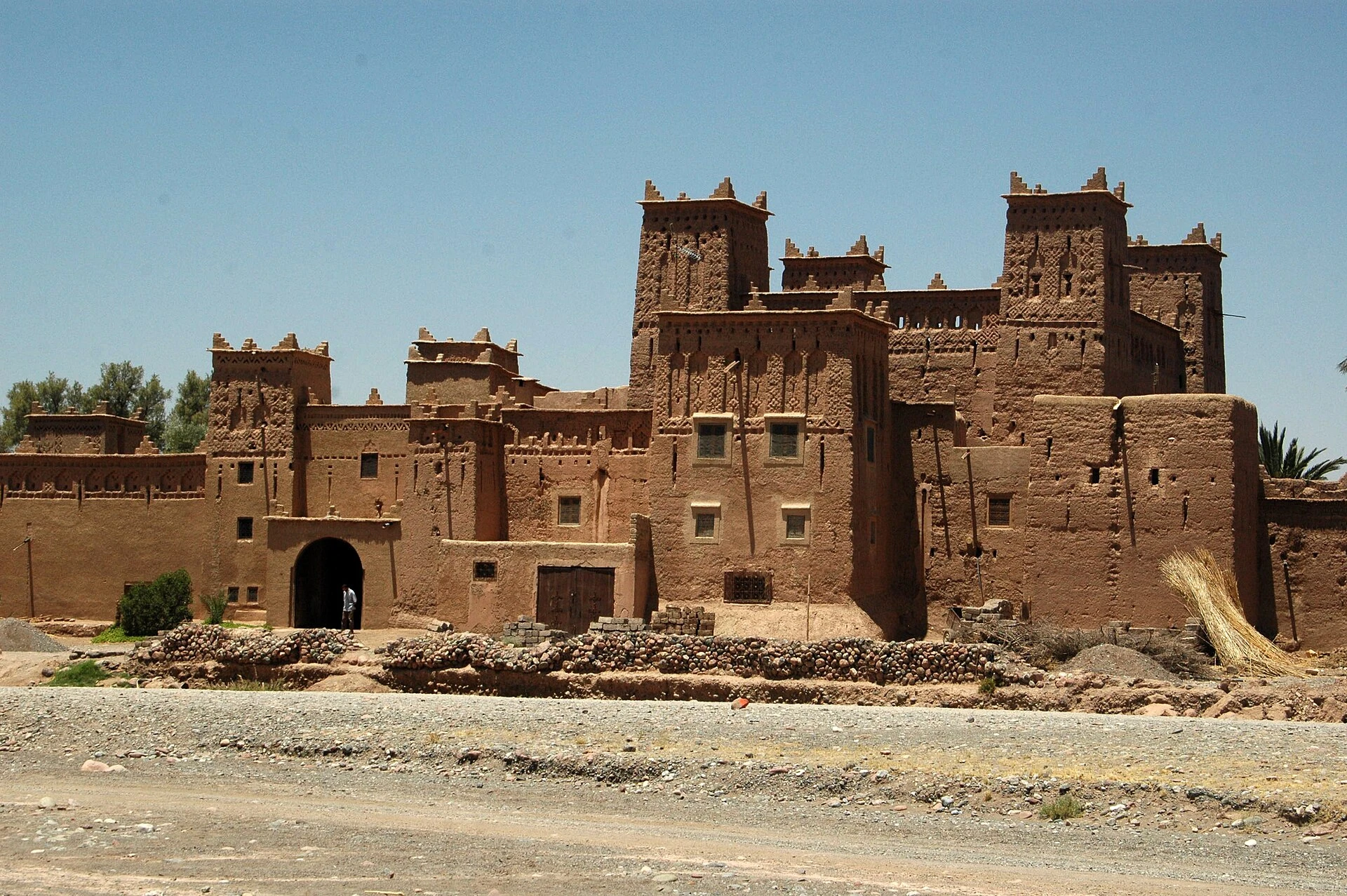
The kasbah is built of rammed earth, soil packed between wooden formwork. A 2007 photo caption notes that this ancient technique now interests people looking for lower-impact buildings.
The corner towers
The tall square towers taper towards the top. Their summits are decorated with geometric patterns carved into the earth, which play with light and shadow.
The inner courtyards
Inside, the rooms are arranged around courtyards. Arcaded galleries open onto these spaces, which bring light and coolness.
Life in the kasbah
The lower rooms often served for stores and animals, the upper floors for families. Visits usually show everyday objects: farming tools, kitchen utensils and old furniture.
The view from the riverbed
A 2007 photo shows the kasbah from the stony riverbed. The ochre walls stand out against the blue sky, above the palms.
Maintaining the earth
Rammed earth must be repaired regularly, especially after rain. Without upkeep, a kasbah can collapse within a few decades, as the nearby ruins show.
The other kasbahs
The palm grove has other kasbahs, often named after the families that built them. According to Wikipedia, the Kasbah Aït Ben Moro has been restored and turned into a hotel.
The ruined kasbahs
Many kasbahs were abandoned as people moved to the cities. Their eroded walls form a strange landscape among the palms.
Preserving the heritage
Restoring some kasbahs as guesthouses has saved them. Tourism can help fund the upkeep of this fragile heritage.
Visiting the kasbah
The kasbah can generally be visited for a small entrance fee. Opening hours may change: ask at your accommodation before going.
Photographing the kasbah
In the morning and evening, the light is softer on the earthen walls. The riverbed offers a good viewpoint over all the towers.
A stop on the Road of the Kasbahs
After Skoura, more kasbahs await on the road to the Dadès, towards Kalaat M’Gouna and Boumalne Dadès.
Tips
- Do not climb on the walls.
- Respect private areas.
- Take a guide to understand the history.
For ideas for visits, read Things to do in Skoura.
