
Contents
This article is part of our complete Tata travel guide.
Among stones and bare mountains, Tata owes its life to its river. Its green banks, gardens and palm trees form an oasis where people love to walk at the end of the day.
This article complements our Tata travel guide. To plan your visit, see also our Tata practical information.
A green ribbon
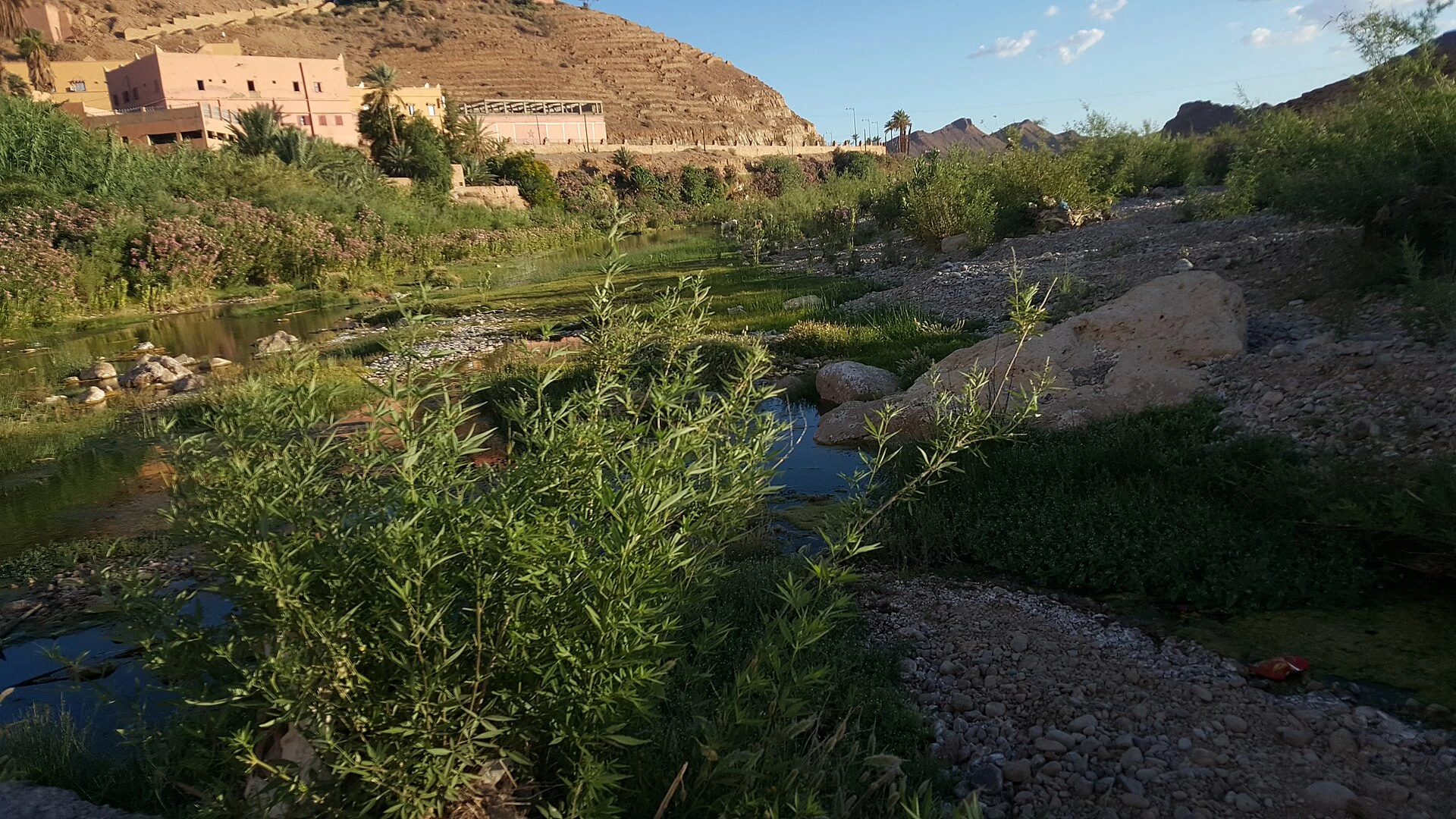
Seen from above, the river draws a green ribbon across the dry plain. A 2017 photo shows its banks covered with reeds and shrubs, below the houses of the town.
Water, the source of life
In the desert, water decides everything. It makes it possible to grow gardens, water livestock and build villages. Tata, like all oases, grew up around this rare resource.
The date palm
The date palm is the king of the oasis. It gives dates, shade and materials: fronds for roofs and mats, trunks for beams. Other crops grow at its foot.
Layered gardens
In an oasis, crops are often grown on several levels: palms on top, fruit trees in the middle, and vegetables, cereals or fodder on the ground. This system protects plants from the sun.
Irrigation channels
Small earth or concrete channels distribute water between plots. Water sharing follows old rules that set each family’s turn.
Floods
The river is often calm, but it can fill suddenly after a storm in the mountains. These floods bring precious water, but they can also damage gardens and tracks.
Oasis birds
The vegetation attracts many birds: songbirds, turtle doves and sometimes herons. In spring, birdsong fills the gardens at dawn.
An oasis in town
In Tata, the oasis and the town touch. In a few steps you go from the arcades of the centre to the gardens by the river. This contrast is the charm of the walk.
The oases of the province
According to Wikipedia, the province has other inhabited oases, such as Akka, Tissint, Foum Zguid and Fam El Hisn. Each has its palm grove and its river at the foot of the hills.
Fragile oases
Drought, falling water tables and the departure of young people threaten the oases of southern Morocco. Projects are trying to preserve the palm groves and the skills linked to water.
The best season
In spring, the gardens are green and the fruit trees blossom. In autumn comes the date harvest, an important moment of the year. In summer, the oasis remains a refuge of relative coolness amid the heat.
Respect the gardens
The gardens are private property. Stay on paths, do not pick anything and ask before entering. A friendly greeting often opens a conversation.
Tips for the walk
Go in the late afternoon, when the heat drops. Wear good shoes, take water and avoid the riverbed if a storm threatens.
Key points
- A green ribbon in the desert.
- Palm trees and layered gardens.
- Sudden floods possible.
- Private gardens to respect.
