
Contents
This article is part of our complete Taznakht travel guide.
Taznakht is one of the great names of the Berber rug in Morocco. In the villages around the town, women have woven rugs with recognisable patterns and colours for generations.
This article complements our Taznakht travel guide. To plan your visit, see also our Taznakht practical information.
The Ouzguita weavers
The rugs of the region are associated with the Amazigh confederation of the Ouzguita. Weaving is women’s work, passed down from mother to daughter. Each weaver brings her own hand and style.
From wool to yarn
It all starts with the wool of local sheep. It is washed, carded and then spun by hand. This long, patient work produces a thick, strong yarn.
Dyes
Colours traditionally come from plants and minerals: madder for red, henna for orange, indigo for blue. Today, chemical dyes are also used. Ask which ones were employed.
The loom
Weaving is done on an upright loom, often set up in the home. The women knot or weave row after row. A large rug can take several weeks or even months.
Patterns
Diamonds, triangles, crosses and zigzags make up geometric designs. Red, orange or dark backgrounds dominate. Each village has its preferences, and some patterns have names.
Knotted and flat-woven rugs
In Taznakht you will find knotted rugs, thick and soft, and flat-woven rugs, which are lighter. Both techniques coexist and serve different uses.
A shop visit
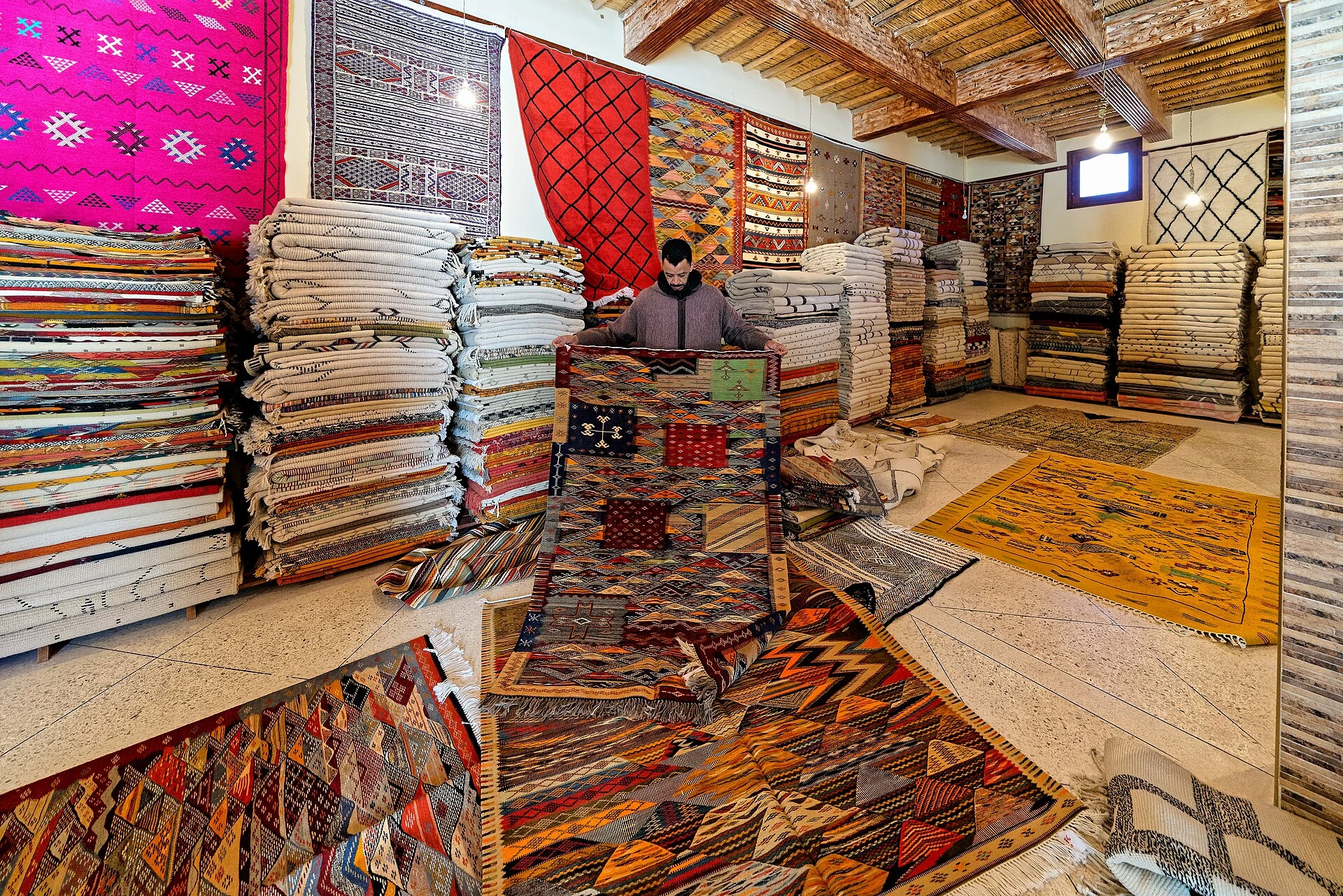
In 2023, a photographer visited a rug workshop in Taznakht. The pictures show stacks of multicoloured rugs and pieces spread on the floor, ready to be shown to customers.
Cooperatives
Several women’s cooperatives sell their rugs directly. This system lets weavers earn a better living from their work and keep control of prices.
A threatened craft
Rural exodus, competition from industrial rugs and falling prices weaken this craft. Buying an authentic rug at a fair price helps keep it alive.
A rug festival
According to the Moroccan press, Taznakht hosts a festival dedicated to rugs. Check the dates: it is a chance to see many pieces and meet the weavers.
Spotting a good rug
Look at the back of the rug: regular, tight knots are a good sign. Feel the wool, which should be supple. Check that the colours do not run.
Caring for your rug
Shake the rug regularly and vacuum it gently. Avoid direct sun, which fades the colours. For a stain, clean with cold water without rubbing too hard, and use a professional for a full wash.
Rugs in Moroccan homes
In the villages, rugs are not just decoration. They cover the floor, serve as blankets in winter and are part of a bride’s dowry. Some pieces are kept for generations and brought out for celebrations.
Bargaining
Bargaining is part of buying. Set yourself a budget, stay polite and do not hesitate to leave if the price does not suit you.
Key points
- Ouzguita rugs.
- Hand-spun wool.
- Geometric patterns.
- Women’s cooperatives.
