
Contents
This article is part of our complete Tendrara travel guide.
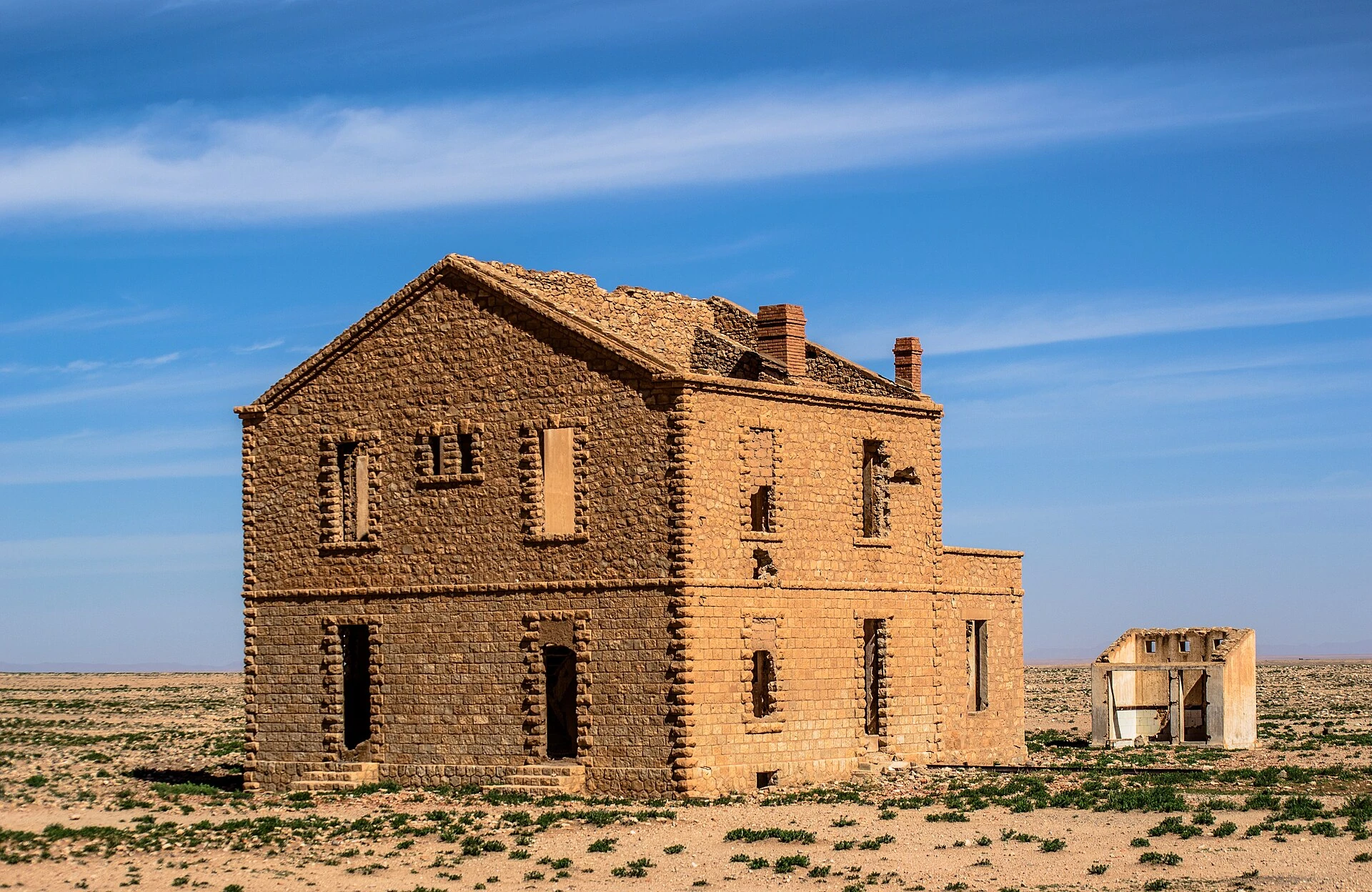
In the middle of the steppe, Tendrara’s old railway station stands as a witness to the past. Its stone walls tell the story of a railway line and of a dark period.
This article complements our Tendrara travel guide. To organise your visit, see also our Tendrara practical information.
A line from Oran
According to the Diarna website, the railway that crosses Tendrara ran down from Oran, in Algeria, across Morocco’s eastern border. Tendrara was born and grew up along this line.
The station building
A 2015 photo shows the old station: a two-storey building in ochre stone, its corners picked out in lighter stone, with a tiled roof. The windows are empty and a small outbuilding stands beside it.
The camp site
According to Diarna, the camp site lies about half an hour by track east of the town. Several sand-coloured buildings with collapsed ceilings face the track there. Barbed wire and Marseille roof tiles can still be seen. The staircase leading to the station house is still intact.
The Vichy camp
According to Wikipedia, a labour camp of the Vichy regime stood near Tendrara during the Second World War. Diarna describes it as the best-preserved Vichy camp along Morocco’s eastern border.
The prisoners
According to the historian Robert Satloff, quoted by Wikipedia and Diarna, prisoners from Warsaw, Leipzig, Salzburg and Bucharest, as well as Spaniards, lived there in tents.
A railway built by prisoners
According to Diarna, this railway was largely built by prisoners of the Vichy regime. The buildings were used by soldiers or by railway company overseers.
A place of memory
Today the old station is a silent place. It recalls the fate of the men sent to work in these harsh conditions, far from home, on the high plateaus.
How to get there
According to Diarna, the camp site is reached by a track east of the town, in about thirty minutes. Ask locally and, if possible, go with a local resident who knows the way.
Visit with respect
Stay outside the buildings, whose roofs have collapsed. Take nothing and leave no litter. This place deserves the respect owed to the memory of the prisoners.
A steppe landscape
Around the station, the steppe stretches as far as the eye can see. A few tufts of grass and small shrubs grow on the stony ground. This bare setting adds to the feeling of solitude.
Rail in the Oriental
The railway long linked the towns of the Oriental, from Oujda southwards. It carried passengers, goods and ore from the region, and left many stations along its route.
Photographing the station
The ochre stone of the station stands out against the blue sky and the pale green of the steppe. Morning and evening light are the most beautiful.
Read before you go
Robert Satloff’s book Among the Righteous, published in 2006, tells the story of the Jews of North Africa during the Second World War. It helps you understand what you see on site.
Key points
- Line from Oran.
- Vichy camp nearby.
- Ruined buildings.
- A respectful visit.
