
At a glance
- Choose between a cave visit, a landscape and a research site — If you want to see the inside of a cave, look for a site where somebody can confirm the visiting conditions.
- Tangier: the Caves of Hercules and Cape Spartel — The Moroccan National Tourist Office presents the caves of Hercules and Cape Spartel among the visits around Tangier.
- Taza and Demnate: a cave shaft, a park and a natural bridge — Friouato lies near Taza in the Tazekka area.
Contents
- Choose between a cave visit, a landscape and a research site
- Tangier: the Caves of Hercules and Cape Spartel
- Taza and Demnate: a cave shaft, a park and a natural bridge
- Tafoughalt and Temara: two stories from prehistory
- Aglou and Morocco’s coastal caves
- Plan a day with a second option
- Frequently asked questions
Choose between a cave visit, a landscape and a research site
If you want to see the inside of a cave, look for a site where somebody can confirm the visiting conditions. Ask about your date, the opening hours, the sections you can enter and the effort needed to get back out. An open site might mean an outdoor area or a defined route with a ticket. Ask what the entry or guided visit covers before deciding whether to make the journey. Save the details and check the notices when you arrive.
| Site | Main interest | Check first |
|---|---|---|
| Caves of Hercules | View of the Atlantic | Visitor route, price and transport back |
| Friouato | Cave shaft and Tazekka landscape | Access to the surroundings and descent |
| Imi n’Ifri | Natural bridge near Demnate | Path condition and access |
| Taforalt and Contrebandiers | Prehistory | Publications and any confirmed interpretation programme |
For a landscape, find a public observation point or an arranged walk. This type of exit is suitable when the group wants to see the coast, an arch or relief without going underground. On the coast, check the swell and tide if you are approaching low areas. In the mountains, find out about possible trails and arrivals after the rain. A planned visit with children must include a return route adapted to their pace.
A search makes sense if the place, layer and date are documented together. The names Taforalt and Smugglers appear in publications on ancient objects, sediments and levels. For an outing focused on this research, start with a museum or illustrated publication. You will have enough to explain the discoveries even if no public journey is confirmed. Before leaving, distinguish the address of a museum from that of the site where the research took place.
Tangier: the Caves of Hercules and Cape Spartel
The Moroccan National Tourist Office presents the caves of Hercules and Cape Spartel among the visits around Tangier. The caves are on the Atlantic side and the rocky opening on the sea is a landmark of the visit. Choose which of the two stops counts most if your time is limited. Find the two arrival points separately. The driver or route planner must be able to distinguish between the lighthouse, caves and the beach of Achakkar.
You can keep a half day for the coast and another for the Tangier Medina. If your family wants to make only one outing, ask which parts of the caves are visiting, and then decide if you want to add the lighthouse. When booking a transfer, specify the waiting time and return price. If you come from a ferry, check the arrival port before calculating the journey. The detailed guide also explains how to read the legend of Hercules and prepare a short visit.
Taza and Demnate: a cave shaft, a park and a natural bridge
Friouato lies near Taza in the Tazekka area. Pictures from inside show the scale and depth of the shaft. Arranging a descent depends on local conditions. Ask which areas are open and who can confirm access. If only the outdoor area is available, decide if the trip is worthwhile for what you can see. Keep a second option in Tazekka National Park or in Taza itself.
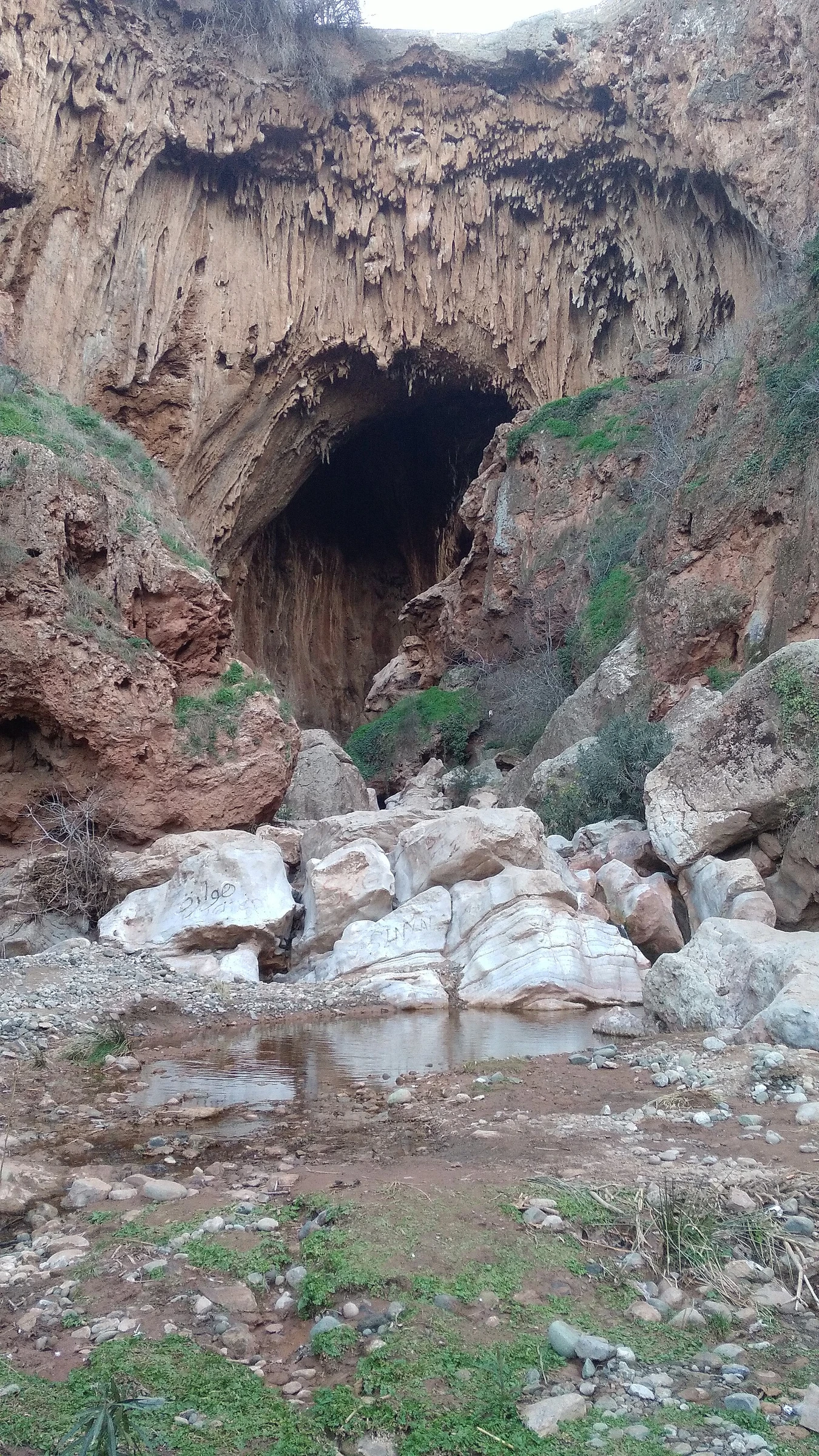
Imi n’Ifri, near Demnate, is a natural bridge. The shape of its arch makes this a different outing from descending a cave shaft. Ask about the condition of the path and check which areas you can reach before planning a descent or a walk under the arch. The M’Goun UNESCO Global Geopark provides a wider geological context for a trip. You can make the landscape itself the focus by using permitted viewpoints.
If you compare Taza and Demnate, leave your actual itinerary. Note the base, means of transport, main activity and alternative plan. For a first stay, choose the area that best integrates with other stages. Provide a margin for slower roads, a change of access or a group that wants to walk less. You can spend the time saved on the city’s heritage or on a short walk.
Tafoughalt and Temara: two stories from prehistory
In the Beni Snassen mountains, the Grotte des Pigeons near Tafoughalt yielded perforated shells studied in deposits around 82,000 years old. Researchers examined their context, where they came from and the marks on their surfaces. Studies of Taforalt cover several periods and types of evidence. Keep the period and method with each result. Our Taforalt guide explains what you can learn from a shell.
On the coast near Temara, excavation at Contrebandiers Cave uncovered shaped bone tools. A study describes tools from deposits dated to around 120,000 to 90,000 years ago. Researchers compared the shapes and traces on some tools with evidence of hide working. If you are staying in Rabat, you can also check the Museum of History and Civilizations and find out what it is displaying on your dates.
These two examples help prepare a cultural visit with older children. Choose an image or figure from a publication for each place. Ask the children to say what they see and then distinguish the part described by the researchers from the proposed function. Then draw two time bands and place the dates studied. You get a preparation activity linked to Morocco and adaptable to your program of the day.
For a stay of several days with an interest in archaeology, give each day a question. At the museum, look at how the periods are presented. On an permitted walk, observe the materials and reliefs that the landscape allows you to read. At your accommodation, take the map and give each result the exact name of the cave. This method explains what the region brings to history, even when objects or layers are only accessible in documents.
If the group compares two sites with similar names, note the name as it appears in the source and nearby municipality. Also keep the question asked: a visit, a landscape or a research topic. Alias such as Taforalt and Tafoughalt are useful for finding studies and maps. The names of the route must then correspond to the places where you can go. For a museum, check the address and program rather than go to the location of a search.
Aglou and Morocco’s coastal caves
The trip to Aglou from Tiznit allows you to choose a coastal promenade. Searches can mix photos of rocks, shelters or accommodations with very different access points. Before you select a place, identify its name, route from the cornice and local instructions. A walk on an permitted path can offer a view of the coast and remain feasible with a margin for return. Ask for the exact point where the transport can take you back.
On the coast, the decision to walk near water depends on the conditions of the day. If access requires crossing wet rocks, the group can change its route and stay on an arranged portion. In the mountains, stay on the allowed route and follow the instructions of the accompaniment. Photograph from the open points and leave stones, shells and other materials in place. The manager’s instructions and closures are part of the route parameters, along with the weather and duration.
Plan a day with a second option
Example on the coast near Tangier: assign the morning to the site that interests you most, confirm access and add a stop only if the schedules allow. Book the way and return by specifying the point of deposit. Also note where the vehicle is waiting for you in case of change. If access to the cave is limited, a stop on the cape or a return to the kasbah can replace the visit. Choose the fold before departure to avoid improvising on the road.
Example for Taza or Demnate: first check the accesses and conditions in the morning, then choose whether the priority remains the natural site or a discovery in the city. Keep available addresses offline and book time for the trip from your accommodation. If the children are tired, choose a single goal and place where you can stop. At the end of the day, compare the time spent on site to the road time before deciding to add another cave to the stay.
Frequently asked questions
Which cave should I choose for a first outing in Morocco?
The Caves of Hercules are an option from Tangier if the public route is confirmed. To focus on geology or prehistory, choose another area and prepare the course or reading of sources accordingly.
Can you visit all these caves?
Each site has its own conditions. Check with the manager for access to the tourist caves and focus on museums and publications to understand research sites whose public reception remains to be confirmed.
