
At a glance
- Find the entrance and check ticket details — The proximity of the Ben Youssef mosque can help guide you, but the Madrasa ticket concerns the school building.
- Understand the role of this Saadian school — The monument’s official site dates the present building to 1564–1565, under the Saadian sultan Abdallah al-Ghalib.
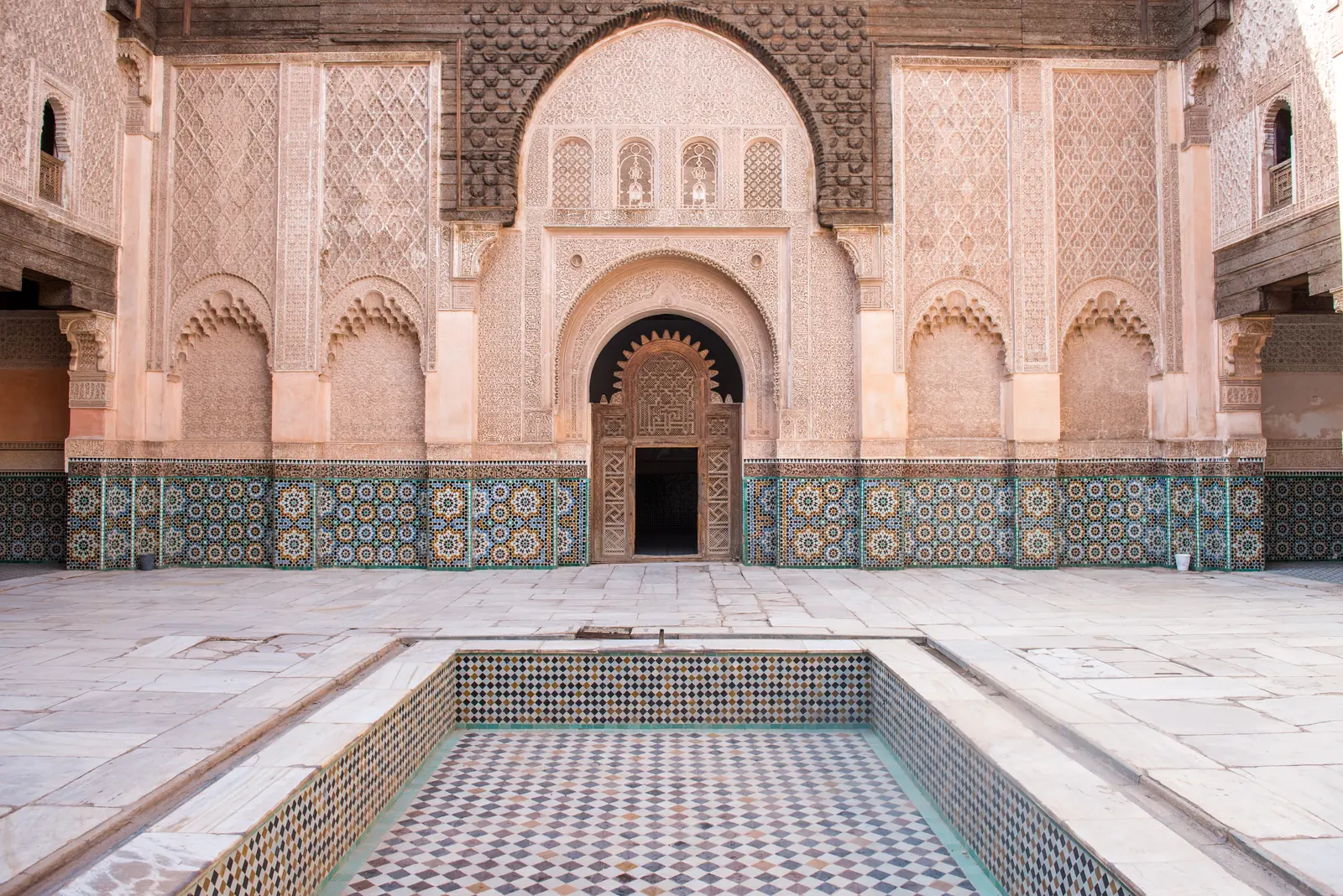
- Read the courtyard from floor to ceiling — In the central courtyard, start by looking at the shape of the patio, the position of the basin and the openings of the facades.
Contents
Find the entrance and check ticket details
Look for Ben Youssef Madrasa on the Marrakech map and register the location indicated by its official website. The proximity of the Ben Youssef mosque can help guide you, but the Madrasa ticket concerns the school building. If your accommodation shows you a route in the souks, ask for the last landmark before the portal. Keep the map on your phone even when you plan a connection. Médersa Ben Youssef
| Space | What to look for |
|---|---|
| Central courtyard | Pool, façades, zellige, stucco and cedar |
| Prayer hall | Decoration around the mihrab |
| Small courtyards | Room size and light |
Walking from your riad or deposit point must remain in your time estimate. The route varies depending on the street you are taking and how long it takes to locate yourself. In shopping passes, choose a place where you can stop without blocking the path if you need to check the direction. For a group, agree on an identifiable meeting place near the entrance.
The official site of the monument offers separate pages for schedules and rates, ticketing and group preparation. Check the conditions for the specific day you will be in the medina. Confirm any ticket requirements and keep your confirmation accessible offline. If you have booked more than one visit, check on each ticket the name of the site, date and time before leaving. Médersa Ben Youssef · Horaires et tarifs · Médersa Ben Youssef · Billetterie
For a wheelchair, stroller or participant who must avoid steps, ask a concrete question at the reception. Check the entrance threshold, access to the court and areas that require switching from one level to another. A response on entry alone does not provide information about all spaces. You can choose to focus the visit on the courtyard and the details visible from the open pitches.
Understand the role of this Saadian school
The monument’s official site dates the present building to 1564–1565, under the Saadian sultan Abdallah al-Ghalib. These dates provide a starting point when comparing the madrasa with other places in Marrakech. The UNESCO listing covers the medina as a whole. Use the madrasa’s own documentation for its building history and current visitor arrangements. Médersa Ben Youssef · Histoire · UNESCO · Marrakech
A madrasa is here a place of teaching and life. It brings together spaces where students learn, pray or lodge. Look at the court and the prayer hall as two parts of the same set. The small pieces around the runners give another idea of the scale of daily life. Retain the distinction between large shared spaces and rooms before studying decorative details.
The official documentation describes 134 rooms grouped around 13 courtyards, with rooms on the ground floor and upstairs. This total provides information on the historical organisation of the building. The tour route determines the rooms you can see. A short observation of a corridor and an open cell can be sufficient to understand the contrast with the proportions of the large courtyard. Médersa Ben Youssef · Architecture
If your visit includes another 16th century place, note the function of each building before comparing its decor. The criteria for reading a school, palace or funeral complex differ. At the madrasa, observe where traffic tightens, where it opens onto the courtyard and how collective spaces are distributed. This look gives a leading thread to a first visit.
Read the courtyard from floor to ceiling
In the central courtyard, start by looking at the shape of the patio, the position of the basin and the openings of the facades. The proportions become easier to read from one edge, looking towards the opposite side. Then move your gaze to a single span. This method avoids dispersing its attention between dozens of patterns and makes it possible to compare a detail with the overall organization.
The zellige assembles tiles cut into motifs, often geometric. You can see it on low surfaces of the courtyard and around some architectural elements. Look for a form that repeats and then look at the joints and color changes. A drawing can be easier to understand by following the contour of a module of the look on some tiles rather than by fixing an entire wall.
The sculpted plaster lends itself to finer patterns, interlacing and inscriptions. Cedar wood appears in elements such as doors and ceilings, depending on the presentation of the monument. To compare the three materials, gradually raise your eyes from the bottom of a single panel or span. The place where the light changes can make the reliefs easier to distinguish. Médersa Ben Youssef · Architecture
The prayer hall is another reading point, since the space allowed. The mihrab indicates the direction of prayer. By observing the visible details, distinguish the treatment of the opening and the surrounding decor. If a rope or barrier limits access, take this step back as an observation point. Staff indications take precedence over routes told in old blogs or photographs.
The official site measures the central courtyard at 21.90 metres long and 16.50 metres wide. It also describes the three aisles of the prayer hall. Use these details to put your photographs in context. Compare the courtyard, open to the sky, with the prayer hall and its interior divisions. From places you may enter, see how the openings direct your view towards the interior or the pool.
The official documentation also describes a traditional water-distribution device in the entrance vestibule, called a maada. It collected water arriving through pipes and distributed it by gravity. The device gives you a way to separate practical engineering from decoration. Look for the explanation on the signs. In the courtyard, return your attention to the pool and its position between the façades. The same walk can help you remember both a piece of working infrastructure and a feature of the building’s layout.
Move from the courtyard to the student rooms
Proceed in contrasts. The large patio allows to read the volume and facades. The courtyards and the rooms show a more intimate ladder. If the floor is open, follow the stairs and direction indicated for visitors. Find the way back before dispersing, especially when several people cross. One minute dedicated to reading traffic avoids blocking a narrow passage.
In an accessible room, look where the light comes from and how the room communicates with the hallway or courtyard. Ask yourself what this position says about the organization of places. Avoid assigning specific use to each niche without any indication. A simple observation such as the width of a door, the height of an opening or the narrowness of the room helps to understand the building’s choices.
Families can choose one pattern per space. At the entrance, ask children to recognize a form of the portal. In the courtyard, compare a mosaic and an inscription. In the courgettes, invite them to notice the difference in size. Alternate remote search and close-up observations when permitted. Adjust the number of stops to the time that the group can spend standing.
Allow time to explore and take photographs
For a short visit, focus on the entrance, courtyard and secondary space when it is open. To go further, also set aside time to compare materials and read panels that explain the function of parts. Keep a margin between the time you think of leaving the monument and your next ticket. The waiting and walking in the medina varies during the day.
For photography, start with a set scene before the details. From an authorized location, photograph the basin and a facade to preserve the context. Then visually approach a plaster pattern, wood element or tile panel. Check tripod and equipment rules prior to visit. Wait until the passage clears, especially if you frame a corridor.
The bright conditions change in an open patio and in the darker rooms. Allow visitors time to adapt before hindering a passage. After the release, caption your images with the name of the space you actually photographed. Separate the photos of the madrasa from those of the nearby mosque and souks. This ranking helps to compare a facade view and an interior detail.
Combine the madrasa with other Marrakech stops
The Madrasa naturally integrates into a walk in the northern part of the medina. Find the possibility of a break before proceeding to the souks. If the next stop is the Bahia Palace, check the route from the actual exit of the monument. A program with two entrances at fixed times leaves less flexibility to follow a detour or wait for a person in the group.
The Marrakech guide in three days helps to distribute the medina, palaces and Guéliz. In the day dedicated to the north of the medina, first fix the Madrasa niche if the ticket office requires it, then hold flexible stops nearby. The Koutoubia can be the subject of an outdoor walk from another area. Consult the information from each location separately before announcing a final order.
Frequently asked questions
Are the madrasa and the Ben Youssef Mosque the same visit?
Search the entrance and conditions of the old school Madrasa. The nearby mosque is a separate landmark. On the map and on the ticket, read the full name. If you book a visit that mentions several monuments, ask which ones are included and what access the group will find.
What should you look for first in the madrasa?
Start with the pool and the proportions of the court. Then compare the zellige of the lower parts, carved plaster and wood elements. When the course allows, finish with a student court to understand the contrast between common spaces and accommodation.
