
Contents
This article is part of our complete Boumalne Dadès travel guide.
The Dadès gorges extend the journey upstream from Boumalne. They lie in the upper valley between the town and M’semrir and cannot be reduced to one cliff or a single road photograph. Their interest comes from successive forms, passages and inhabited landscapes. This article helps choose a discovery suited to your time and way of travelling. The Boumalne Dadès guide provides town and regional context; here the focus is the gorges and the differences between driving, observing and walking. A clear purpose makes it easier to arrange transport and judge a proposed outing sensibly.
Understand successive gorge landscapes
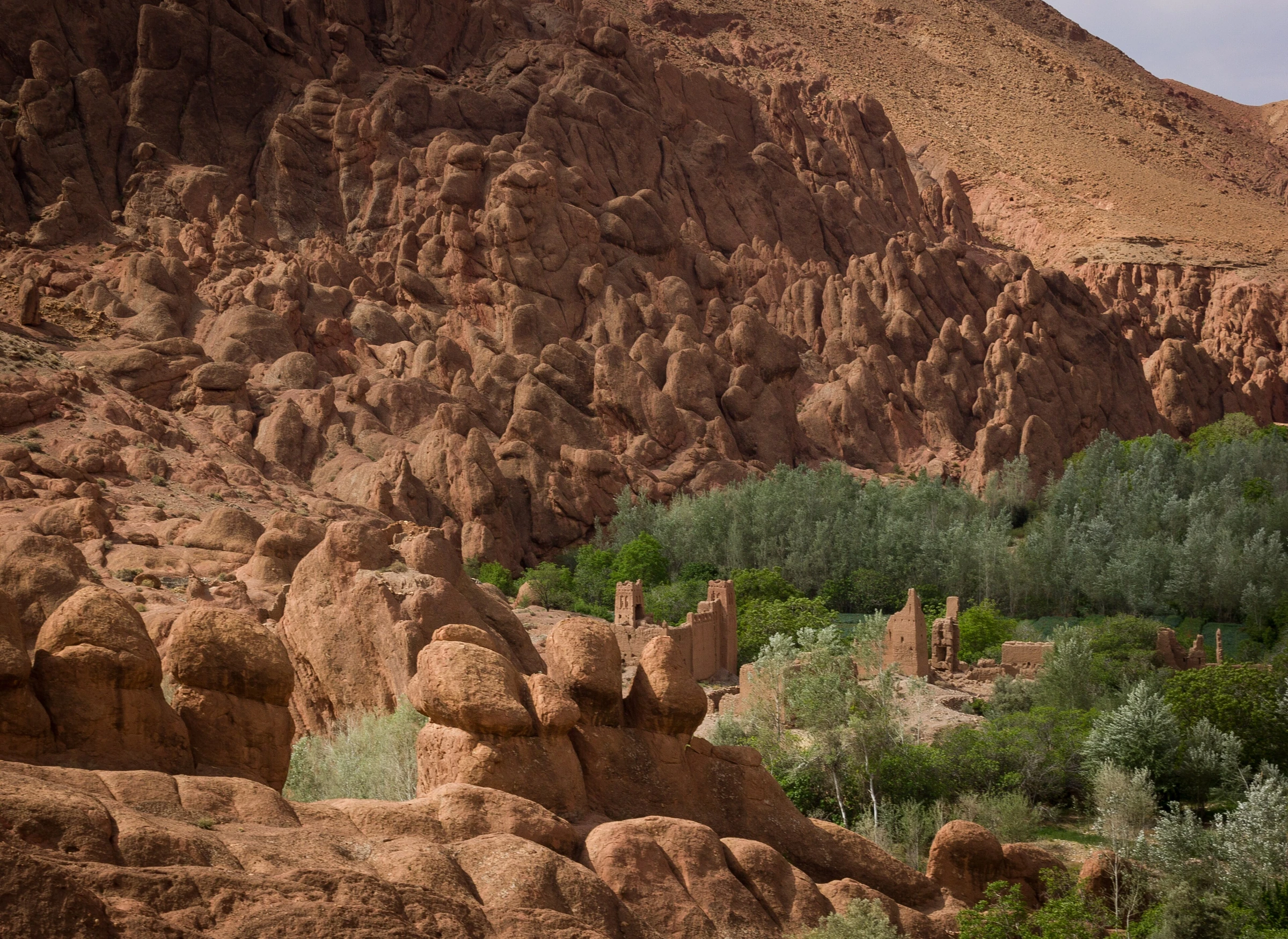
Dadès gorges describes several sequences of narrow passages and basins along the upper valley. This explains why published images can look different: pale walls, red rocks, wider spaces or a winding road. They do not necessarily show one sector. Before arranging an outing, ask the represented place’s name and position relative to your accommodation. Staying in the gorges remains too general for a meeting, a walking estimate or a vehicle collection point. A precise location connects the attractive image with the activity you can actually organise during your stay.
A first visit can focus on one sector rather than pursuing every landscape in a day. That preserves time to understand what you see and take breaks. The number of stops does not measure discovery. One sequence observed calmly may explain more than a succession of pictures through a vehicle window. Retain confirmed names in your notes and distinguish roadside observations from those made during a walk. This is useful both for telling the experience and for preparing a return visit, when a better understanding may lead to a different choice of sector.
Read rocks with a few useful ideas
Geological descriptions mention sedimentary rocks including limestone, sandstone and marl, followed by uplift and river incision. For visitors this provides a way to look: layers, colour contrasts, massive forms and more gullied ground. A precise age for every wall is not necessary to appreciate the differences. Colour alone cannot identify rock with certainty either. Detailed interpretation should come from a competent resource or person rather than a guess made from a photograph. A simple description of visible forms can be informative without attaching geological labels you cannot establish on the ground.
Relief records a long history, while the condition of a passage belongs to present circumstances. Keep those scales apart. Gorge formation does not by itself explain today’s flow, a usable path or an open road. The available gorge notice draws partly on an older synthesis and contains insufficiently sourced passages. Retain broad landscape distinctions rather than repeating depth figures, settlement stories or descriptions as guaranteed visiting facts. Stable geological context can enrich an outing, but practical decisions still require information about the exact place and date you intend to travel.
Separate scenery from the road
The winding road is a familiar Dadès image. It is a landscape subject rather than space reserved for photographers. Prepare stops where they are permitted and possible without obstructing traffic. A view from a terrace or particular property does not mean the same angle is freely available from the carriageway. If you want a similar frame, ask where it was made and what access requires. Another, simpler view can be more rewarding when its position is clear and it can be enjoyed without interrupting the road’s ordinary use.
With a driver, establish whether the outing includes stops, waiting or only transfer to an address. With your own vehicle, retain time for driving and pauses. An application estimate excludes searching for a stopping place and looking at a formation. A good day may depend on a few selected stops and an agreed return rather than a distant objective chosen simply because it appears on a list. Plan road movement and discovery together. The vehicle can connect sectors but cannot replace the time needed to observe them or authorise access beyond the route.
Choose between a viewpoint and walking
Observation and hiking answer different interests. From an authorised position, you may already study a narrowing, water where visible and relationships between slopes and settlement. Walking adds an experience of ground but requires known access and return. An apparent valley entrance does not establish maintenance or suitability for your group. Prefer a clearly explained outing to a vague promise of secret places. The useful details concern what you will actually do: where it begins, how far you walk and how the return is organised after the visit.
Before walking, ask about length, height change, surface and particular passages. Explain experience and group capacity. Accompaniment can help selection and interpretation if the person knows the sector and the service is agreed. This article guarantees no technical route or river crossing. The activities around Boumalne also offer approaches for travellers preferring simpler observation. A less ambitious choice may leave more attention for the surroundings than an outing that demands all your concentration on movement. The objective is an experience you can appreciate, not reaching a point irrespective of the conditions.
Understand names used in descriptions
Tourist accounts mention the Monkey Fingers and Tissadrine. Connect names to the precise place proposed by an interlocutor rather than treating them as sufficient directions for an independent outing. Rock formations, road and inhabited sectors may have different labels in accounts. Ask what the proposal really includes: approach, observation, walking or a stop. This avoids booking a drop-off while expecting accompaniment. An image alone cannot establish those details. Asking for a location does not diminish the landscape’s appeal; it makes the experience you are buying or planning more understandable.
Explain your interests too. A photographer may seek an overall view, a family a brief pause and someone interested in geology a longer explanation. Those needs do not require the same pace. A modest, adapted proposal can satisfy without collecting every familiar name. Do not turn a building glimpsed along the route into an open historic kasbah without its identity and access being established. The valley remains inhabited, and private places keep their uses independently of visitor movements. A worthwhile discovery respects that continuity instead of treating every visible feature as a service provided for tourists.
Account for water and actual conditions
The Dadès is central to the landscape, but water and bank conditions vary. An old photograph confirms neither today’s level nor the possibility of crossing. If an outing depends on a passage near the channel, request recent information for that sector. Rain within a catchment may matter even where conditions seem calm at departure. Observation from simpler access can remain interesting when the ground does not permit the imagined walk. You can preserve a clear subject for the day without insisting on a route whose practical assumptions no longer hold.
Consult a forecast for the outing and prepare for real duration: water, suitable footwear, protection and layers for pauses. Shade in one sector does not describe the whole route’s exposure. Set a moment to reassess and allow a margin for returning. Success does not depend on reaching the final planned point. It rests on discovery the group can enjoy and finish under understood conditions. The practical guide connects these decisions with transport, food and accommodation. Those ordinary arrangements can make a greater contribution to the experience than an extra stop added without enough time.
Photograph without relocating the place
Dadès and Todra gorges are distinct settings. They may appear in the same journey, but captions must not move a photograph from one to the other. Record each stop and, where the exact name is missing, prefer an honest broader description to invented precision. An upper-valley view does not necessarily show central Boumalne. These distinctions make an album clearer and help later travellers understand where the scene that interests them is located. The same care applies when describing a route: distinguish what was driven from what was actually walked.
For readable images, stabilise the camera and check the frame. A rock detail, wide view and agreed daily-life scene may create a richer sequence than repeated panoramas. People, farm work and houses are not props. Ask for necessary agreement and keep passages clear. Reusing another person’s image requires source, author and licence too. A sharp photograph gains its full value through a real location and accurately described context. Dramatic processing cannot replace that information and should not make a scene appear to document conditions that were never observed during the visit.
Give the gorges a coherent place in the trip
For a first visit, select one main purpose and an easily arranged return. A day can combine a gorge sector and time in the centre or concentrate on a longer accompanied discovery. These are choices to adapt to confirmations, not personally tested circuits with universal timings. If sleeping in the valley, check the room’s position relative to the outing start. An address described as near the gorges is not necessarily close to every sector carrying that name. Make the location and planned experience work together before choosing the number of nights.
Keep other destinations for separate projects: Tinghir and Todra, Kalaat M’Gouna or walking in the Saghro require their own journeys. You do not need to combine everything to understand the Dadès. Careful observation reveals several relationships: water and rock, road and relief, settlement and cultivation. Giving those links time turns the gorges into a discovery rather than an isolated photograph whose location and circumstances are forgotten. The result can be personal and substantial even when the outing includes fewer stops than the first idea suggested.
