
At a glance
- Start with ingredients you can identify — Ask to see them separately and specify whether you want seeds or ground spice.
- Ask what is in a ras el-hanout blend — Ras el-hanout combines several spices; there is no single composition that every seller must reproduce.
- Compare equivalent quantities and formats — Prices can only be compared meaningfully when quantities and presentations are comparable.
Contents
Start with ingredients you can identify
Cumin and coriander are different ingredients. Ask to see them separately and specify whether you want seeds or ground spice. With cinnamon, distinguishing the whole product from a powder also makes comparison easier. Learning a few names gives you a practical starting point, without requiring you to purchase everything displayed or master an entire cooking repertoire.
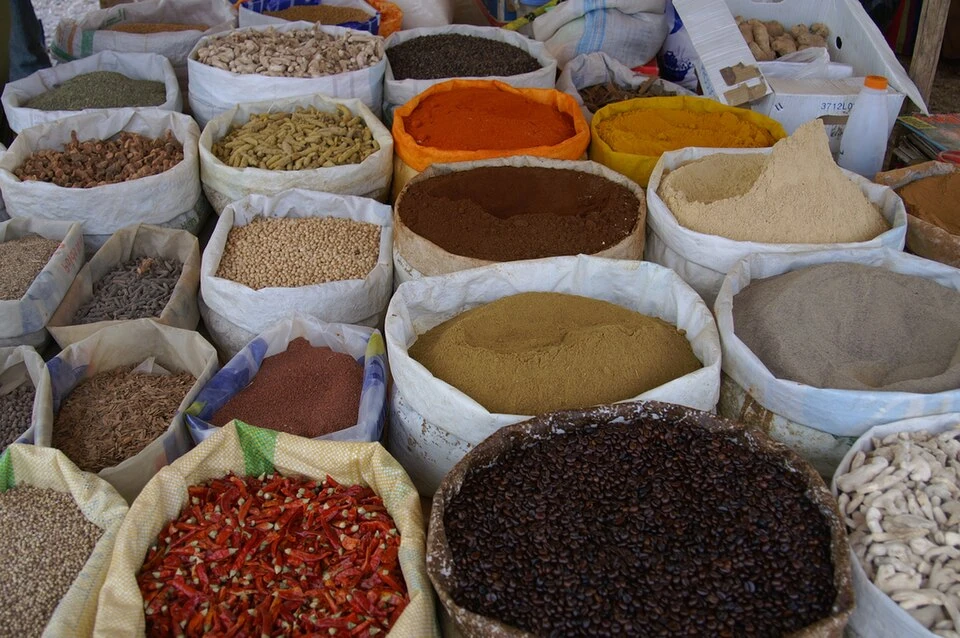
Paprika and turmeric contribute to the colours described in the tourism office’s account of markets. However, a red powder is not automatically mild. Ask whether it is hot and how it is used. If an ingredient interested you during a meal, record the cook’s name for it rather than inferring the recipe from the dish’s appearance alone.
Ask what is in a ras el-hanout blend
Ras el-hanout combines several spices; there is no single composition that every seller must reproduce. Ask which ingredients are in the particular mixture, how strong its flavour is and which dishes the seller recommends it for. These answers are more useful than a claim that one secret recipe is superior to every other version.
Anyone with an allergy needs precise ingredient information. A familiar blend name does not replace that information, and a small quantity should not be assumed harmless when the composition is unclear. Choose an identified product that meets your needs instead. This guide concerns culinary choices and does not offer medical advice or endorse the health claims sometimes attached to spices.
Compare equivalent quantities and formats
Prices can only be compared meaningfully when quantities and presentations are comparable. Confirm the weight, total price and packaging. A small spoon used to show the spice is not necessarily the unit being charged. Before agreeing to buy, ask to see the amount going into the packet, especially if several items are being weighed together.
A whole ingredient lets you inspect its form; a powder is ready for certain cooking uses. Neither format alone certifies origin or quality. With saffron in particular, ask about its stated origin and the information available. An impressive display, an intense colour or a therapeutic promise should not be treated as a substitute for a clear description of the product.
Link the purchase to food you actually prepare
Describe the dish you intend to make: vegetable stew, soup, fish or an accompaniment. Ask how the seller would use the spice, then relate that suggestion to your recipe. A blend suited to one preparation need not become the default seasoning for every meal. Begin with an amount you can reasonably use, rather than purchasing a large souvenir solely for its appearance.
For a gift, keep the names with the individual packets. An unlabelled assortment is difficult to interpret at home. A short selection chosen after a useful explanation can be better than a large box of unknown powders. Present it as a culinary discovery, without promising that the contents prevent illness, treat a condition or provide a guaranteed health benefit.
Pack the spices and keep their information
Ask for closed packaging that separates the products. Protect packets against leakage and retain the storage advice supplied. Before returning to another country, check its rules for food, seeds and plant material. Requirements depend on the specific product and destination; this guide is not a replacement for the relevant customs information or an authority’s current guidance.
The photograph shows a spice display at M’rirt’s souk in October 2006. It illustrates presentation, rather than recommending a current stall or guaranteeing stock. During your trip, connect these ingredients with different dishes: soup, tagine and couscous reveal distinct uses. Moroccan cooking is easier to appreciate when it is not reduced to one blend scattered over everything.
Frequently asked questions
Is ras el-hanout always made to the same recipe?
No. Ask about the actual blend, particularly when an allergy makes the ingredients important.
Can a spice be identified by colour alone?
No. Ask its name, form, possible added ingredients and intended use.
