
At a glance
- What zellige means — The individual elements, or tesserae, can form multicoloured geometric patterns.
- Look at a composition in three stages — Move closer without touching to identify individual shapes.
- Take photographs without disturbing the place — A courtyard, establishment or monument may restrict photography and access to particular areas.
Contents
What zellige means
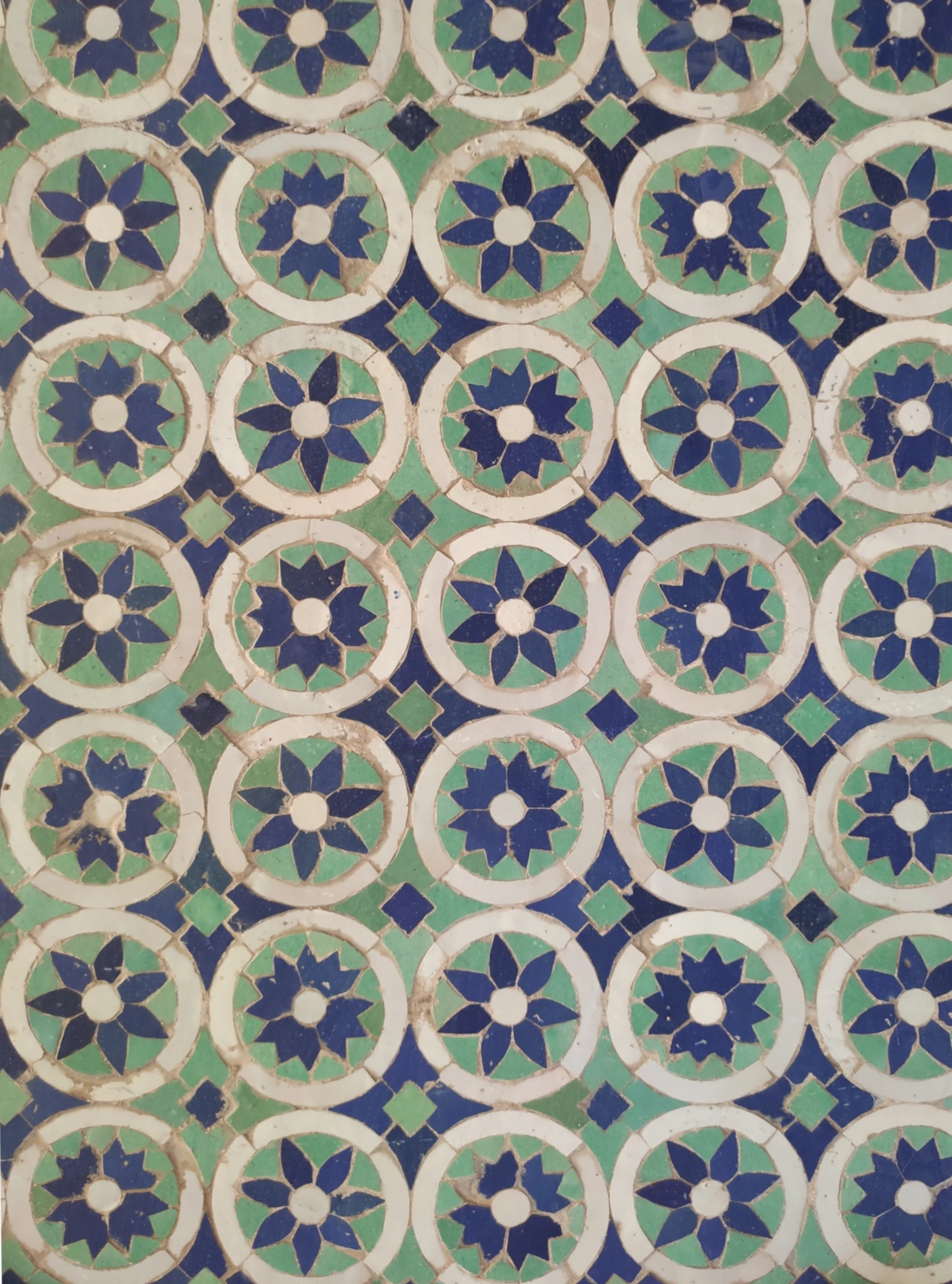
Zellige is ornamental mosaic made from pieces of glazed terracotta tiles, cut and assembled into a design. The individual elements, or tesserae, can form multicoloured geometric patterns. The technique appears in different buildings and uses: its presence alone cannot date a structure or establish its function.
Distinguish this assembly from a tile carrying a printed or painted design that visually imitates mosaic. Both can create an attractive surface, but they involve different production methods. Ask for the exact process rather than relying on a commercial label.
Look at a composition in three stages
Begin with the whole: where does the pattern repeat, how are the colours arranged and how does the design relate to a doorway, basin or wall? Move closer without touching to identify individual shapes. Finally, study the borders, which show how a composition adjusts to the available surface.
- Find a repeating motif and follow its symmetries.
- Compare the centre with the borders.
- Distinguish the pattern of joints from the arrangement of colours.
- Read the site information before assigning a date or maker.
Take photographs without disturbing the place
A courtyard, establishment or monument may restrict photography and access to particular areas. Ask permission and do not block a passage while seeking a perfectly frontal image. Do not rest equipment against decoration or wet surfaces to change their appearance.
The photograph used here shows zellige decoration in a Saïdia hotel. It provides an example of composition, rather than a view of a Fez workshop or proof of an old decorative scheme. Keeping that distinction separates what is visible from a history we might be tempted to imagine.
Ask precise questions before ordering
| Question | What to establish |
|---|---|
| Production | Cut and assembled pieces or a reproduced pattern? |
| Backing | Portable object, panel or element requiring installation? |
| Measurements | Finished dimensions, thickness and weight |
| Use | Indoor, wet area or another intended setting to confirm |
| Delivery | Packaging, transport and responsibility for damage |
If a piece will be installed at home, confirm its specifications with both the seller and installer. A photograph does not reveal weight or the requirements of the supporting surface. Minor irregularity may be visible in manual work, but it does not by itself establish origin or quality.
Continue through a specific place
Fez, Tétouan and Marrakesh provide ways to place decorative arts within a wider cultural visit. Read the local guides for actual places to explore, then choose a question about production, restoration or the decoration’s role in the building. This guide explains how to look, rather than repeating city itineraries.
Frequently asked questions
Are all patterned tiles zellige?
No. Printing or painting can imitate the appearance of assembled tesserae.
Does irregularity prove a piece is old?
No. Appearance alone cannot establish age or provenance.
