
At a glance
- Three terms for different settings — Kasbah can refer to complexes of different kinds.
- Ksar: look at the settlement as a whole — The interest lies in relationships between homes, passages and enclosure, not only a photogenic façade.
- Kasbah: establish which complex you are visiting — At Taourirt, identify the building volumes, towers and different spaces before looking for an interior route.
Contents
Three terms for different settings
| Term | Useful clue | Example |
|---|---|---|
| Ksar, plural ksour | Grouped settlement, often fortified in pre-Saharan contexts | Ksar of Aït-Ben-Haddou |
| Kasbah | Citadel or fortified complex; usage varies by place | Kasbah of Taourirt |
| Medina | Historic urban fabric with many buildings and functions | Medina of Fez |
These are starting points rather than a rule resolving every North African place name. Kasbah can refer to complexes of different kinds. Ask what the name encompasses locally: a residence, part of a town, defensive structures or several spaces brought together.
Ksar: look at the settlement as a whole
UNESCO’s Aït-Ben-Haddou file describes earthen buildings grouped within defensive walls reinforced by corner towers. The interest lies in relationships between homes, passages and enclosure, not only a photogenic façade. A distant viewpoint and a walk through authorised areas provide complementary readings.
Read our dedicated ksar guide for practical visiting details. Here, the key is collective scale: a group of houses should not be understood as a single monument. Private or closed spaces do not become accessible merely because they appear in tourist photographs.
Kasbah: establish which complex you are visiting
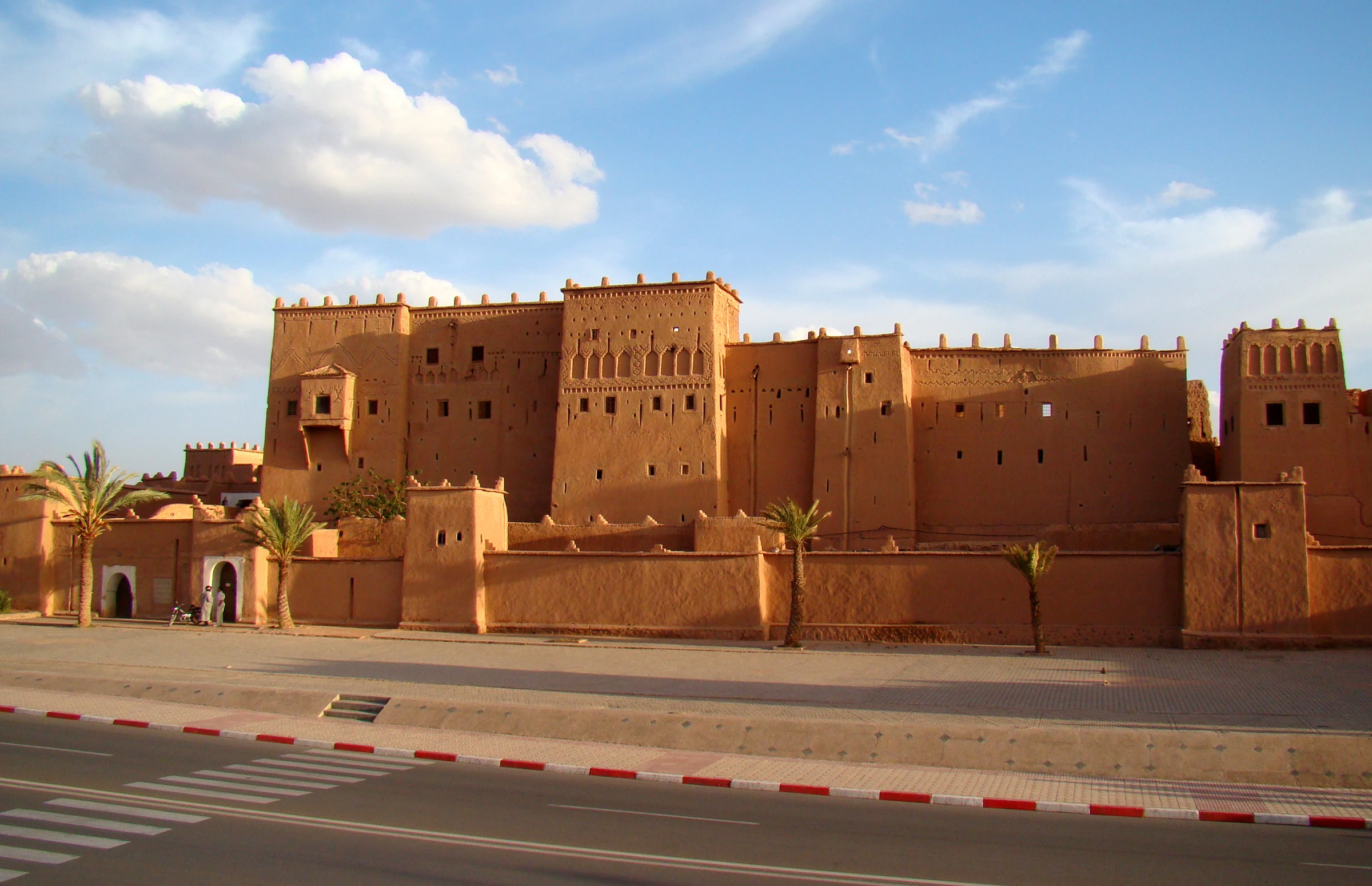
At Taourirt, identify the building volumes, towers and different spaces before looking for an interior route. Ask which parts are actually open and their role within the whole. The local guide covers history and access; a general definition cannot replace it.
The photograph shows Taourirt’s façade in Ouarzazate in 2011. It does not establish the current condition of interiors or routes. To compare several complexes during a journey, use our kasbah-route article, whose purpose is planning the progression between stops.
Medina: understand an inhabited city
A medina brings together homes, trade, worship and other functions. UNESCO’s Fez file mentions madrasas, fondouks, palaces, residences, mosques and fountains. It is neither a single souk nor a continuous museum. Daily activity remains essential to understanding the streets.
Notice where a commercial route becomes a residential passage, where spaces broaden and which thresholds separate uses. Stay in public areas, leave room for people working and ask before entering courtyards. Attractive decoration does not remove a place’s private character.
Avoid shortcuts about earthen architecture
An ochre colour alone cannot identify building material, age or construction technique. To understand a wall, restoration or roof, look for explanations from the manager or a knowledgeable guide. Do not remove fragments or climb damaged structures to inspect them. Careful interpretation starts with observation from permitted spaces.
Frequently asked questions
Is ksour a different place from a ksar?
Ksour is a plural of ksar. A route using that word may therefore bring together several settlements.
Is a medina simply its market?
No. Trade is only one function alongside residential space and other urban activities.
